

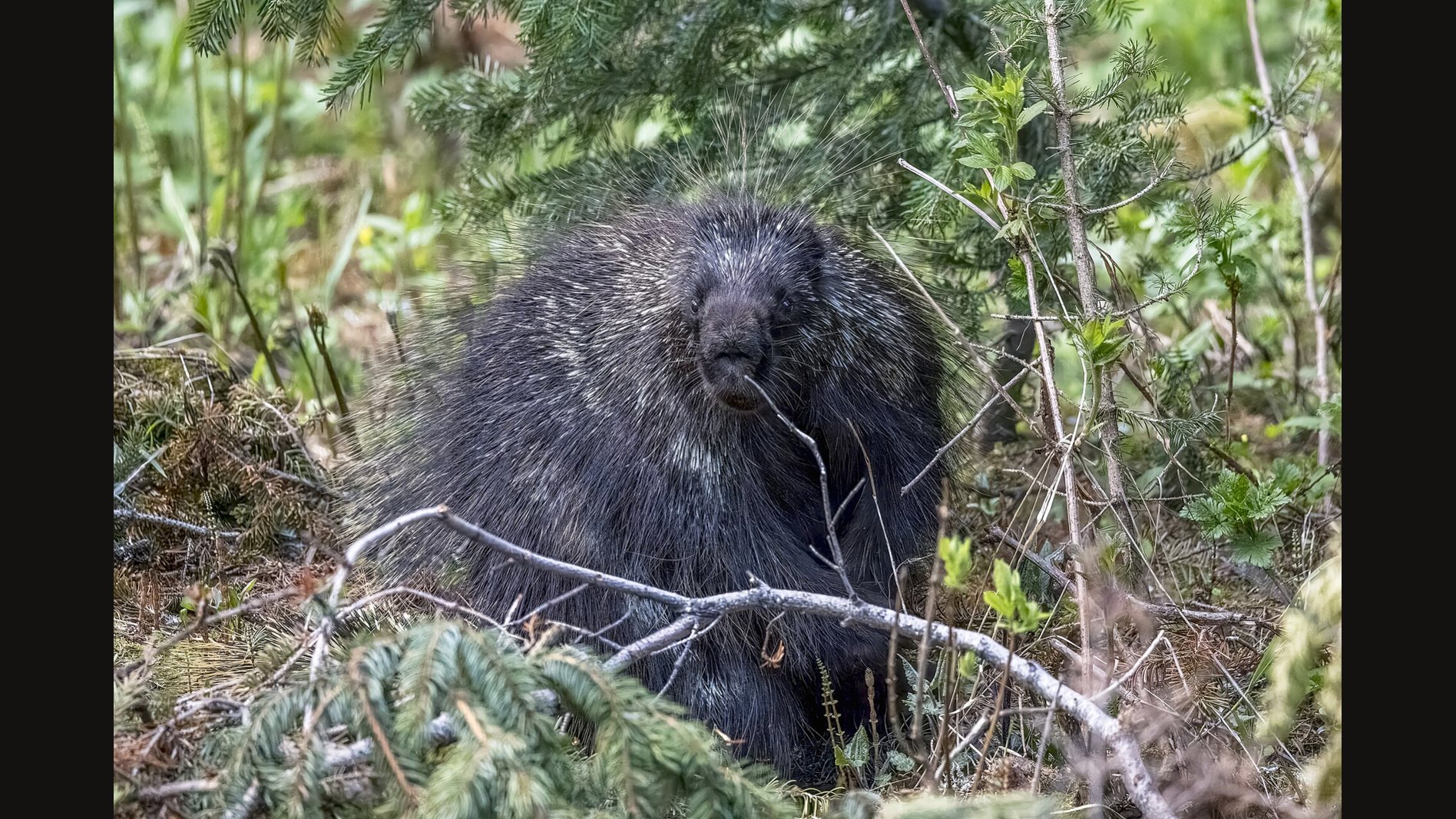
No. 296
Porcupine Skull Identification: Orange Teeth and the Big Opening Under the Eye
A broad rodent skull about 93 to 112 mm long (roughly 3.7 to 4.4 inches), with orange or reddish-brown front teeth, 20 teeth in all and a very large opening just below and in front of each eye socket is very likely a North American porcupine, *Erethizon dorsatum*.
That opening is the quickest tell. It is called the infraorbital foramen, and in a porcupine it is big enough to stand out even on a weathered skull.
The orange teeth are a good start but not proof on their own, because beavers have them too. Put them together with the size, the tooth count and that opening, and a porcupine is hard to mistake for its beaver and groundhog look-alikes.
What a porcupine skull looks like
Turn the skull over in your hands and the first impression is width. The North American porcupine has a large, broad skull with the eye sockets set wide apart, and the Michigan State University Comparative Mammalian Brain Collections notes that the skull is large for the size of the animal. There are also generous openings and spaces where the big jaw muscles once attached.
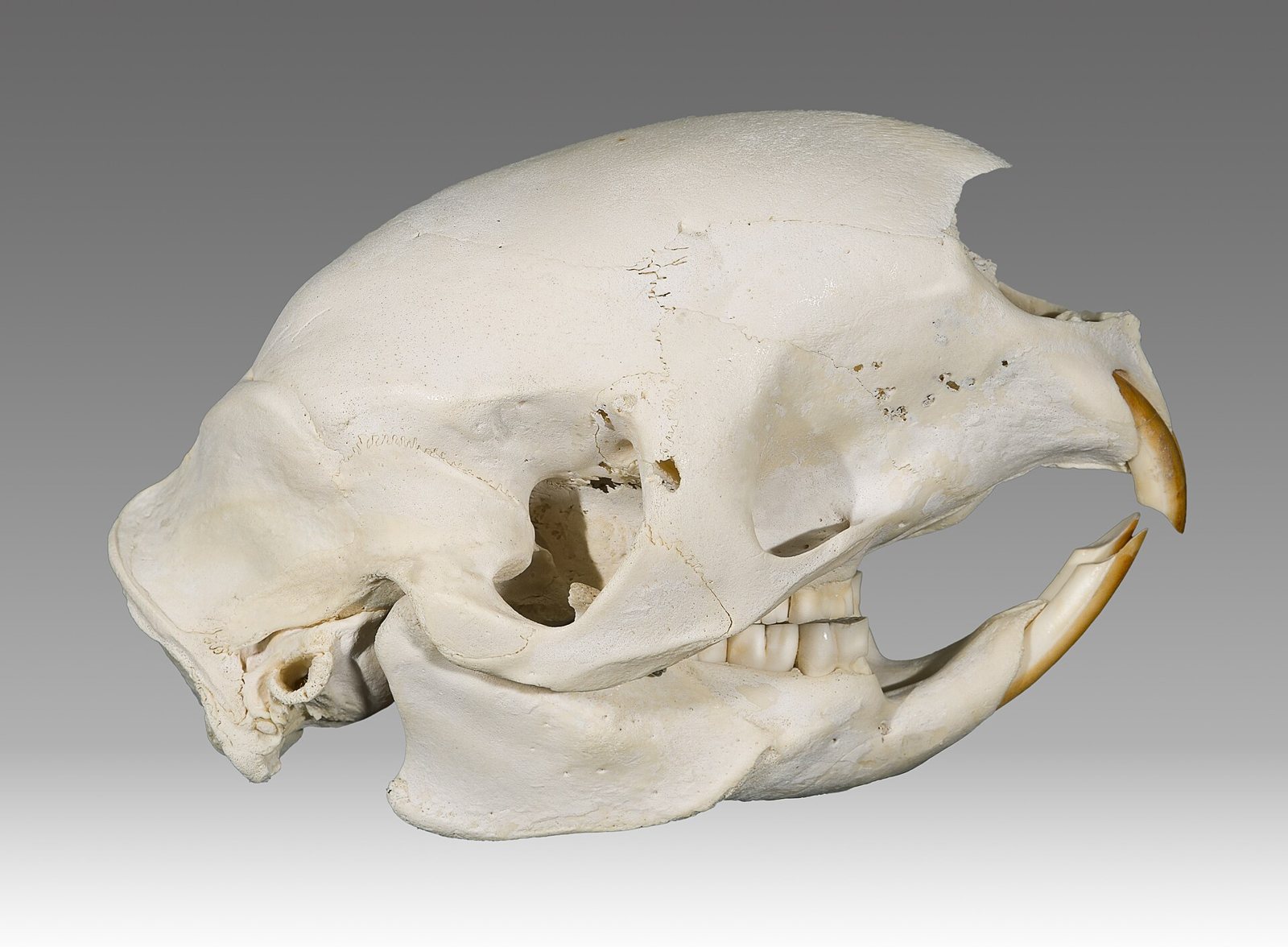
Then look just in front of each eye socket and a little below it. The porcupine's infraorbital foramen is a very large hole there, much larger than you would expect if you are used to squirrel or rat skulls.
Size helps, with a caveat. Adult skulls usually run about 93 to 112 mm long. Two specimens in the Dokkyo Medical University mammal collection measured 105.1 mm and 106.7 mm at their greatest length, right in that range.
You may also see a smaller number. The Pennsylvania skull key uses "longer than about 73 mm" as one step on its path to porcupine. That is a cutoff for sorting rodent skulls, not the typical adult size, so a 100 mm skull passes it easily. Size alone never settles it; a young animal will be smaller, so put the measurement beside the teeth and the opening under the eye.
How many teeth does a porcupine have?
A North American porcupine has 20 teeth: four incisors and 16 cheek teeth, according to the National Park Service at Acadia National Park.
Skull keys write this as a dental formula, 1/1, 0/0, 1/1, 3/3. Read it as one side of the mouth, upper over lower, in the order incisors, canines, premolars and molars. So, each side has one upper and one lower incisor, no canines at all, one premolar above and below, and three molars above and below. Double it for both sides and you get 20.
The zeros matter for identification. Between the front teeth and the cheek teeth there is a long gap with nothing in it, right where canines would sit.
Why the front teeth are orange
The color is what makes people stop and stare. The National Park Service explains that porcupine incisors are yellow, orange or reddish-brown because iron compounds strengthen the enamel. The color comes from the tooth itself, which is why it shows even on a clean skull.
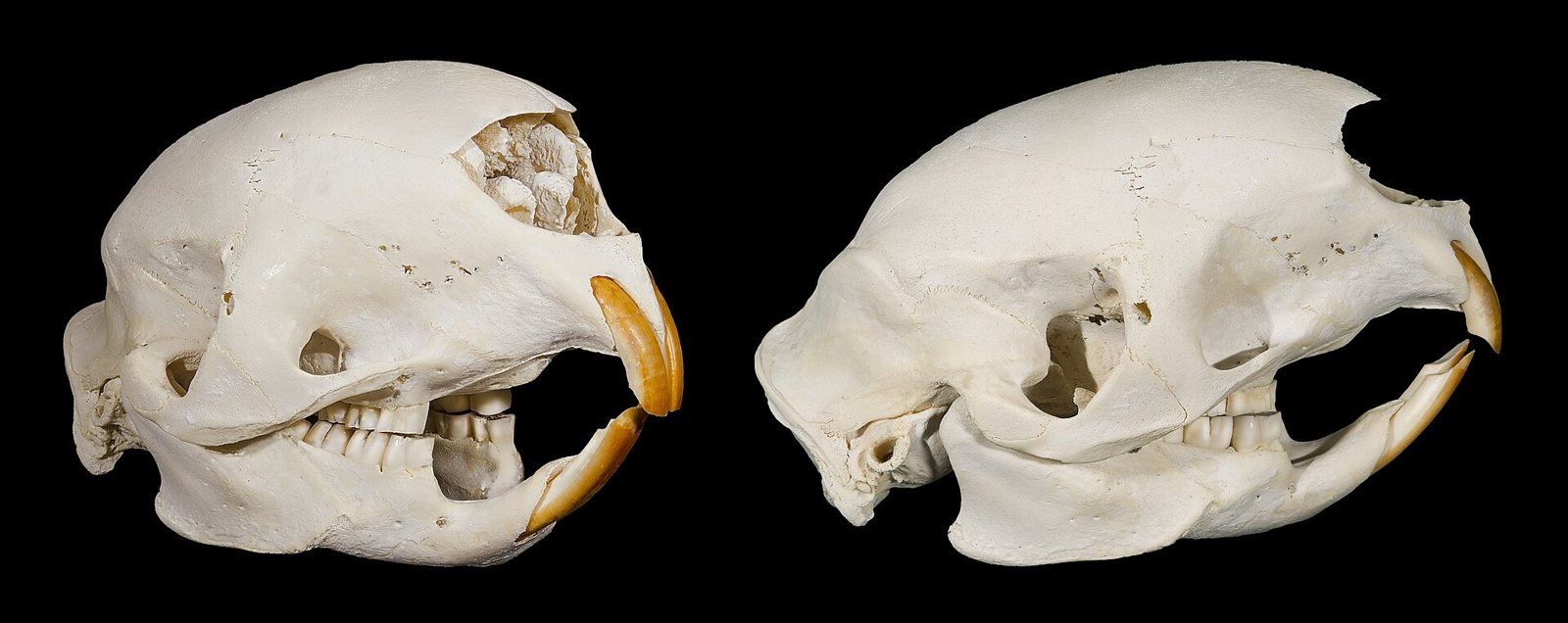
Those incisors also grow continuously. A porcupine is a herbivorous gnawer, and the steady wear from gnawing keeps the front teeth in check while the cheek teeth grind plant material behind them.
Porcupine skull vs beaver skull, and the groundhog question
If your skull seems too big for a squirrel and too small for a beaver, a porcupine is a strong candidate, and the beaver is the one to rule out. Beavers have orange incisors too, so the color will not separate them. The opening under the eye will.
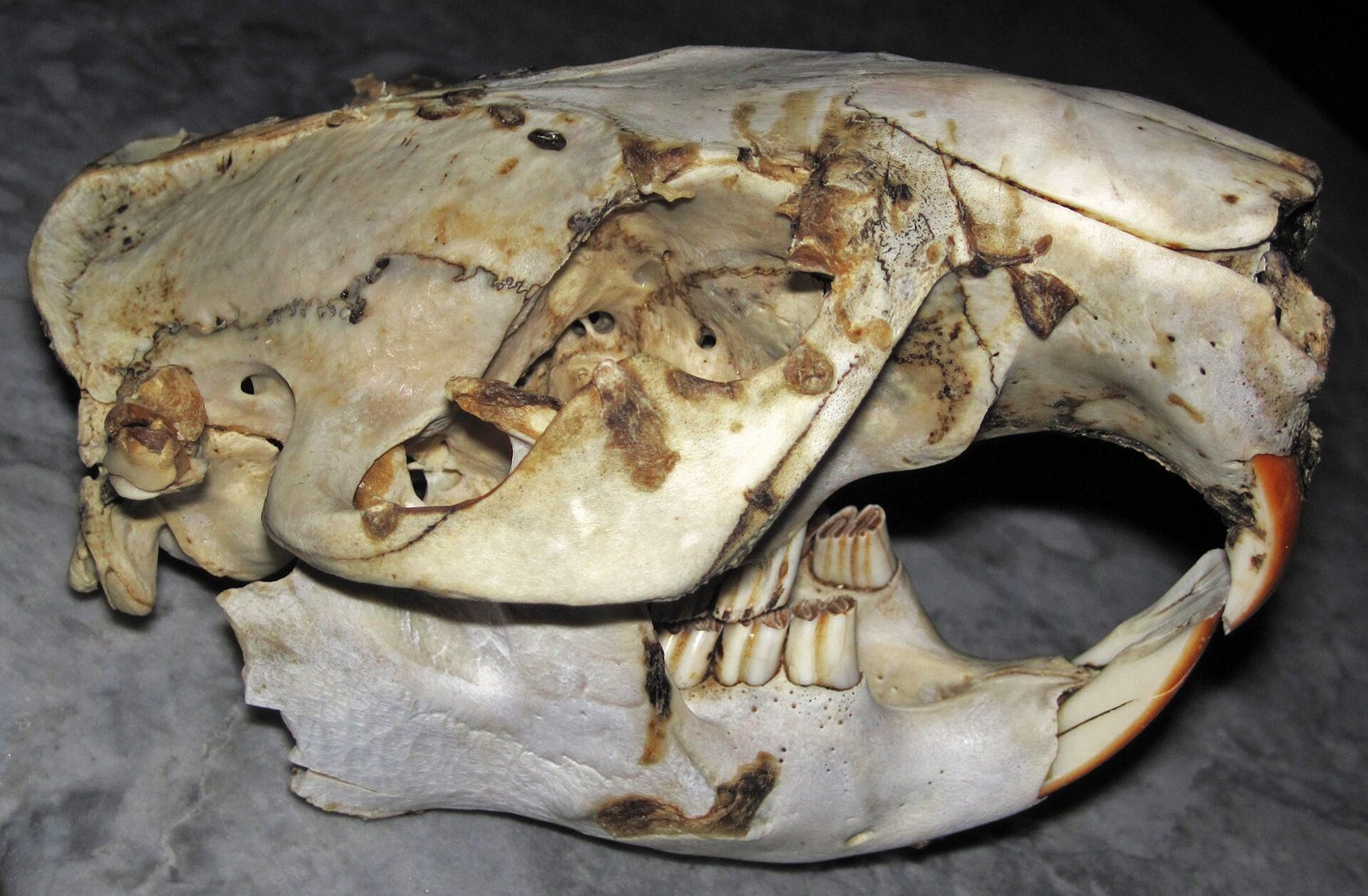
In the Pennsylvania key, a porcupine has a large infraorbital foramen while an American beaver, *Castor canadensis*, has a small one, less than about 4 mm wide. The Alaska Department of Fish and Game puts it neatly: the porcupine has a comparatively smaller skull than the beaver but a much larger opening within the orbits. Beavers have their own tells as well. The Maryland Department of Natural Resources key points to the beaver's relatively high, pointed auditory bullae, the rounded bony capsules around the ear, and its long ear canals that angle upward. Our beaver skull story goes further into those.
The groundhog, or woodchuck, *Marmota monax*, is the other big woodland rodent. It has 22 teeth, listed in the Pennsylvania key as 12 above and 10 below, and its incisors are usually whitish rather than orange. The Maryland key gives its skull length as more than 76 mm and points to a sharply pointed post-orbital process, a spike of bone behind the eye socket that is typical of the squirrel family. The groundhog skull story covers it in detail, and if your skull is on the smaller side, the squirrel skull story is worth a look.
One more porcupine clue from the keys: the paraoccipital process, a small knob of bone at the back of the skull, does not extend past the auditory bullae.
Tap or hover a row to highlight it.
| Feature | Porcupine | Beaver | Groundhog |
|---|---|---|---|
| FeatureScientific name | Porcupine*Erethizon dorsatum* | Beaver*Castor canadensis* | Groundhog*Marmota monax* |
| FeatureTeeth | Porcupine20 | BeaverRodent incisors and cheek teeth; compare the full skull | Groundhog22 |
| FeatureIncisors | PorcupineYellow to orange or reddish-brown | BeaverOrange or reddish-brown | GroundhogUsually whitish |
| FeatureOpening under the eye | PorcupineVery large | BeaverSmall, under about 4 mm | GroundhogNot the defining feature in the key |
| FeatureOther useful clue | PorcupineParaoccipital process does not extend past the auditory bullae | BeaverLong, upward-pointing ear canals | GroundhogSkull usually over 76 mm; pointed post-orbital process |
When the skull has seen some weather
A skull that has spent a season or two on the forest floor rarely looks like a museum specimen. It may be stained, cracked, sun-bleached in patches or missing teeth. The incisors in particular can be worn, broken or gone entirely, and once they are out of their sockets the orange clue goes with them.
That is when the structure does the work. The large infraorbital opening, the overall proportions, the empty tooth sockets and the arrangement of the cheek-tooth row are all more reliable than tooth color. A young porcupine's skull may still show clear suture lines, the seams where the skull plates had not yet fused.
You might also come across chewed bones or antlers nearby. Porcupines gnaw, but so do other rodents, and weathering can leave marks that look like gnawing, so chew marks are not proof of a porcupine. The skull's own anatomy is the better witness, and the Smithsonian's guide to reading a mammal skull is a friendly introduction to what to look at. Use several features together, and compare the skull with a museum or agency skull key before settling on a name.
Is it a porcupine skull? Six questions to ask
Tap a card to bring it forward.
- Large rodent: Does it have two prominent upper incisors at the front?
- Tooth color: Are the incisors yellow, orange or reddish-brown?
- Length: Is the skull longer than about 73 mm?
- Opening under the eye: Is the infraorbital foramen very large?
- Tooth count: Are there about 20 teeth, not the 22 of a groundhog?
- Ear canals: Do they lack the long, upward-pointing canals of a beaver?
If most of your answers are yes, the skull points to a North American porcupine. A damaged or incomplete skull is still worth comparing with a museum or wildlife agency key.
Old World and New World porcupines
The porcupine in North American woods is not the only kind, and the two main groups are separate families. Old World porcupines, the family Hystricidae, live in Europe, Africa and Asia. New World porcupines, the family Erethizontidae, live in North, Central and South America, according to the San Diego Zoo.
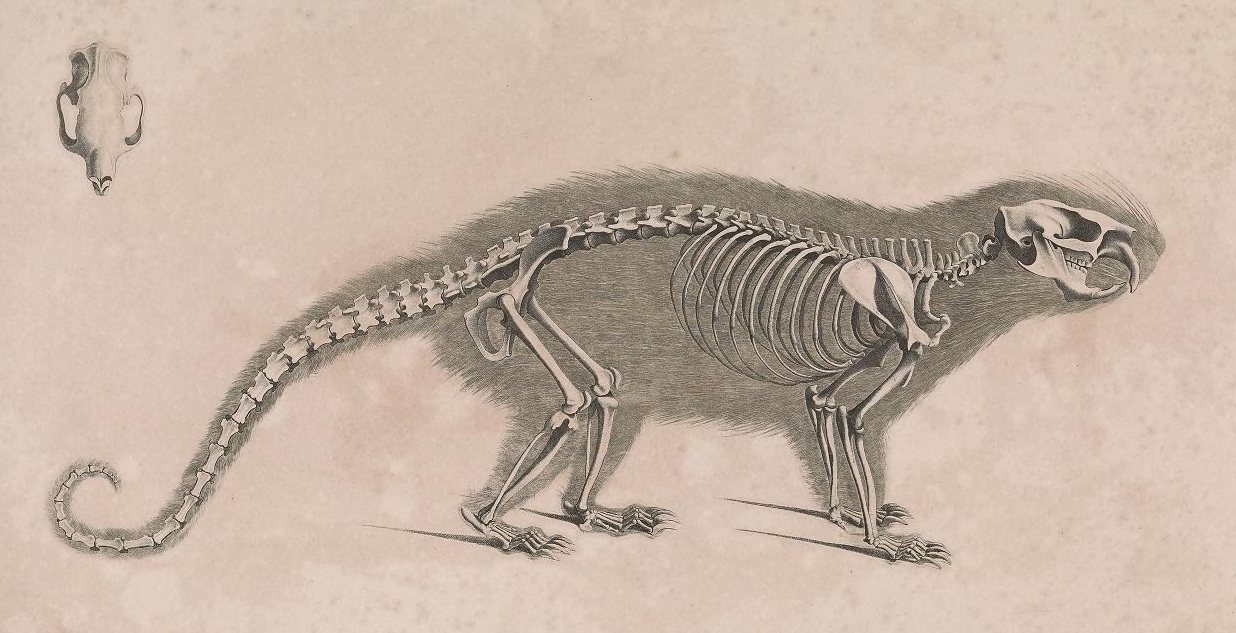
They live differently, too. Old World porcupines are mostly ground dwellers, often with long quills that form a crest, dense quills on the rump and, in some species, hollow tail quills that rattle. New World porcupines generally carry smaller quills, many species climb trees, and their quills have backward-facing barbs, a fine reason to admire the living animal from a polite distance. UCL Culture's specimen notes on porcupine quills are a good read on the quills themselves.
For identification, geography does most of the work. A skull from the woods of Utah, New England or Ontario is most likely the New World *Erethizon dorsatum*. A large crested porcupine skull from Africa or Asia belongs to a different family altogether.
Can you keep a porcupine skull you found?
This is general information, not legal advice. Rules on keeping a wild animal's skull change from country to country and state to state, and they can depend on whose land it was on, the species and how the animal died. Private land usually needs the owner's permission, and many parks and protected areas do not allow natural objects to be taken home at all.
Two examples show how differently places handle it. Alberta asks anyone who comes across a skull or other wildlife part and hopes to keep it to contact a Fish and Wildlife office first. Wisconsin allows some clean skulls and bones of unprotected wild animals under set conditions, restricts protected species, and requires landowner permission on private property. Neither rule makes a find legal to keep anywhere else.
The practical step is the same wherever you are. Write down exactly where the skull was, then ask the wildlife agency for that place about keeping it, collecting it, moving it and any park rules. Our story on what to do after finding an animal skull lists who to contact. If the agency says you may keep it, how to clean an animal skull covers the next step.
Porcupine skull questions, answered
A few more questions tend to follow the main ones.
What is the big hole in front of a porcupine's eye socket?
It is the infraorbital foramen, an opening just below and in front of the eye socket. In a porcupine it is very large, while in a beaver the same opening is small, under about 4 mm wide in the Pennsylvania key, which makes it the fastest way to tell the two apart.
Do porcupines have canine teeth?
No, porcupines have no canines. The 0/0 in the dental formula 1/1, 0/0, 1/1, 3/3 means no upper or lower canines, which leaves a long, empty gap between the front teeth and the cheek teeth.
What if my skull does not match a porcupine?
Check the close look-alikes next: a beaver if the orange teeth are there but the opening under the eye is small, a groundhog if there are 22 teeth and whitish incisors, and a squirrel if the skull is much smaller. If you are not sure the bones are from an animal at all, how to tell a human skull from an animal skull is the place to start.
Porcupine skull quiz
Answer every question to check.
Where to go next
A porcupine skull rewards a slow look: the orange enamel, the empty gap where canines would be, and that wide window under each eye. If you are building a small collection of comparisons, our beaver, groundhog and squirrel stories make a good set, and a natural history museum's mammal collection is the best place to see all of them side by side.
Terms in this story
Tap a term to see what it means.
Erethizon dorsatum. The scientific name of the North American porcupine.
---