

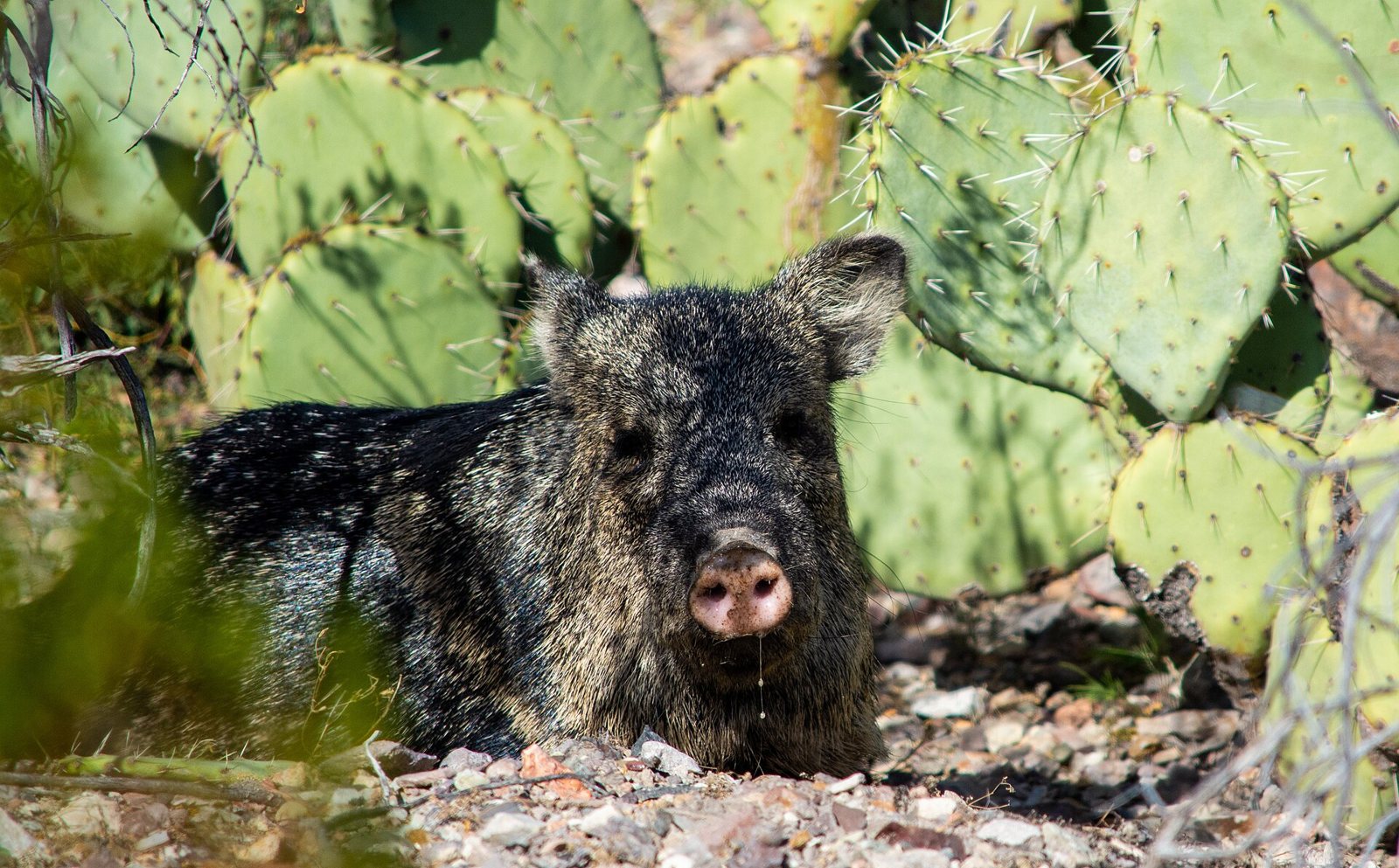
No. 293
Javelina Skull vs Pig Skull: How to Tell a Peccary From a Hog
Look at the tusks first. A javelina, the collared peccary *Pecari tajacu*, has relatively straight canines set almost vertically: the upper ones point down, the lower ones point up, and they meet and interlock. A feral hog or domestic pig, *Sus scrofa*, has canines that curve outward and backward into larger, sweeping tusks.
So, a compact skull with straight, interlocking tusks and 38 teeth is very likely a javelina. Curved tusks that flare out to the sides point to a pig.
Size and tooth count help confirm it, and both are worth a careful look, because a young pig can be small enough to pass for a javelina at first glance.
What a javelina skull looks like
The Arizona-Sonora Desert Museum skull guide gives a clear portrait of the collared peccary. The rostrum, or snout, is long and medium-narrow. The jaw is generally flat, a prominent sagittal crest runs along the top of the skull, the canines are very large for the animal, and the cheek teeth are low-crowned and rectangular.
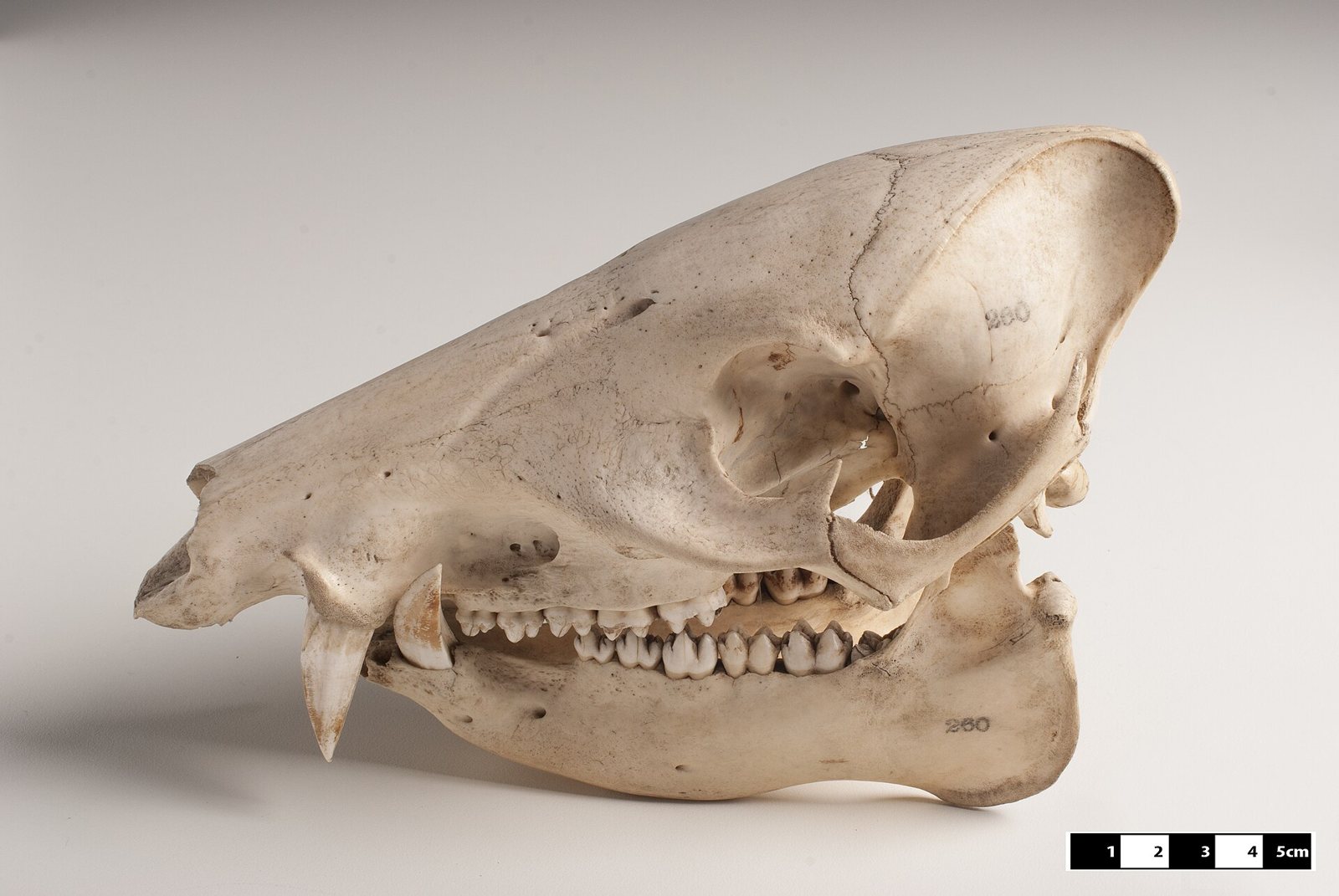
Count the teeth if they are all there. A collared peccary has 38, with the dental formula I 2/3, C 1/1, P 3/3, M 3/3, according to the Desert Museum, Animal Diversity Web and the National Park Service at Big Bend. The formula describes one side of the mouth, upper teeth over lower: two upper and three lower incisors, one canine above and below, three premolars and three molars. Double it and you have 38.
The canines are the showpiece. The Animal Diversity Web account describes the uppers pointing downward and the lowers pointing upward as tusks, so the upper and lower canines interlock. That straight, vertical arrangement is the single most useful thing a javelina skull can show you.
Javelina, feral hog or domestic pig?
Tusk direction does most of the work. The San Diego Zoo contrasts the javelina's relatively straight, vertically set canines with the pig's, which curve outward and backward. In a pig or feral hog, those curved canines grow into larger tusks that stick out from the sides of the snout.
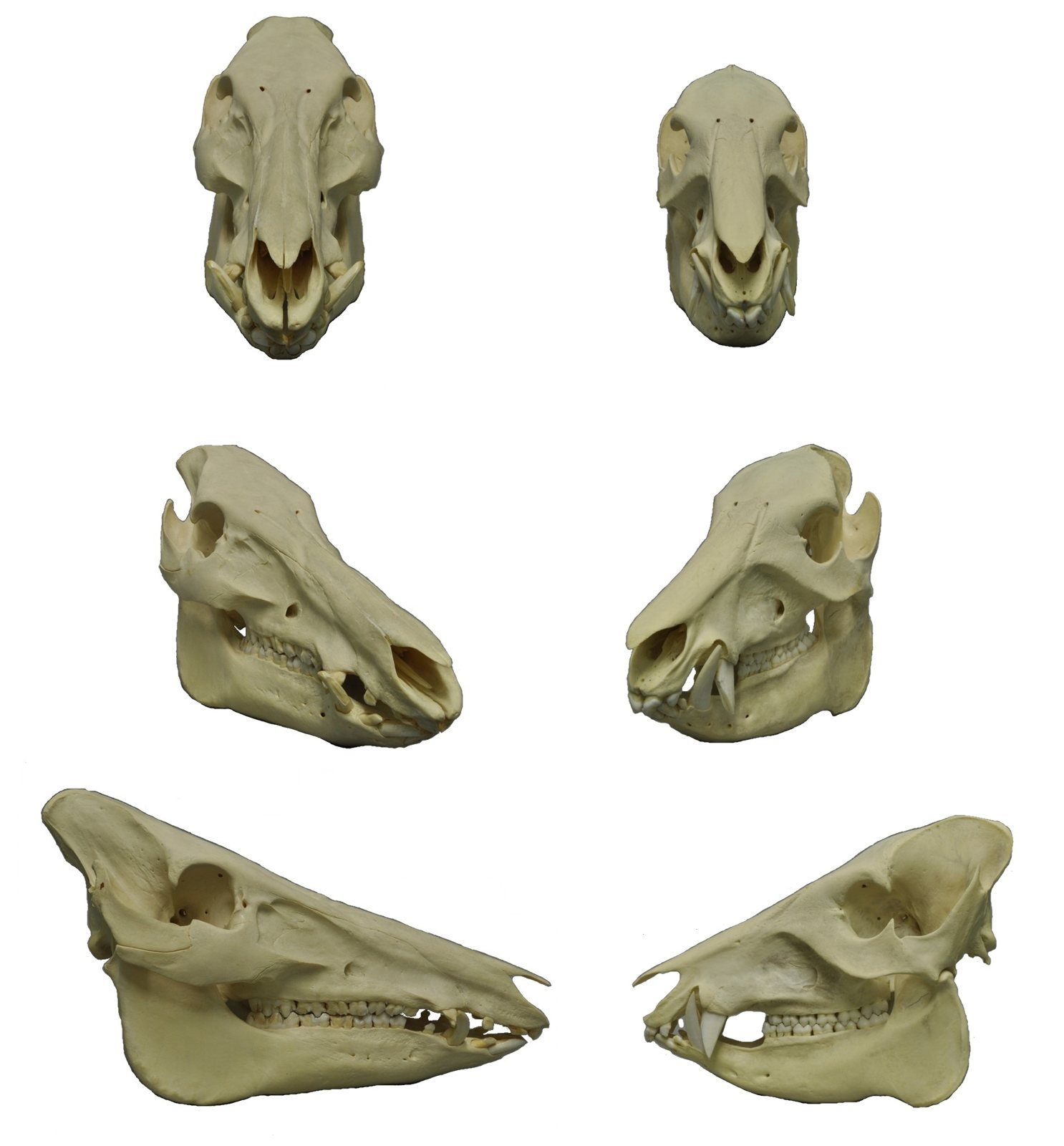
Tooth count is the next check. Javelinas have 38. Pigs are often given as 34 or 44, depending on the reference and the condition of the teeth, so a count well above 38 leans toward a pig. Our pig skull story covers the pig side in detail.
Then there is size, which needs more care. USDA APHIS describes javelinas as usually 15 to 25 pounds, while adult feral swine commonly weigh 75 to 250 pounds. A grown hog's skull is much bigger than a javelina's. But a young pig can be smaller than an adult javelina, so a small skull is not automatically a peccary.
It also helps to know that domestic pigs, wild boar and feral hogs are all the same species, *Sus scrofa*. Texas A&M AgriLife notes that domestic breeding produces a lot of variation in that species, so pig skulls can vary a good deal from one animal to the next. Judge tooth count, canine direction, muzzle proportions and overall size together, not one tusk alone.
Tap or hover a row to highlight it.
| Feature | Collared peccary (Pecari tajacu) | Pig or feral hog (Sus scrofa) |
|---|---|---|
| FeatureFamily | Collared peccary (Pecari tajacu)Tayassuidae | Pig or feral hog (Sus scrofa)Suidae |
| FeatureTeeth | Collared peccary (Pecari tajacu)38 | Pig or feral hog (Sus scrofa)Often given as 34 or 44 |
| FeatureCanines | Collared peccary (Pecari tajacu)Relatively straight and vertically arranged | Pig or feral hog (Sus scrofa)Curve outward and backward |
| FeatureUpper canines | Collared peccary (Pecari tajacu)Point downward | Pig or feral hog (Sus scrofa)Curve outward |
| FeatureLower canines | Collared peccary (Pecari tajacu)Point upward and form interlocking tusks | Pig or feral hog (Sus scrofa)Develop into larger curved tusks |
| FeatureTypical body size | Collared peccary (Pecari tajacu)About 15 to 25 pounds (USDA APHIS) | Pig or feral hog (Sus scrofa)Adult feral swine commonly 75 to 250 pounds |
| FeatureTail in the living animal | Collared peccary (Pecari tajacu)Short or nearly invisible | Pig or feral hog (Sus scrofa)Distinct and longer |
Five checks for a tusked skull
Tap a card to bring it forward.
- Count the teeth: If the skull is complete, 38 points to a javelina.
- Read the canines: Straight and vertical suggests javelina; curved outward and backward suggests pig.
- Compare size and muzzle: Look at the overall size and the proportions of the snout together.
- Go easy on small skulls: A young pig can be smaller than an adult javelina.
- Ask before removing it: Check collection rules with the land manager and wildlife agency first.
Is a javelina a pig?
No, a javelina is a pig-like animal from a family of its own. The collared peccary belongs to Tayassuidae, while domestic pigs and feral hogs belong to Suidae. The two families are distant relatives, and the National Park Service says the peccary and pig lines diverged about 37 million years ago.
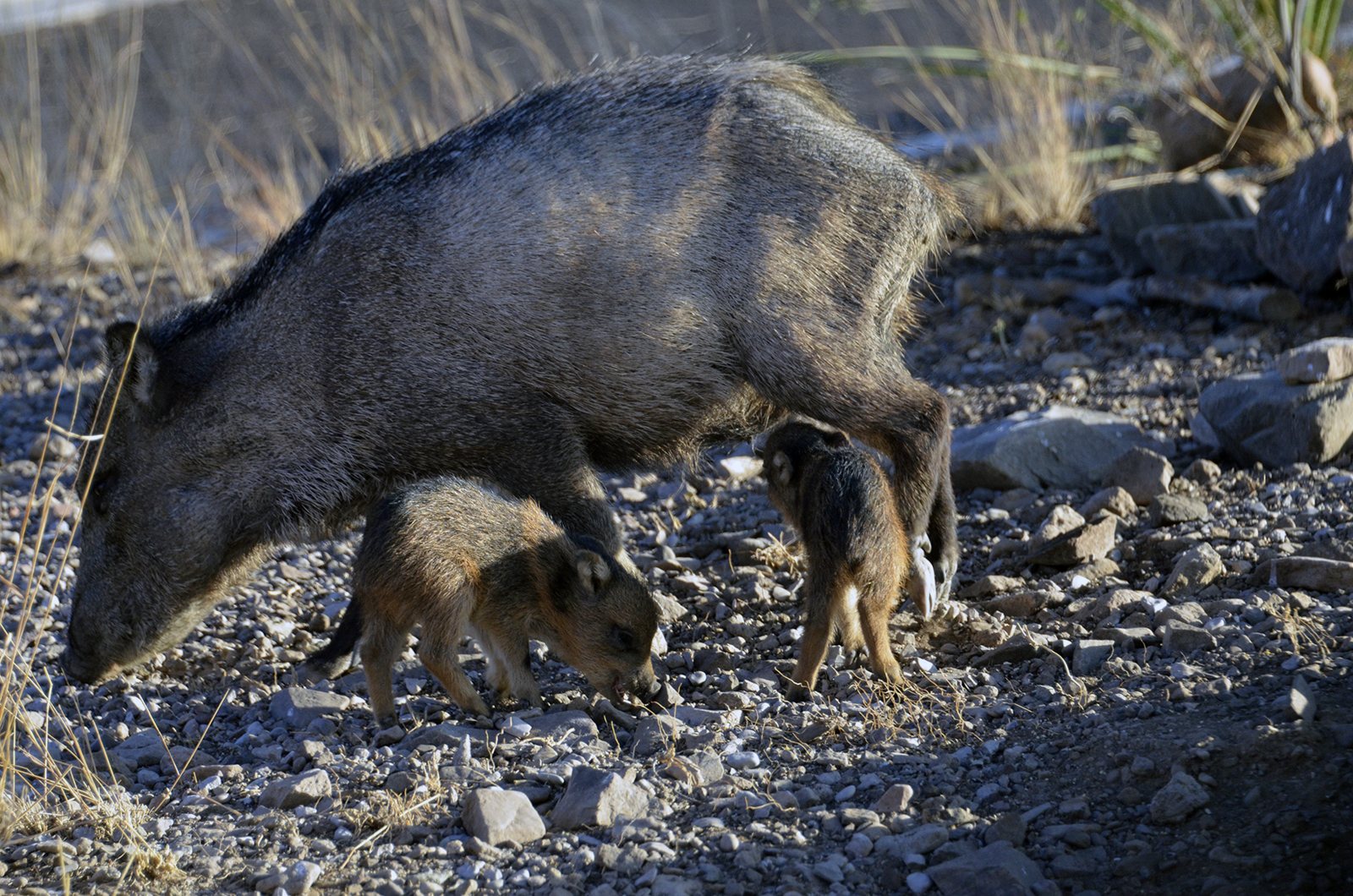
That long separation shows. Beyond the teeth and tusk direction, the two groups differ in their feet, tails, digestive anatomy and scent glands, as the National Park Service, Texas Parks and Wildlife and the Illinois State Museum all describe. In the living animal, a javelina's tail is short or nearly invisible, while a pig's is distinct and longer.
You may see two scientific names for the same animal. The collared peccary is usually *Pecari tajacu* today, and some older references call it *Tayassu tajacu*.
Peccaries of the past
Peccaries are an old lineage. Their fossil history reaches back about 33 million years, and at different times fossil peccaries lived in North America, Europe and Asia. They reached South America about 2.5 million years ago.
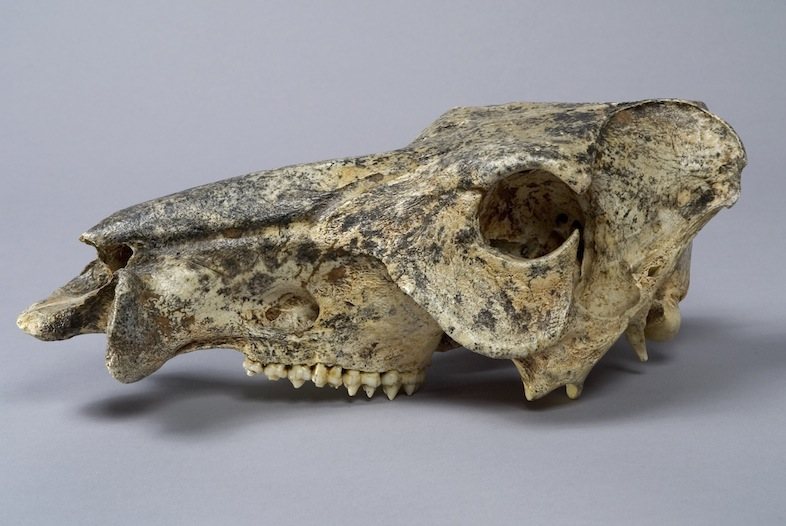
The Illinois State Museum describes two extinct North American species: the flat-headed peccary, *Platygonus compressus*, and the long-nosed peccary, *Mylohyus nasutus*. Their fossils come from Missouri, Kentucky and Texas, including cave deposits that herds used. At Bat Cave, Missouri, the remains represent at least 98 flat-headed peccaries, a crowd of ancient javelina cousins gathered in a single cave. Both species died out in North America about 11,500 years ago. Mexico's national biodiversity agency, CONABIO, has its own account of the flat-headed peccary on Biodiversidad Mexicana.
Older still is *Platygonus pearcei*, an ancient peccary the National Park Service dates to about 4 to 3 million years ago. Its holotype, the specimen that defines the species, was discovered at Hagerman Fossil Beds in Idaho in 1934: a complete adult skeleton lying with two juveniles. Other specimens have turned up in Washington and Nevada.
Peccaries through time
Tap or hover a step to follow the order.
About 37 million years ago
The peccary and pig family lines have diverged.
About 33 million years ago
The peccary fossil record begins.
About 4 to 3 million years ago
Platygonus pearcei lives in what is now the western United States.
About 2.5 million years ago
Peccaries reach South America.
About 11,500 years ago
The flat-headed and long-nosed peccaries die out in North America.
1934
The Platygonus pearcei holotype is unearthed at Hagerman Fossil Beds, Idaho.
Can you keep a javelina skull you found?
This section is general information, not legal advice. Rules differ from state to state, and they also differ between private land, state land, federal land, parks and protected areas.
Javelinas are game animals in Texas, which shows how closely some states manage them. For 2026 to 2027, Texas Parks and Wildlife lists a northern season from October 1, 2026 through February 28, 2027 and a southern season from September 1, 2026 through August 31, 2027, applied county by county, with a bag limit of two javelinas per license year. Texas also lists wildlife violations for possessing javelina during a closed season and for possessing certain parts without the required documentation.
Neighboring states handle found skulls in their own ways. The New Mexico Department of Game and Fish says skulls of protected animals should be left where they are and reported to a conservation officer. Utah's Division of Wildlife Resources asks people to report found skulls with big-game antlers or horns attached before moving them. Those are examples of how rules vary, not permissions for a javelina.
The friendly, practical step is to work out who manages the land, then call the state wildlife agency before you remove the skull or decide to keep it. A skull lying in the open is not automatically yours to take. Our story on what to do after finding an animal skull has the contacts and questions to start with.
Javelina skull questions, answered
These come up once the tusks are sorted out.
How many teeth does a javelina have?
An adult collared peccary has 38 teeth. Its dental formula is I 2/3, C 1/1, P 3/3, M 3/3, which means two upper and three lower incisors, one canine, three premolars and three molars on each side.
Are javelina tusks straight?
Yes, javelina tusks are relatively straight and set vertically. The upper canines point down and the lower canines point up, so they interlock when the jaw closes, unlike a pig's outward-curving tusks.
Could a small skull be a young pig instead?
Yes, a young pig can be smaller than an adult javelina, so size alone cannot settle it. Check the tooth count and the direction of the canines, which are more reliable than overall size.
What if the skull has fangs but no tusks?
If the canines do not form tusks at all, the skull may belong to a different animal altogether. Our coyote skull, bobcat skull and mountain lion skull stories cover other animals of the Southwest, and how to tell a human skull from an animal skull helps if you are unsure the bones are from an animal at all.
Javelina skull quiz
Answer every question to check.
Where to go next
A javelina skull carries a long family story in a compact package: straight tusks that lock together, 38 teeth and a lineage that split from the pigs some 37 million years ago. If you are in the South and the skull in your hands has tiny peg teeth instead of tusks, our armadillo skull story is the one to read next.
Terms in this story
Tap a term to see what it means.
Collared peccary. The javelina's standard common name. Its scientific name is Pecari tajacu, and some older references use Tayassu tajacu.
---