

No. 192
Rat Skull or Mouse Skull? How to Identify the Small Ones
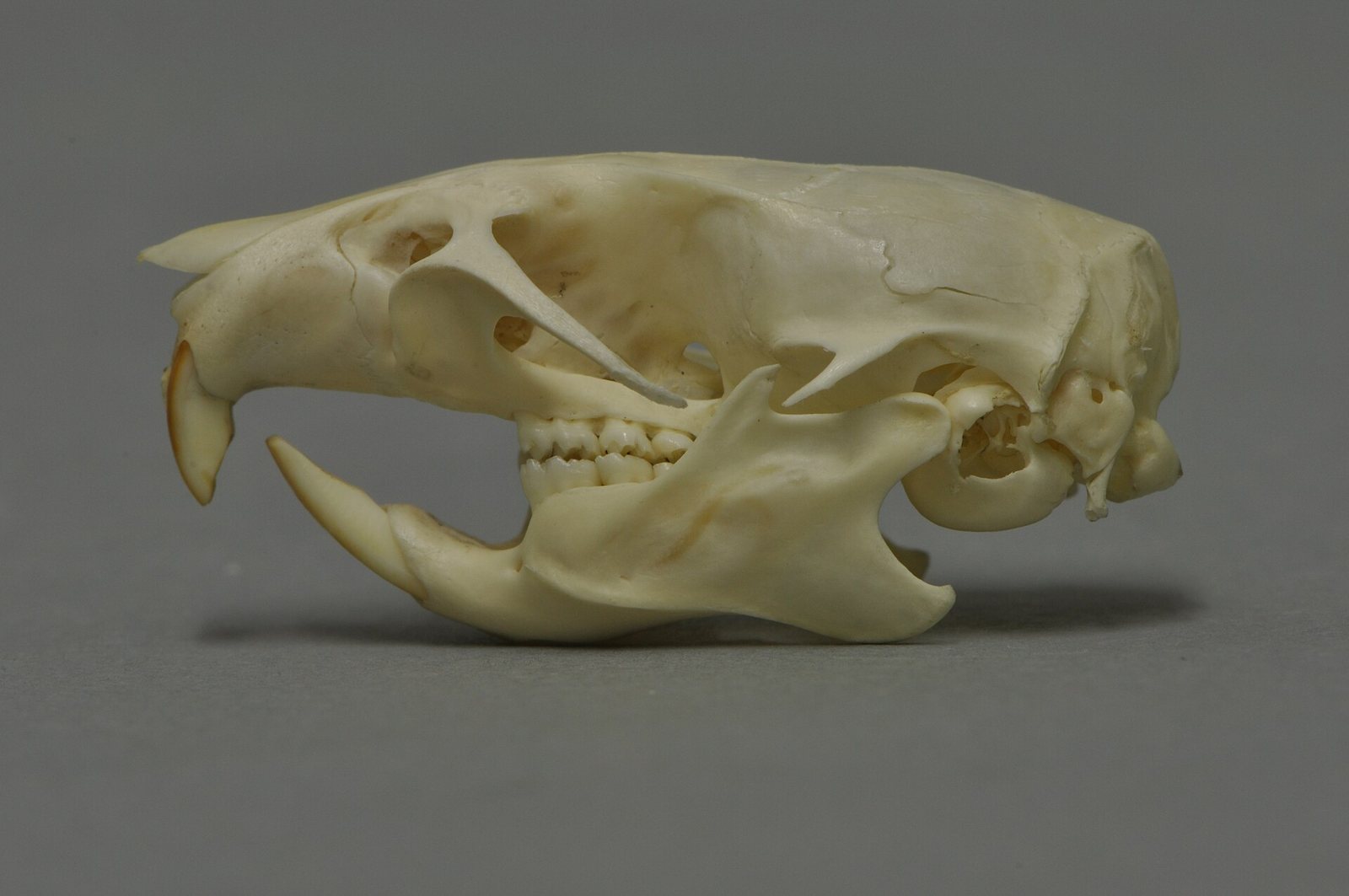
A rat skull has four long front teeth that never stop growing, no canines and no premolars, a long toothless gap behind the incisors, and three molars on each side of each jaw. That makes 16 teeth in all, written as the dental formula 1/1, 0/0, 0/0, 3/3, according to the Michigan State University Comparative Mammalian Brain Collections and the University of Texas at El Paso rodent overview.
Rats and mice share that same basic tooth pattern, so the fastest first test is a ruler. In the UTEP regional key to the mouse and rat family, a skull under 20 mm long points to a house mouse, *Mus musculus*, and a skull over 20 mm points toward a rat, *Rattus*. Measure the skull's length first, then read on for the finer clues.
What a rat skull looks like
A rat skull is a narrow rodent skull. At the front sit four prominent incisors, two above and two below, which grow throughout the animal's life and commonly look yellow-orange. Behind them comes the diastema, a long stretch of jaw with no teeth at all, because rats have no canines and no premolars to fill it. Then come the molars, three on each side, top and bottom. Four incisors plus twelve molars gives the 16-tooth total.
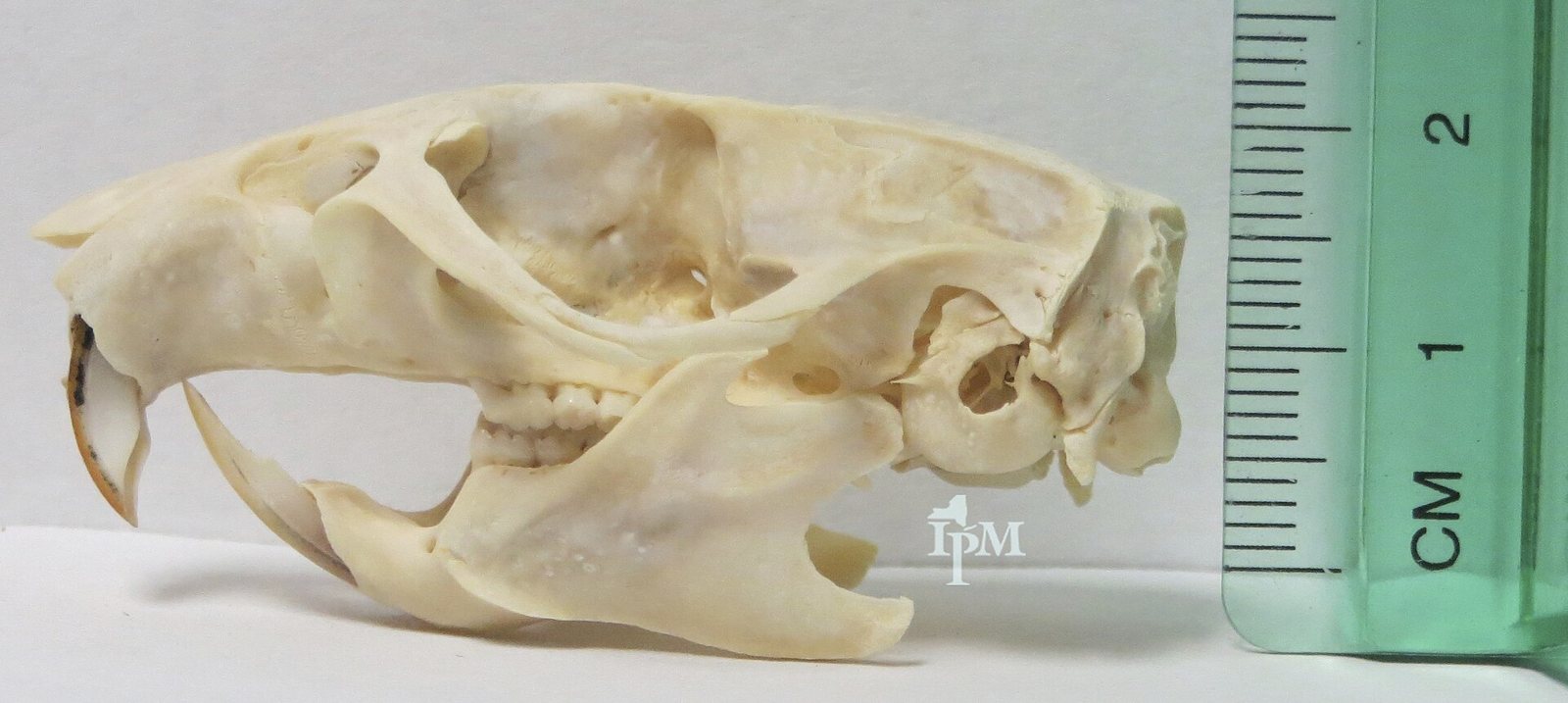
Size depends on the species and the animal's age. The Michigan State account gives the laboratory Norway rat, *Rattus norvegicus*, an average total length of nearly 400 mm and a body mass of 140 to 500 g; those are whole-animal figures, tail included, not skull measurements. For the skull itself, the University of Florida key to rodent skulls describes large rat skulls as generally longer than 25 mm. A young rat will measure smaller, which is why the ruler is a first clue rather than the last word.
If you are wondering why the incisors are colored at all, that question has its own answer in our story on the squirrel skull, which covers the 2024 science on orange rodent teeth.
Rat, mouse or vole?
These are the three small skulls most likely to turn up in a shed, a garden or an owl pellet, and they can look alike at a glance. Each one gives itself away in a different place.
Tap or hover a row to highlight it.
| Feature | House mouse | Norway rat | Black rat | Vole |
|---|---|---|---|---|
| FeatureScientific name | House mouseMus musculus | Norway ratRattus norvegicus | Black ratRattus rattus | VoleMicrotus or another vole genus |
| FeatureFirst size clue in the UTEP key | House mouseSkull under 20 mm | Norway ratSkull over 20 mm | Black ratSkull over 20 mm | VoleDo not rely on this cutoff |
| FeatureTemporal ridges | House mouseNot used by this key | Norway ratRelatively straight and parallel | Black ratBowed and diverging | VoleThe cheek-tooth pattern is more useful |
| FeatureDental pattern | House mouseFour incisors, no canines or premolars, three molars per side | Norway ratSame basic 16-tooth pattern | Black ratSame basic 16-tooth pattern | VoleMolar enamel is often folded or prismatic |
| FeatureCaution | House mouseLocal species may differ | Norway ratJuveniles can be smaller | Black ratJuveniles can resemble other rats | VoleSpecies-level identification may need specialist comparison |
Mouse against rat comes down to size first. In the UTEP key, under 20 mm suggests a house mouse and over 20 mm suggests a rat, and the rat skull is generally longer and more heavily built, with more pronounced ridges on the cranium.
If you have a rat, the ridges on top tell you which one. Look down on the skull at the two temporal ridges that run back along the top of the braincase. In the Norway rat they run relatively straight and parallel. In the black rat or roof rat, *Rattus rattus*, they bow outward and diverge. Chile's Ministerio del Medio Ambiente also describes the black rat skull as shorter and more oval than the Norway rat's, with curved temporal and occipital ridges.
Voles are the trickiest, because size alone will not separate them safely. Their cheek teeth are the giveaway: the enamel on a vole's molars forms distinctive folded, prismatic patterns. The University of Florida owl-pellet key separates voles using molar shape, the shape of the tooth bed, the edges of the eye socket and the ridges on the skull. For any of these, a complete skull or a full upper row of molars tells you far more than a single small fragment.
Rat or squirrel?
A rat and a squirrel both have ever-growing incisors, no canines and a diastema, so the front of the skull will not settle it. The cheek teeth will. Rat-like rodents lack premolars and have three molars on each side. Squirrels have premolar-like cheek teeth in front of their molars, and the number and arrangement of upper cheek teeth differ among squirrel species.
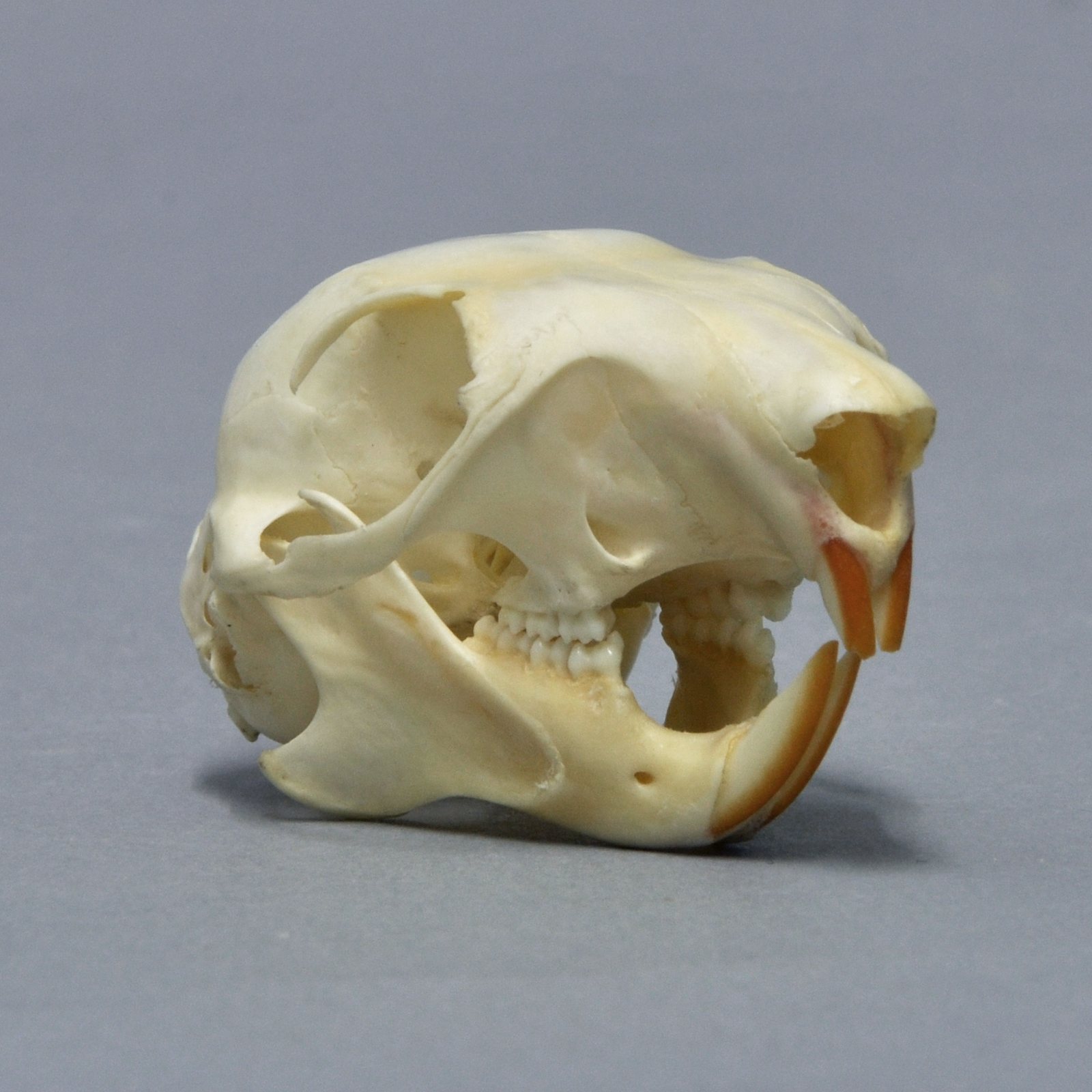
The University of Georgia Mammal Skull Key separates squirrels by total skull length, by where the eye socket sits relative to the cheek teeth, and by the number of upper molar-like teeth. If you want to see the differences side by side, the University of Illinois *Fieldbook of Illinois Mammals* illustrates the molar patterns of the Norway rat, meadow vole, house mouse and fox squirrel.
Orange incisors on their own never prove squirrel, since rats have colored incisors too. Our squirrel skull story covers the squirrel features in detail. And if the skull you are holding has a second, smaller pair of upper incisors tucked behind the first, it belongs with the rabbit skull instead.
How to identify a skull from an owl pellet
Owls swallow many small prey animals whole, then bring up the parts they cannot digest, the bones, fur and feathers, as a compact pellet. The Texas Parks and Wildlife Department explains that the skulls, jaws and other bones inside a pellet show what the owl ate.
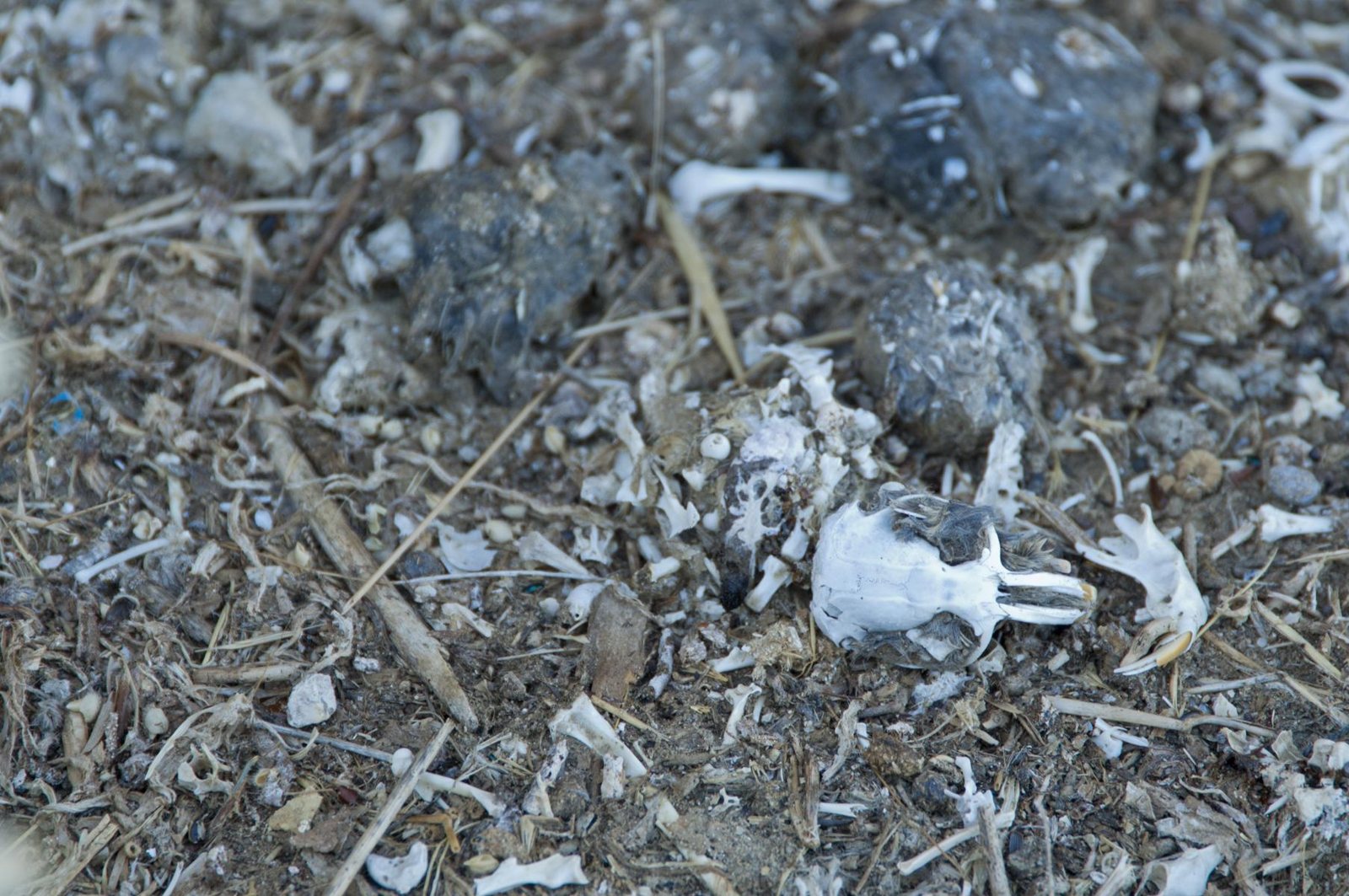
The National Park Service lesson "Owl Pellets from the Past", based at Tule Springs Fossil Beds National Monument in the Las Vegas Valley, Nevada, turns that into a classroom activity for grades 3 through 5. Students dissect pellets, sort the bones on black paper, examine the lower jaws and skull pieces, record what they find and compare the rodent skulls against a chart. The lesson ties the work to fossils: identifying a vole from a pellet uses the same habits of looking as identifying an animal from bones in the ground. Our story on how old are these bones picks up that thread for older finds.
The Maine Department of Inland Fisheries and Wildlife adds the practical steps: sort the bones, look closely at the teeth, and wash your hands afterward. A good pellet kit is simple. Gloves, a magnifier, a ruler and a skull chart for your region will do more than guessing, and they keep you from assuming every tiny skull is a mouse when it might be a vole or a young rat.
Owls also turn up beside skulls as a symbol, and our story on the owl and skull covers that side of the pairing.
Handling a skull from a shed or garden
A small skull from a shed, a garden bed or a pellet is easy to handle safely with a few habits. The CDC's guidance on cleaning up after rodents and its hantavirus prevention page set out the general steps. This is public-health guidance for everyday handling, not medical advice.
Handling a small skull from a shed or pellet
Tap a card to bring it forward.
- Gloves on: Wear rubber or plastic gloves before you pick it up.
- Hands off your face: Keep gloved hands away from your eyes, nose and mouth.
- Air out the shed: If you see droppings, urine, nesting material or a dead animal, ventilate the shed or outbuilding for 30 minutes before going in.
- Wet it first: Spray the material with disinfectant until it is thoroughly wet.
- No dry sweeping: Do not sweep or vacuum dry waste, because the dust can rise into the air.
- Double-bag: The CDC advises double-bagging dead rodents and contaminated nesting material.
- Wash up: After removing the gloves, wash your hands with soap and warm water.
None of that needs special equipment, and it takes the guesswork out of picking up a find. A skull that came from a classroom pellet kit gets the same gloves and handwashing.
Can you keep it?
That depends on the animal and the place it came from.
> Legal note: Here you will find general information only, not legal advice. Rules on possessing wild animal parts vary by species, by the status of the land and by location, and they can change. Whether your particular skull may be kept is for your state wildlife agency or the U.S. Fish and Wildlife Service to answer, so ask them first.
As one example, the Wisconsin DNR treats clean skulls of unprotected animals differently from protected wildlife, and it requires permission to collect on private property. The Alaska Department of Fish and Game explains that possession rules vary by species, by agency and by location. A rat skull from your own shed and a vole skull from a state park may land in very different places in those rules. Our story on what to do when you have found an animal skull covers the general questions to ask.
If you have the go-ahead and want to clean it, our guide to cleaning an animal skull covers the steps, and how museums use dermestid beetles explains the method collections rely on for skulls this small.
Small rodent skull quiz
Answer every question to check.
Quick answers about small rodent skulls
A few more questions come up once the ruler comes out.
How many teeth does a rat have?
16: four incisors and twelve molars. The formula is 1/1, 0/0, 0/0, 3/3 on each side, and the missing canines and premolars leave the long gap behind the front teeth.
What are the main types of rodent skulls?
The small ones fall into rat-like rodents, mice, voles and squirrels. Their incisors look much alike, so they are told apart by skull proportions, temporal ridges, eye-socket shape and the structure of the cheek teeth.
Can a vole skull look like a mouse skull?
Yes, at a glance. The molars settle it: a vole's cheek teeth have folded, prismatic enamel, so check the upper molar row under a magnifier rather than relying on size.
Where to go next
If your skull is a rat or a mouse, found an animal skull covers the rules, and how to clean an animal skull covers the next step once you have the go-ahead. If it is bigger and broader, with pointed spurs over the eye sockets, compare it with the squirrel skull; and if it is heavy and about three inches long, the groundhog skull is the one to check.
Terms in this story
Tap a term to see what it means.
Rattus norvegicus. The Norway rat. Its skull has relatively straight, parallel temporal ridges.
---