

No. 134
Whale Skull: What It Looks Like, How Big It Gets and Where to See One
A whale skull looks strange because its bones moved. As whale skulls adapted to life in water, the bones overlapped and shifted, a pattern scientists call telescoping, which G. S. Miller described in a 1923 Smithsonian study. Every whale skull also belongs to one of two kinds: a baleen whale skull, broad in the snout with no working teeth, or a toothed whale skull, with teeth or tooth sockets and often a lopsided shape.
How big they get depends on the whale. At the New Bedford Whaling Museum in Massachusetts, the skull and lower jaw of a young blue whale measure about 18 feet together and weigh roughly one and a half tons. That is a juvenile.
If you came across a whale skull on a beach rather than in a museum hall, the simplest step is to leave it where it is and report it to the NOAA Fisheries Stranding Network or NOAA, because marine mammals and their parts are protected by federal law in the United States.
Two kinds of whale skull
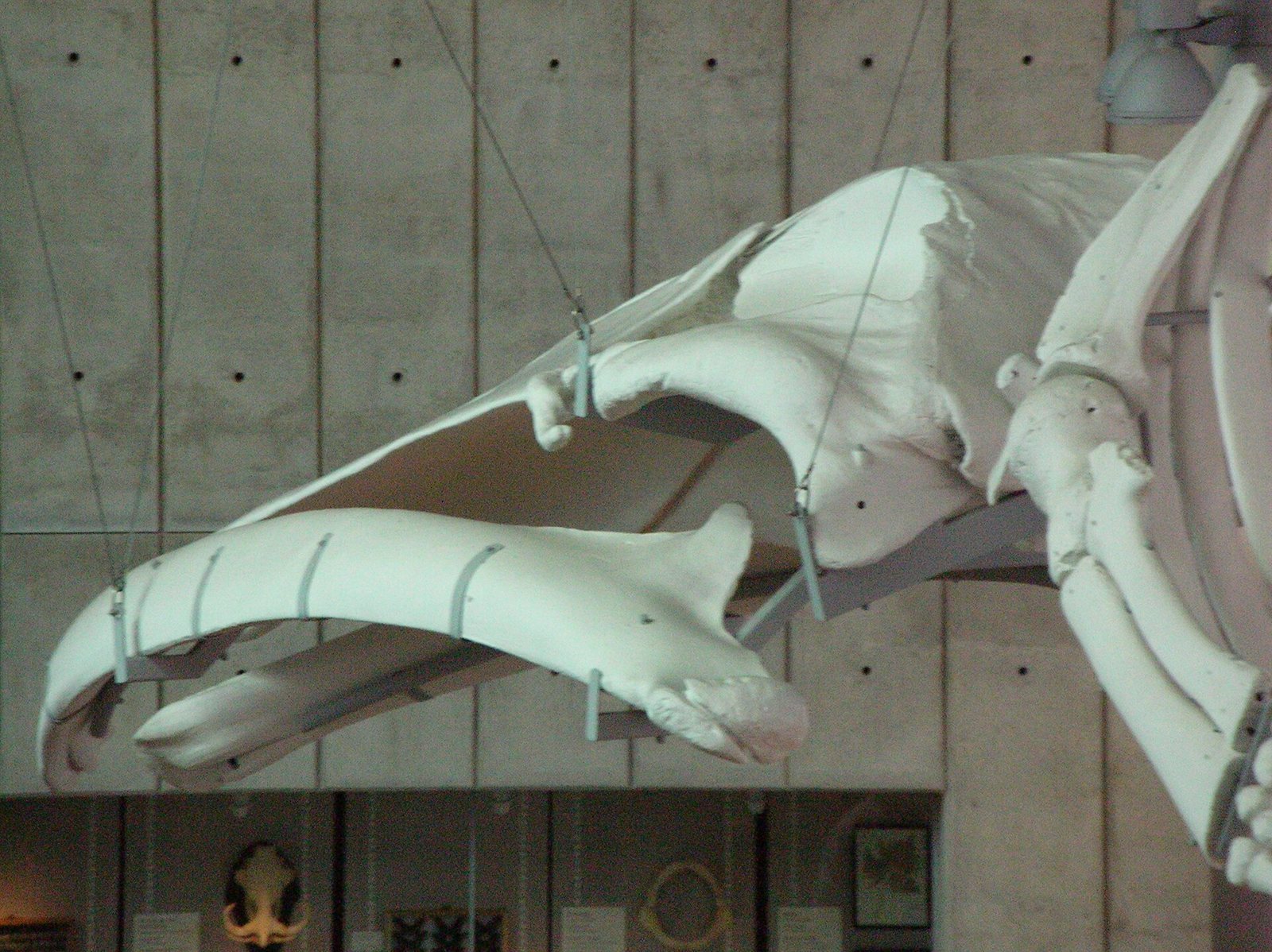
The first question to ask of any whale skull is whether it held baleen or teeth. Baleen whales, or mysticetes, include the blue whale (*Balaenoptera musculus*), the humpback (*Megaptera novaeangliae*), the gray whale (*Eschrichtius robustus*) and the bowhead (*Balaena mysticetus*). The Natural History Museum in London explains that these whales have broad rostra, the long snout section of the skull, and no functional teeth. Instead, their upper jaws carry plates of baleen, made of keratin, that filter food out of the water.
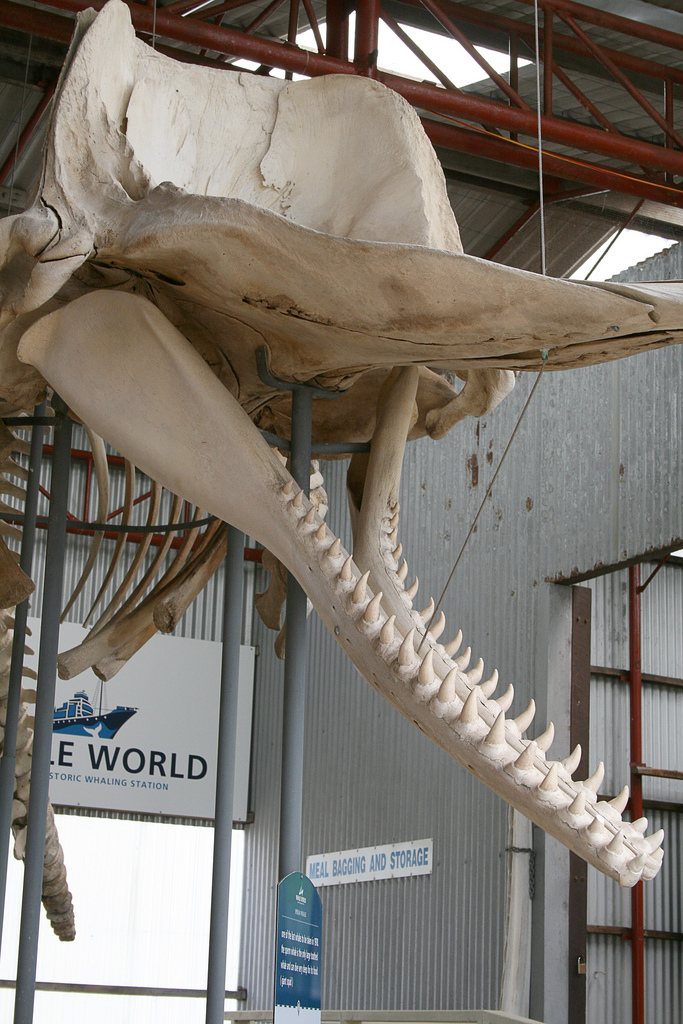
Toothed whales, or odontocetes, include the sperm whale (*Physeter macrocephalus*), the dolphins and the orca (*Orcinus orca*). Their skulls generally have teeth or empty tooth sockets, narrower rostra and more heavily modified nasal passages.
On a beach or in a collection, that first split narrows things down fast. A wide, flat, toothless snout points to a baleen whale. A row of teeth or sockets points to a toothed whale. Naming the exact species is a job for a museum or for NOAA.
Blowholes, telescoping and the lopsided skull
Both groups breathe through blowholes on top of the head. Baleen whales have two openings and toothed whales have one, according to Smithsonian Ocean. The blowhole itself is soft tissue, though, so a cleaned skull shows only the bony nasal openings underneath.
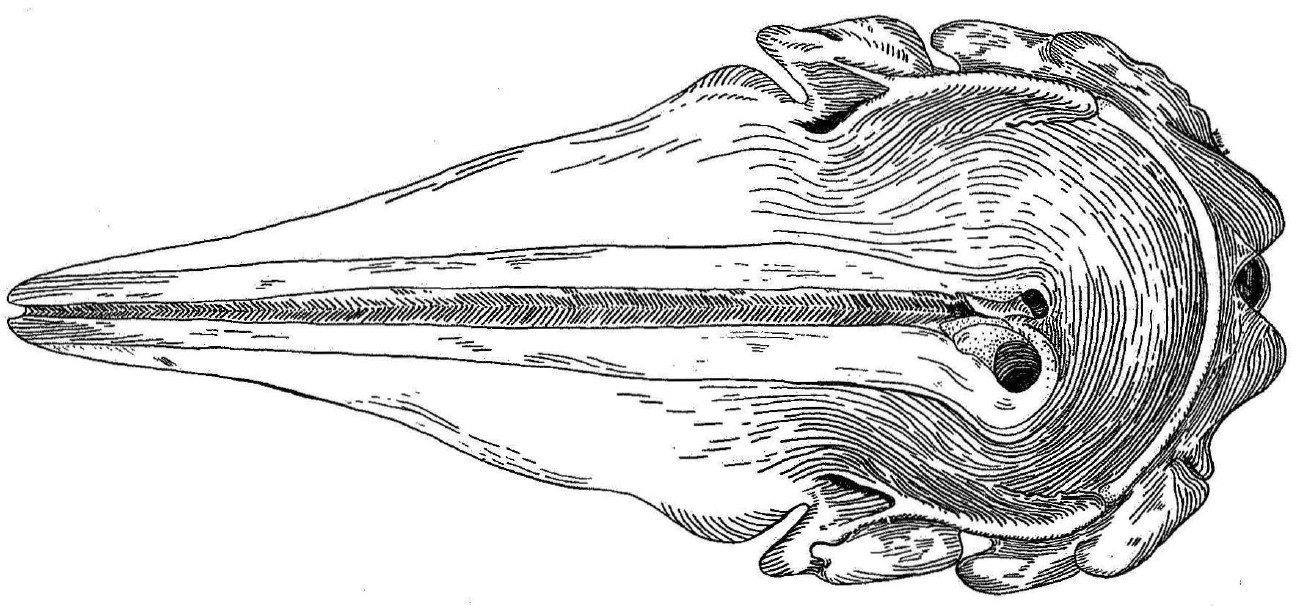
Those openings sit where they do because of telescoping. G. S. Miller's 1923 study describes how the skull bones overlap and shift in different patterns in different whales. In baleen whales, the maxilla, the main bone of the upper jaw, keeps a broad plate that extends back over the eye socket. Toothed whales lack that plate and often have a more slender, beak-like rostrum.
Toothed whales add one more oddity: their skulls are commonly asymmetrical, with the left and right sides shaped differently. The Natural History Museum's work on whale skull evolution links this asymmetry to echolocation, the way toothed whales use sound to find their way and their food. Sperm whale skulls are especially lopsided. A human skull, by contrast, is close to a mirror image of itself from side to side.
How big whale skulls get
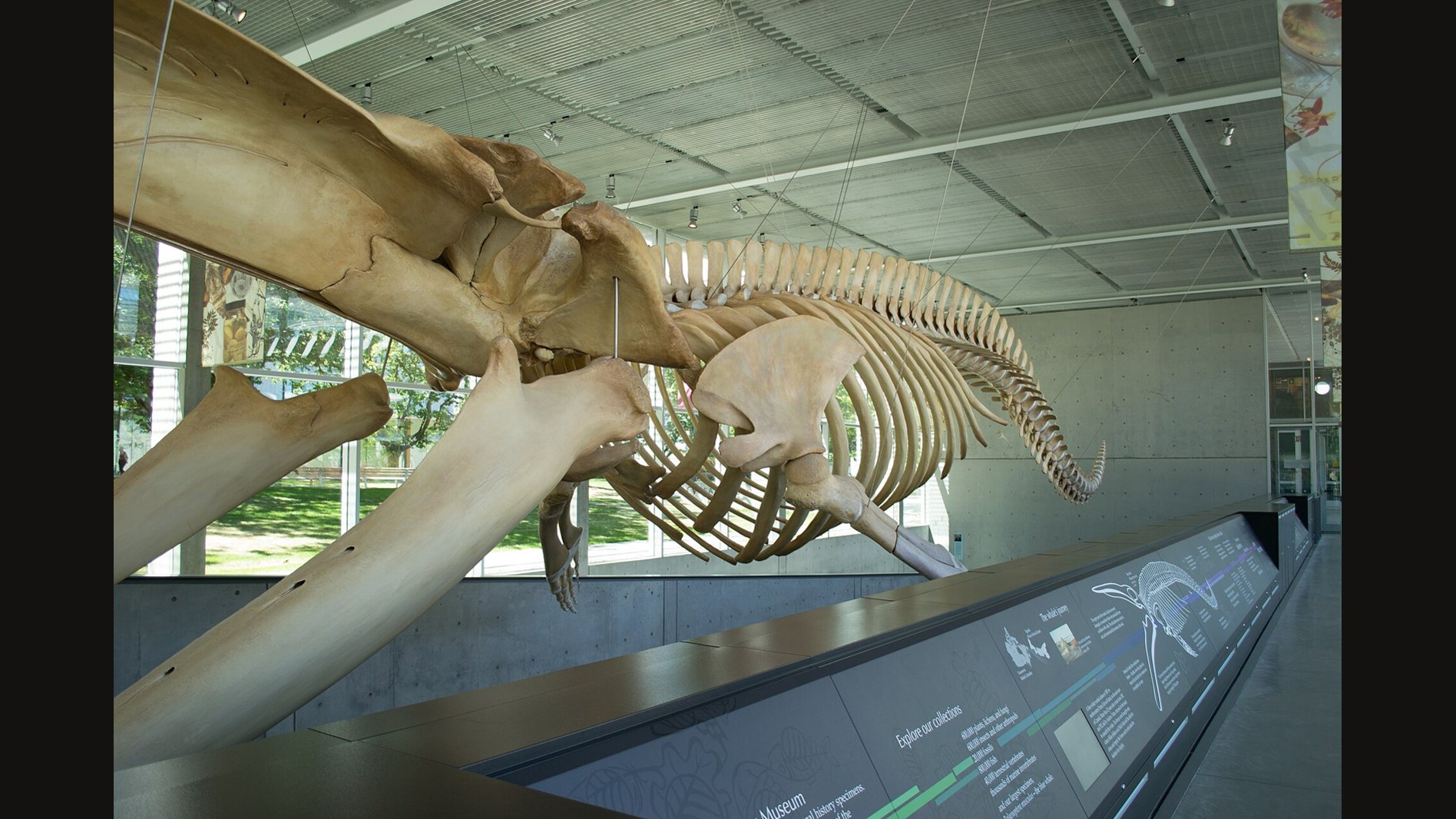
The blue whale has the largest skull of any living whale. The juvenile at the New Bedford Whaling Museum came from a 66-foot animal that came ashore in Rhode Island in March 1998, and its skull and lower jaw alone stretch about 18 feet and weigh roughly one and a half tons.
A full-grown blue whale is bigger still. Hope, the blue whale skeleton at the Natural History Museum in London, measures 25.2 metres and weighs 4,500 kilograms. She came from a whale found beached in Wexford, Ireland, in March 1891.
Other baleen whales come smaller. A Mexican cetacean biology manual published through SEMARNAT, Mexico's environment ministry, gives a gray whale skull a length of approximately 2.5 metres.
Among the toothed whales, the sperm whale is the giant. Manchester Museum notes that sperm whales can grow to around 19 metres, and its own skeleton came from a whale that stranded on the Massachusetts coast. For an exact skull measurement of any one sperm whale on display, ask the museum that holds it.
Tap or hover a row to highlight it.
| Specimen | Where | Size |
|---|---|---|
| SpecimenHope, blue whale skeleton | WhereNatural History Museum, London | Size25.2 m long; 4,500 kg |
| SpecimenJuvenile blue whale | WhereNew Bedford Whaling Museum, Massachusetts | Size66 ft whale; skull and lower jaw about 18 ft and about 1.5 tons |
| SpecimenBlue whale skeleton | WhereWhales of Iceland, Húsavík | Size25 m skeleton of a female |
| SpecimenSperm whale skeleton | WhereAustralian Museum, Sydney | Size17.4 m male; stranded in 1871; displayed since 1910 |
| SpecimenOrca | WhereAustralian Museum account of the species | SizeAbout 9 m and 5 tonnes; the largest dolphin |
Dolphin and orca skulls
An orca is a dolphin, zoologically speaking. The Australian Museum places *Orcinus orca* in the dolphin family, Delphinidae, and calls it the family's largest member, reaching about 9 metres and 5 tonnes. Its skull is a classic toothed whale skull: large pointed teeth, a rounded braincase and a relatively short, indistinct beak.
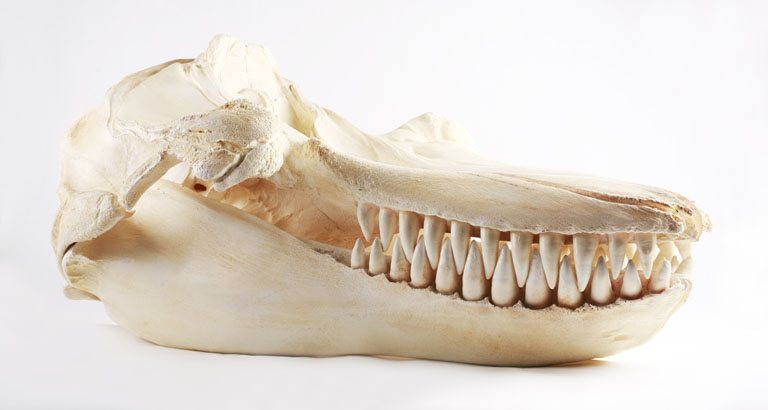
One real example gives a sense of scale. A Te Papa Tongarewa collection loan record lists a killer whale skull, jaws and teeth collected from a stranding at Allports Island, Queen Charlotte's Sound, New Zealand, on 3 July 1994. The skull measures approximately 300 millimetres high, 350 millimetres wide and 1,300 millimetres deep.
Smaller dolphin skulls vary a great deal. Many have long, narrow rostra. Natural History Museum researcher Agnese Lanzetti and colleagues showed that porpoises keep comparatively symmetrical skulls, unlike many other toothed whales and dolphins. River dolphins such as the baiji (*Lipotes vexillifer*) have especially long, thin beaks, as the Natural History Museum's baiji profile shows.
Where to see a whale skull
Museums are the best place to stand next to a whale skull, and several show them as part of full skeletons.
At the Natural History Museum in London, Hope, the 25.2-metre blue whale, has hung in Hintze Hall since 2017, her skull and jaw visible as part of the complete skeleton. The New Bedford Whaling Museum in Massachusetts displays the skull and lower jaw of its 66-foot juvenile blue whale with the rest of the specimen.
In Sydney, the Australian Museum has suspended the skeleton of a 17.4-metre male sperm whale since 1910; the whale stranded at Tom Thumb Lagoon near Port Kembla on 13 November 1871. Manchester Museum's young sperm whale skeleton has been on display since it arrived in 1898, two years after the animal stranded in Massachusetts.
At Whales of Iceland in Húsavík, the skeleton of a 25-metre female blue whale that washed ashore in Iceland in 2010 is on display. The Western Australian Museum in Perth reassembled its blue whale, Otto, in Hackett Hall after a four-year conservation and installation project. And the South Australian Museum in Adelaide says its first large prepared skeleton, a 17-metre sperm whale, is still on show.
Opening hours and gallery layouts change, so check the museum's own website before you go.
Whale skulls and skeletons through time
Tap or hover a step to follow the order.
1871
On 13 November, a 17.4-metre male sperm whale strands at Tom Thumb Lagoon near Port Kembla, Australia.
1891
The blue whale later known as Hope is found beached in Wexford, Ireland.
1896
A young sperm whale strands on the Massachusetts coast.
1898
Its skeleton arrives at Manchester Museum.
1910
The Australian Museum suspends its sperm whale skeleton.
1923
G. S. Miller publishes his Smithsonian study of telescoping in whale skulls.
1972
The Marine Mammal Protection Act is enacted in the United States on 21 December.
1994
On 3 July, a killer whale skull is collected from a stranding at Allports Island, New Zealand.
1998
In March, a 66-foot juvenile blue whale comes ashore in Rhode Island.
2010
A 25-metre female blue whale washes ashore in Iceland.
2017
Hope goes on display in Hintze Hall at the Natural History Museum, London.
If you find whale bones on a beach
This part is general information, not legal advice. The plain answer first: do not take a whale skull or bone home from the beach. The simplest step is to leave it in place and report it to the NOAA Fisheries Stranding Network or NOAA, which can tell you what applies to that particular bone.
In the United States, marine mammals are protected under the Marine Mammal Protection Act, enacted on 21 December 1972. NOAA Fisheries sets out the rules for beach-found parts on its protected species parts page:
- Parts may not be collected from a carcass or from remains with soft tissue still attached. A dead animal with soft tissue should be reported to the NOAA Fisheries Stranding Network, and NOAA asks people not to move stranded whales, dolphins or porpoises.
- Parts from species listed under the Endangered Species Act, including sperm whales, may not be collected without authorization.
- Bones, teeth or ivory from a marine mammal that is not ESA-listed, found on a beach or on land within a quarter mile of an ocean, bay or estuary, may be kept only after they are identified and registered with the nearest NOAA Fisheries office.
- Marine mammal parts may not be bought or sold.
Local, state, tribal, park and international rules can add restrictions on top of these. Outside the United States, contact the wildlife or marine-mammal authority for the country, state or territory where the bone washed up. Our page on finding an animal skull covers the general questions, and the sea otter section of our otter skull guide shows how another protected marine mammal is handled.
Found whale bones on a beach?
Tap a card to bring it forward.
- Leave it in place: The simplest step is not to move or take the bone or skull.
- Soft tissue still attached: Report it to the NOAA Fisheries Stranding Network; parts may not be collected from a carcass.
- Sperm whale or other ESA-listed species: Parts may not be collected without authorization.
- Any other marine mammal bone: It may be kept only after it is identified and registered with NOAA Fisheries, and it may never be bought or sold.
- Outside the United States: Call the wildlife or marine-mammal authority for that country, state or territory.
Whale skull questions
A few quick answers for anyone still standing under the skeleton.
Are orcas whales or dolphins?
Orcas are dolphins. The Australian Museum places *Orcinus orca* in the dolphin family Delphinidae as its largest member, even though its common name, killer whale, says otherwise.
How many blowholes does a whale have?
It depends on the kind of whale: baleen whales have two blowhole openings and toothed whales have one. On a cleaned skull you see the bony nasal openings rather than the blowholes, which are soft tissue.
How can you tell what kind of whale a skull came from?
Start by deciding whether it is a baleen or a toothed whale skull: a broad, toothless snout means baleen, and teeth or tooth sockets mean a toothed whale. For the exact species, a natural history museum or NOAA Fisheries can compare it with known specimens.
Whale skull quiz
Answer every question to check.
The scale of it
A whale skull is two stories in one bone: telescoped bones that overlap and shift as the skull adapted to water, and either a broad baleen jaw or a lopsided, toothed one linked to echolocation. The biggest belong to blue whales, with a juvenile's skull and jaw already about 18 feet long, and the best way to stand beside one is in a museum. If whale-sized skulls are your thing, our stories on the mammoth skull and the elephant skull and the Cyclops cover two more giants, and the Skeleton Coast is another shoreline where bones meet the sea.
Terms in this story
Tap a term to see what it means.
Mysticetes. The baleen whales, such as the blue, humpback, gray and bowhead whales, which filter food instead of using teeth.
---