

No. 331
The Frog Skull: Wide, Flat and Built for Swallowing
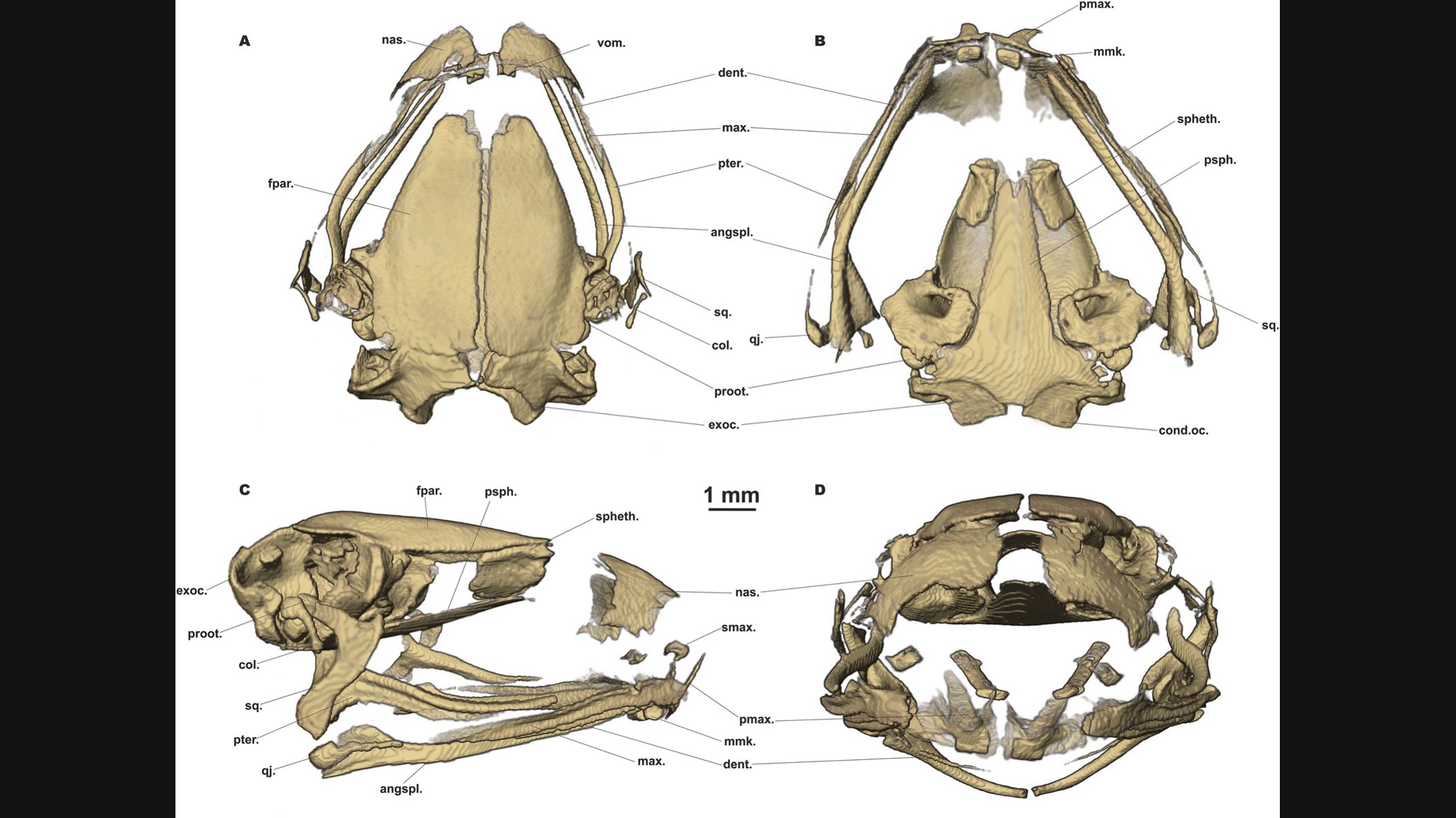
A frog skull is wide and flat, with a narrow braincase running down the middle and huge openings on either side for the eyes and jaw muscles. Seen from above, it can look more like a frame than a box.
That open look is normal. Much of the front of a frog's skull never turns to bone; it stays cartilage in life, so a cleaned skull often looks unfinished, as the University of California, Berkeley's guide to amphibian and reptile skulls explains.
There is more to it than the shape. Many frogs have small teeth along the upper jaw but almost never in the lower one, and some frogs even pull their eyes down into the mouth to help swallow. The skull is built around getting food in whole.
Wide, flat and mostly window
The overall shape is the first clue. A frog skull is broad and flattened from top to bottom, with a narrow braincase and large openings around the eyes and temples that anatomists call the orbitotemporal openings. Berkeley's guide and the Florida Museum of Natural History describe those openings as the space for the eyes, the jaw muscles, nerves and the temple region.
The wide outline comes mainly from three paired bones: the premaxillae at the very front, the maxillae along the sides of the upper jaw, and the quadratojugals that close the curve at the back. Inside that rim there is a lot of empty space, and much of the anterior neurocranium, the front part of the braincase, remains cartilage. Once the cartilage is gone, what is left looks almost see-through.
Those are not the only holes, either. Like any skull, a frog's has openings for the eye sockets, the nostrils, the spinal cord at the back, the nerves and the ear. Berkeley adds that much of the anuran braincase never turns to bone and that several bones found in other amphibians are missing altogether. The University of Texas DigiMorph collection shows the pattern in labeled top, side and bottom views of an American bullfrog (*Rana catesbeiana*) skull.
Shape still varies from species to species. The Florida Museum notes that aquatic frogs often have long, flat skulls, while burrowing frogs and frogs that eat other vertebrates may have shorter, deeper or heavily reinforced ones.
A map of the bones, snout to back
For a student labeling a diagram, or anyone trying to put a fragile skull back together, it helps to know the names. Starting at the front, the upper jaw is made of the premaxillae and the maxillae, the bones that carry the teeth in frogs that have them. The quadratojugal connects the maxilla to the cranium at the back of the jaw, according to Berkeley.
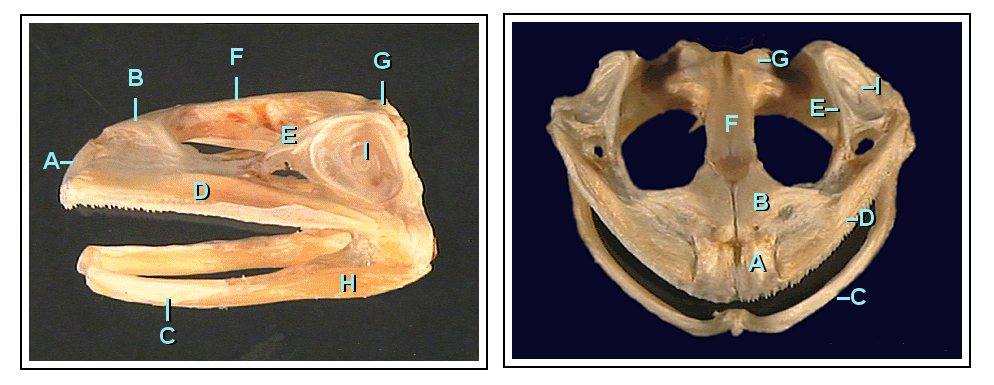
The roof of the skull is made of the frontoparietals, formed where the frontal and parietal bones fuse. Other commonly named parts include the nasals, the sphenethmoid, the squamosals, the pterygoids, the palatines, the vomers, the parasphenoid, the prootics and the exoccipitals, as listed by Berkeley and a frog anatomy text from the University of Uttarakhand. The vomers sit in the roof of the mouth.
The lower jaw has its own pieces. An openly licensed labeled diagram of a frog skull on Wikimedia Commons, drawn by Jon Houseman, marks the dentary and the angulosplenial in the lower jaw, alongside the premaxilla, nasal, maxilla, squamosal and frontoparietal above. With so many small, flat parts and so much missing cartilage, putting a frog skull back together is a patient job.
A frog skull from snout to back
Tap a card to bring it forward.
- Premaxillae and maxillae: The upper jaw, front and sides. In many frogs these bones carry small teeth.
- Quadratojugal: Closes the curve at the back of the jaw and connects the maxilla to the cranium.
- Frontoparietal: The fused roof of the skull, formed from the frontal and parietal bones.
- Vomers: Paired bones in the roof of the mouth. Some species carry vomerine teeth here.
- Dentary: A bone of the lower jaw. Almost all frogs have no teeth on it.
- Cartilage at the front: Much of the front of the braincase stays cartilage, which is why a cleaned skull looks open.
Do frogs have teeth?
Many frogs do, though not where people expect. Most toothed frogs carry small teeth along the upper jaw, on the premaxillae and maxillae, and those teeth hold prey. They do not chew it.
Some frogs have a second set on the roof of the mouth. These vomerine teeth sit on the paired vomer bones, and they come and go across species. In a 2021 comparative study of frogs, Hime and coauthors recorded upper-jaw teeth in 292 of the groups they examined, vomerine teeth in 202 species and no vomerine teeth in 226.
The lower jaw is nearly always bare. Almost all frogs lack teeth on the dentary, and Guenther's marsupial frog (*Gastrotheca guentheri*) is the notable documented exception. Because tooth patterns vary this much, there is no single dental formula or tooth count for frogs. A count only means something once the species is known.
Eyes that help push dinner down
If you have ever watched a frog swallow and seen its eyes sink into its head, that is part of the meal. In the northern leopard frog (*Rana pipiens*), the eyes move downward and inward into the mouth cavity during swallowing.
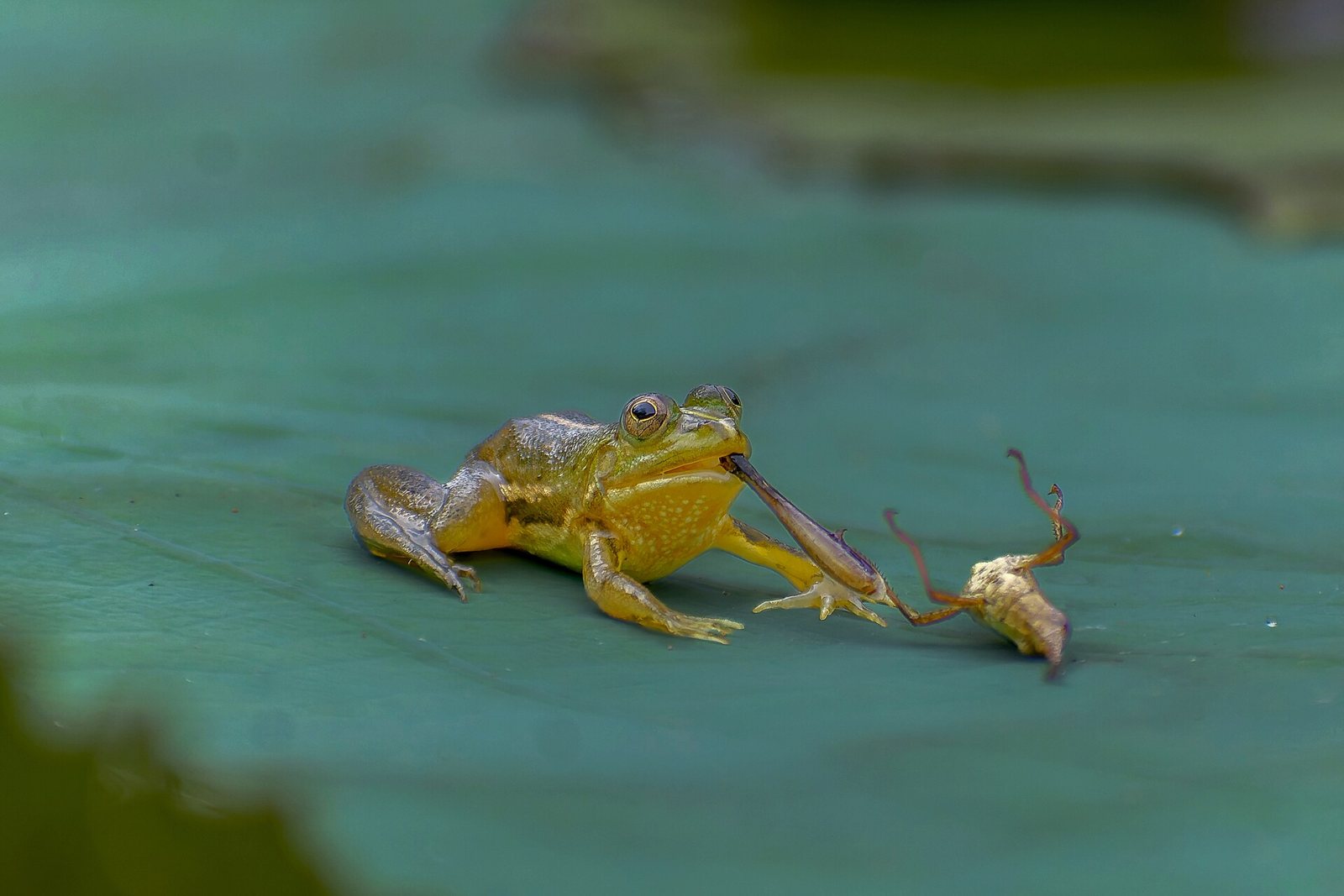
Robert P. Levine, Jenna A. Monroy and Elizabeth L. Brainerd tested this in a 2004 study that combined behavioral observation, cineradiography (X-ray video), electromyography (recording muscle activity) and experiments that disabled the nerves to the eye muscles. The retracted eyes appeared to touch the prey and help move it toward the esophagus, or hold it in place against the floor of the mouth while the tongue moved it along.
The eyes are a helper, not the main engine. When both retractor bulbi nerves were cut, the frogs could still swallow, but they needed an average of 4.0 swallows per cricket instead of 2.3. Later work on bullfrogs, summarized in a review of eye movements in frogs and salamanders, suggests the eyes help pin prey against the floor of the mouth while the mouth floor itself supplies much of the backward push.
The idea is old. The 2004 study looked back to Mary Dickerson, who in 1906 described how a toad's eyes press down into the mouth when it swallows, according to the Journal of Experimental Biology paper.
Frog, toad or salamander?
Frogs and toads are both anurans, the tailless amphibians. "Toad" is mainly a common name for some of them rather than a separate skeletal group, so a skull cannot be labeled frog or toad from that word alone. Identifying the species is the reliable route.
Salamanders are a different branch, and their skulls show it. Berkeley's guide notes that salamander skulls are also often broad and flat, but their frontal and parietal bones generally stay separate across the midline instead of fusing into a frontoparietal. The pattern of vomerine teeth is especially useful for telling salamander families apart, and salamanders keep some skull elements that frogs have lost, according to Berkeley and the work of Carroll on the ancestry of amphibians.
State field guides sort these animals by the living body. The skull is not part of the key. The Ohio Department of Natural Resources' Amphibians of Ohio uses traits such as parotoid glands, eardrums (tympana), dorsolateral folds, costal grooves, tails and body proportions. None of those survive on a bare skull, which is why a skull needs its own comparison.
Tap or hover a row to highlight it.
| Feature | Frog | Toad | Salamander |
|---|---|---|---|
| FeatureMajor group | FrogAnura | ToadA common-name grouping within Anura | SalamanderCaudata or Urodela |
| FeatureSkull roof | FrogFrontals and parietals fused into a frontoparietal | ToadVaries by species | SalamanderFrontals and parietals generally separate |
| FeatureTeeth | FrogUpper-jaw teeth in many species; vomerine teeth variable | ToadSpecies-dependent | SalamanderVomerine teeth common, in family-specific patterns |
| FeatureJaw connection | FrogQuadratojugal connects maxilla to cranium | ToadAnuran pattern varies by species | SalamanderVaries among salamander families |
| FeatureIdentification tip | FrogSkull shape varies widely | ToadDo not rely on "frog versus toad" alone | SalamanderVomerine tooth arrangement can help identify families |
Horned frogs and skulls built like armor
Not every frog skull is a delicate frame. When Daniel Paluh and colleagues compared CT scans of skulls from 158 frog species, the Florida Museum reported, the scans showed that hyperossification, the building of extra bone, evolved more than 25 times. Heavily reinforced skulls go with eating large prey, burrowing, defense and other specialized ways of life.
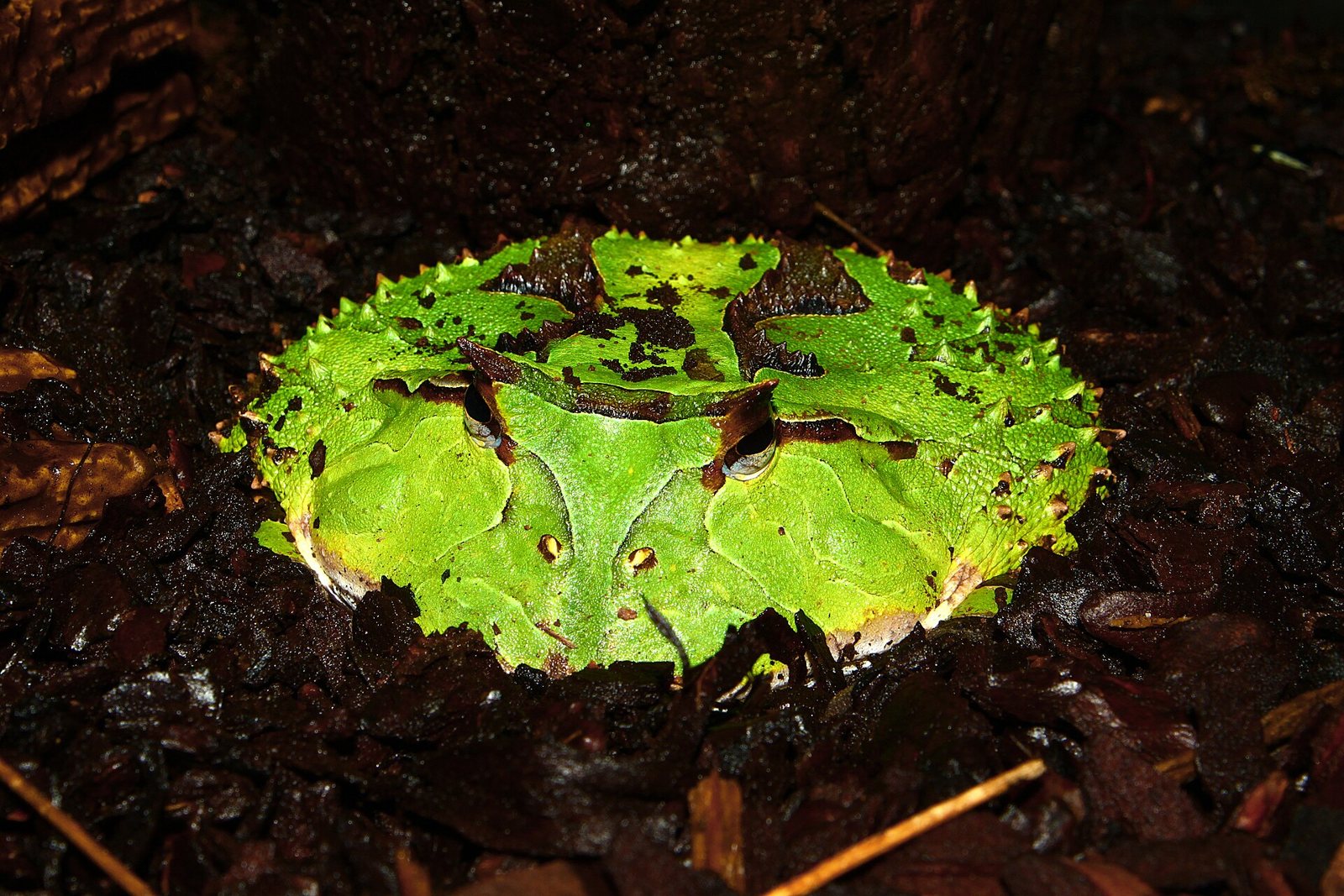
Some of the results look fierce. The triangle-headed or horned tree frog (*Hemiphractus scutatus*) has a wide skull and a large gape that help it take vertebrate prey. Pacman frogs, in the family Ceratophryidae, have roomy skulls and jaw joints set far back, which open the mouth very wide.
One of those is the ornate horned frog (*Ceratophrys ornata*) of Uruguay, Brazil and northern Argentina. The American Museum of Natural History describes it as an ambush predator that waits under leaves or loose soil and lunges at passing prey, eating mice, lizards, birds, snakes, insects and other frogs. A skull built to take a mouse is a very different object from a delicate frame by the pond. The Natural History Museum's page on whether frogs can be venomous adds Greening's frog, whose skull carries spines.
Beelzebufo, the armored fossil frog
The most famous heavy-headed frog lived long before any of these. *Beelzebufo ampinga* comes from the Late Cretaceous Maevarano Formation of Madagascar and was named in 2008. In 2014, Evans, Groenke, Jones, Turner and Krause described more complete material in PLOS ONE.
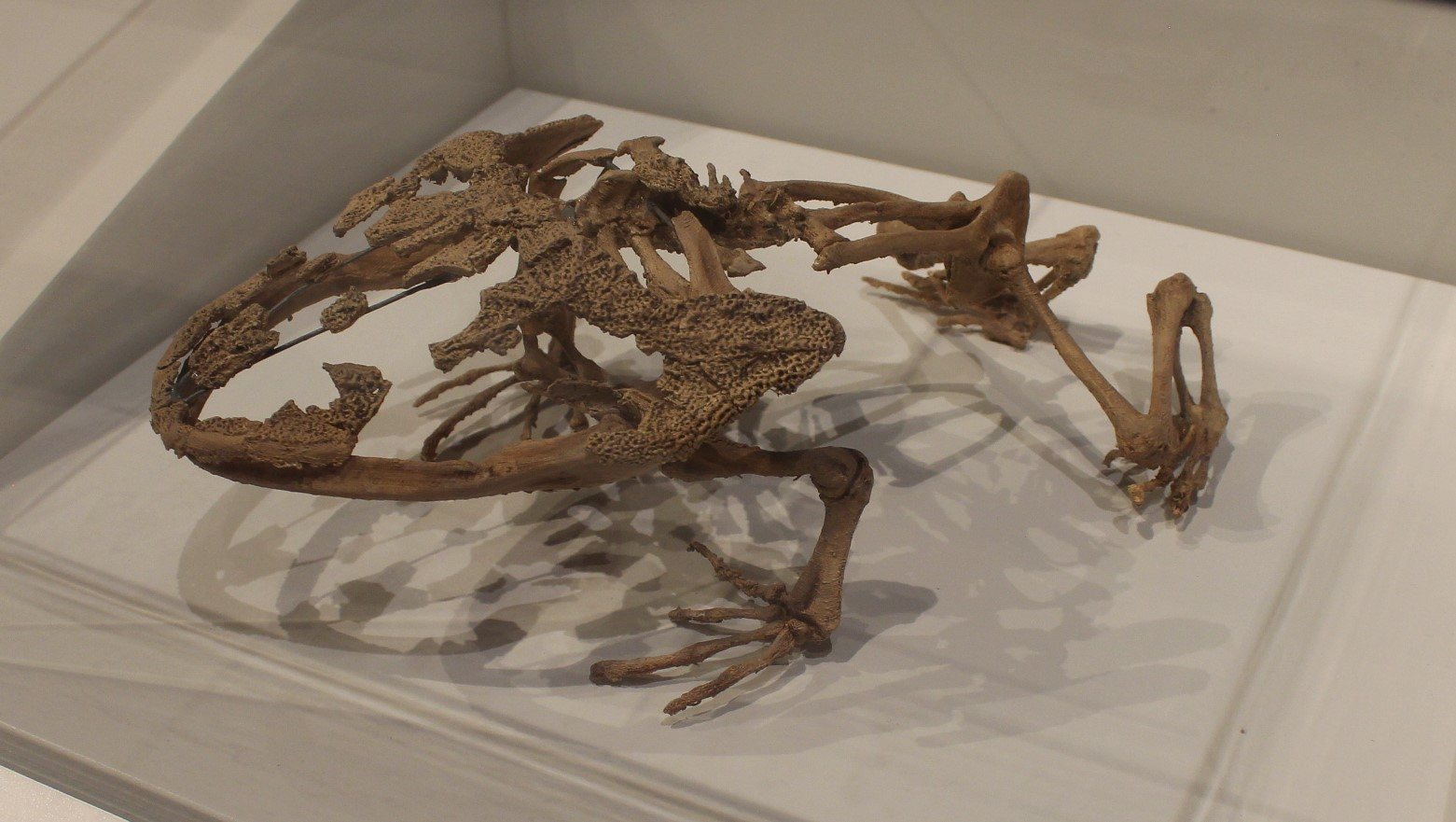
They describe a large, broad-headed, hyperossified frog that lived on land. Its skull had heavy cranial exostosis, a rough, built-up bone surface, along with large flanges at the back corners of the skull and a heavily reinforced roof. Some of their analyses place it near the South American horned frogs, though how a frog in Madagascar relates to frogs in South America is still debated.
Frog skulls in science
Tap or hover a step to follow the order.
1906
Mary Dickerson describes a toad's eyes pressing down into the mouth during swallowing.
2004
Levine, Monroy and Brainerd test eye retraction in the northern leopard frog, Rana pipiens.
2008
Beelzebufo ampinga is named from Late Cretaceous fossils from Madagascar.
2014
Evans and coauthors describe more complete Beelzebufo material with large skull flanges and heavy exostosis.
2021
Hime and coauthors analyze tooth loss across 425 frog species.
2021
Daniel Paluh and colleagues use CT data from 158 frog species to study skull shape and extra bone.
A small skull by the pond
A small, flat, see-through-looking skull near water may well be a frog's, but naming the species takes a closer comparison than any field guide can give. The reliable route is a species-specific bone reference, or a museum herpetology collection that can look at it. Hold off on any tooth count until the species is known, since teeth vary so much.
You can also compare it with a scan. The Florida Museum's oVert project shares CT-scanned vertebrate specimens, including frog skull material, through the MorphoSource platform, so a pond-side skull can be set beside a museum one in 3D. If you plan to clean it, how to clean an animal skull and our story on dermestid beetles cover the methods for small, fragile bones. Whatever you decide, the California Department of Fish and Wildlife advises wearing gloves around animal remains and avoiding contact with body fluids or parasites.
Before it goes on a shelf, think about the rules. Some amphibians may be protected where you live, and the rules on keeping or moving animal remains differ between states, provinces, tribal lands and countries. This is general information rather than legal advice: check with the relevant wildlife agency, or the US Fish and Wildlife Service in the United States, before you keep it, and read what to do when you find an animal skull.
Frog skull quiz
Answer every question to check.
Frog skull questions, answered
A few quick answers for the student and the pond-side finder.
Which bones make up a frog skull?
The main named bones are the premaxillae, maxillae and quadratojugals around the jaw, the frontoparietal on the roof, and the nasals, sphenethmoid, squamosals, pterygoids, palatines, vomers, parasphenoid, prootics and exoccipitals. The lower jaw includes the dentary and the angulosplenial.
What are vomerine teeth?
They are small teeth on the vomers, paired bones in the roof of the mouth. In frogs they are present in some species and absent in many others, while in salamanders their arrangement helps identify the family.
How can I tell if a skull is a frog's?
Look for a wide, flat skull with a narrow braincase, very large eye openings and a fused frontoparietal roof. To name the species, compare it with a species-specific bone reference or ask a museum herpetology collection.
What is the circle on the side of a frog's head?
It is the tympanum, the frog's eardrum, sitting just behind the eye. The American Museum of Natural History explains that it vibrates with sound and passes the vibrations to the inner ear; on a bare skull the membrane is gone, so the ear region can look like an opening or a shallow dip, with a tiny rod-shaped bone, the columella, inside.
Do frogs have a skeleton?
Yes, an internal skeleton of bone and cartilage with a skull, a backbone, shoulder and hip girdles, four limbs and a hyoid apparatus that supports the tongue. The Atlas of Animal Anatomy and Histology shows how it is built for jumping, with long hind limbs, fused ankle bones and a backbone that ends in a rod called the urostyle.
Is a toad skull different from a frog skull?
Not as a rule, because toads are frogs too, all within Anura. Differences follow the species, so identify the species; the word "toad" alone will not settle it.
More skulls from the water's edge
A frog skull is a small marvel of open space: a wide frame for big eyes, a fused roof, gripping teeth on top and none below, and room for the eyes to help push food down. For other skulls you might meet near a pond, see the turtle skull and snake skull stories. And if you are wondering what eats all those toads, the hognose snakes that play dead are near the top of the list.
Terms in this story
Tap a term to see what it means.
Anuran. A member of Anura, the tailless amphibians, which includes all frogs and toads.
---