

No. 328
Do Snakes Have Bones? How Many, and Which Animals Have None
Yes, snakes have bones, and a lot of them. A snake is a vertebrate, built around a skull, a long backbone made of many vertebrae, and rows and rows of ribs.
The Natural History Museum in London counts 100 to 400 vertebrae in a snake's spine, plus up to 200 more in the tail. So, a snake has hundreds of bones, and the exact number depends on the species.
The head holds about 30 bones of its own, several of which move independently, which is how a snake swallows meals wider than its head. Further down, there are also the animals that truly have no bones at all, from jellyfish to octopuses, and the sharks whose skeletons are made of something else.
What a snake skeleton is made of
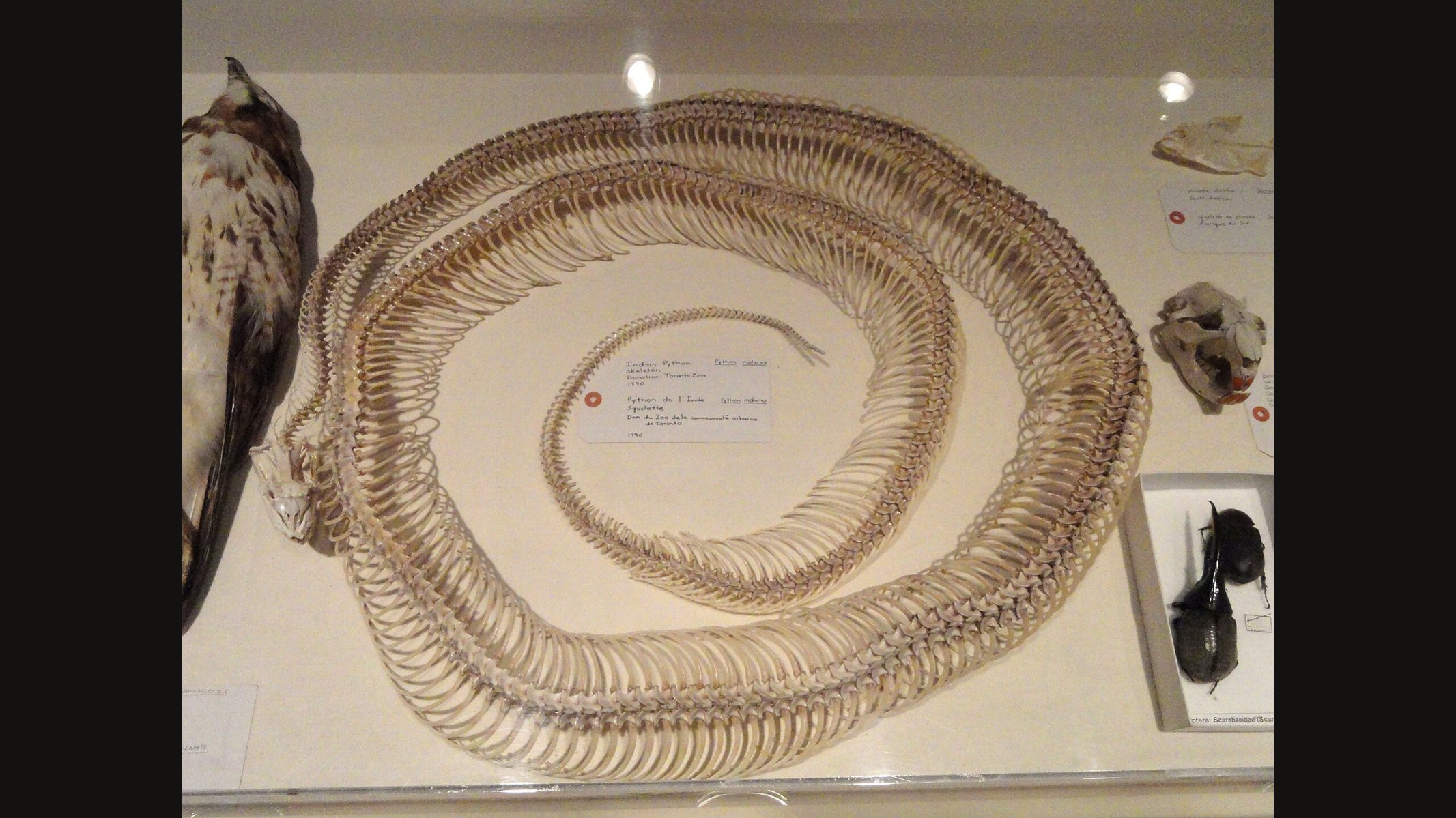
Take away the scales and muscle and a snake is mostly a very long chain. The Natural History Museum describes its skeleton as a skull, a long vertebral column and ribs, and says most of the vertebrae carry a movable pair of ribs. Those ribs can move independently of one another.
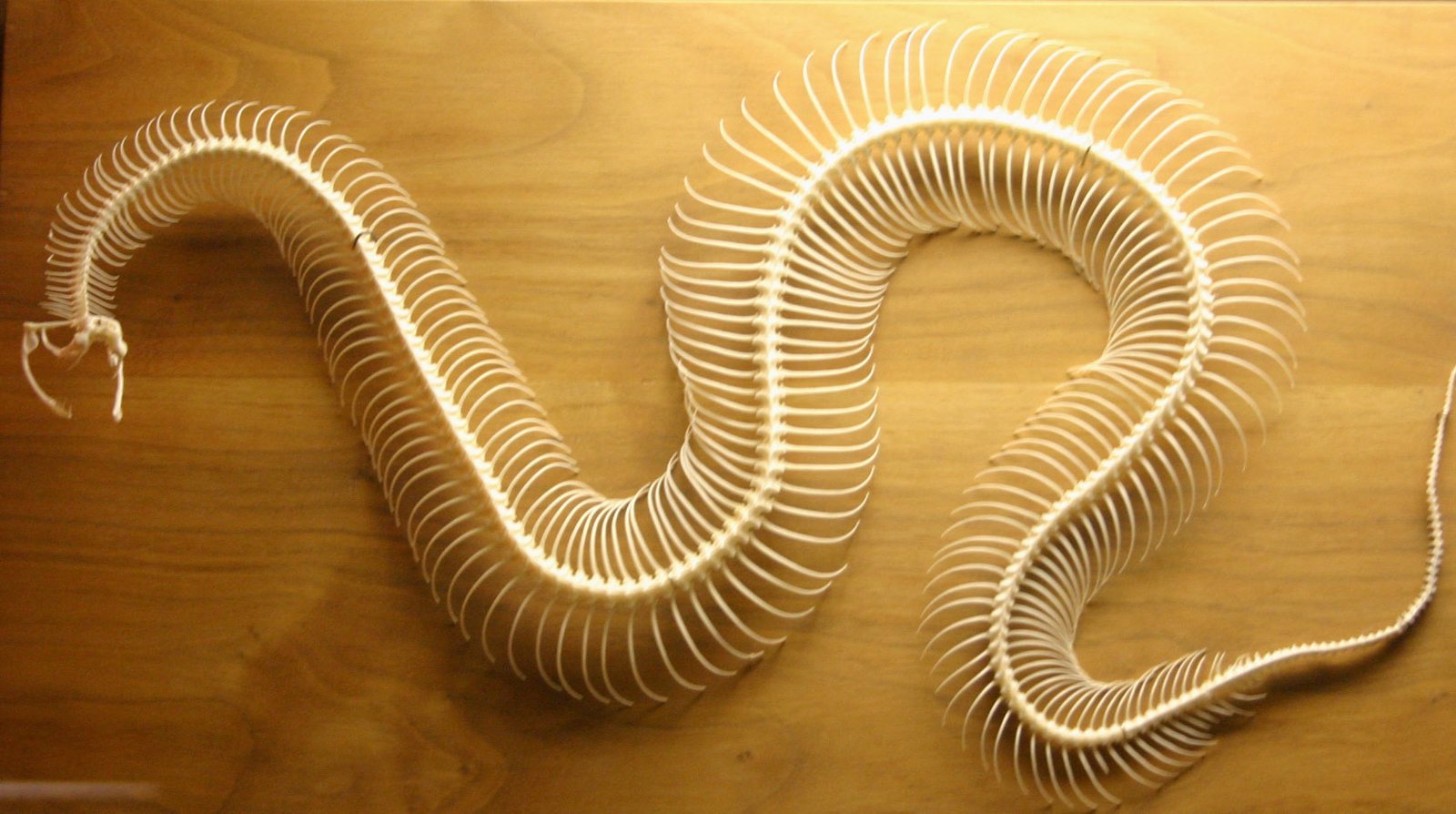
What a snake leaves out is just as telling. Snakes have no working arms or legs, and they have no sternum, the breastbone that joins the ribs at the front in many other animals. The City College of San Francisco's notes on reptiles list the missing sternum among the features of snakes.
Inside a snake skeleton
Tap a card to bring it forward.
- Skull: About 30 bones, several of which move independently.
- Spine: 100 to 400 vertebrae, according to the Natural History Museum.
- Tail: Up to 200 more vertebrae.
- Ribs: A movable pair on most vertebrae.
- Sternum: None. The ribs are not joined by a breastbone.
- Hind-limb spurs: Small leftover leg bones in some boas and pythons.
How many bones does a snake have?
There is no single number for every snake, because species differ so much in length and build. The best answer is a range, and two museums give slightly different ways of counting it.
The Natural History Museum counts 100 to 400 vertebrae in the spine and up to 200 more in the tail. Since most of those vertebrae carry a pair of ribs, the rib count climbs with them. The Smithsonian's National Zoo gives a combined figure of about 175 to 400 ribs and vertebrae for an individual snake. The City College of San Francisco notes give 200 to 400 vertebrae. Add the roughly 30 bones of the skull, and every snake lands somewhere in the hundreds.
The ranges differ because they measure different things and cover different snakes, so it helps to keep each with its own museum rather than averaging them into one figure. For a sense of scale on the other side of the comparison, see how many bones are in the human body.
The skull and the stretchy jaw
A snake's head is not one solid box. Its skull is made of about 30 bones, and several of them can move on their own, according to the Natural History Museum. The American Museum of Natural History points to these specialized skulls and jaws as one of the things that sets snakes apart.
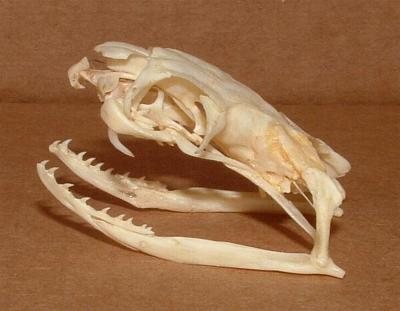
The real trick is in the lower jaw. Its two halves are not fused at the chin, as ours are. They are joined at the front by an elastic ligament, and each side connects to the skull through a mobile joint. That lets the lower jaw spread sideways around prey that looks far too big to fit.
Then the snake goes to work. It moves one side of the jaw forward, then the other, in turn, so the head walks itself over the meal while backward-curving teeth keep the prey moving in only one direction: down. The jaw stretches; it does not come out of its joint. It is a slow, steady way to eat, and it works.
The ribs have a job during mealtime too. In 2022 the Natural History Museum reported on how a *Boa constrictor* manages to breathe while crushing its prey, a question that involves those many ribs. To tell one snake's skull from another's, our snake skull story covers identification.
Hidden leg bones in boas and pythons
Most snakes have no trace of legs, but some boas and pythons still carry small pelvic and hind-limb remnants. The Florida Museum of Natural History describes these vestigial hind limbs in some modern pythons as spurs used during mating and combat. The common boa (*Boa constrictor*) and the Burmese python (*Python bivittatus*) are two snakes that keep them.
So, even a legless snake can carry a little leg bone. It is one more reason a snake skeleton rewards a close look.
Real bone, all the way down the back
A snake's backbone is made of true bone, just like a lizard's, a bird's or a person's. That is what makes a snake a vertebrate: it has a backbone. The American Museum of Natural History groups snakes with lizards among the vertebrates for exactly this reason.
Snakes are sometimes compared to worms because both are long and legless, but the comparison stops at the outline. A worm has no backbone at all, while a snake has hundreds of vertebrae linked into one long column. A pet ball python curled on someone's arm is carrying that whole column of bone under its scales.
Because it is real bone, a snake's skeleton can break. In a 2012 veterinary case report, X-rays showed a displaced compression fracture in one mid-spine vertebra of a coastal taipan (*Oxyuranus scutellatus*) at Cairns Tropical Zoo in Australia, and veterinary surgeons stabilized it with a spinal staple. A 2024 report by Varshney and Monpara from Surat, India, describes another snake's spinal fracture after an injury. A snake that may be hurt needs a reptile veterinarian, not a home splint.
Tap or hover a row to highlight it.
| Animal | Group | Skeleton | Named by |
|---|---|---|---|
| AnimalSnake | GroupVertebrate | SkeletonBony skull, vertebrae and ribs | Named byNatural History Museum |
| AnimalShark | GroupVertebrate | SkeletonMainly cartilage | Named bySmithsonian Ocean |
| AnimalRay and skate | GroupVertebrate | SkeletonMainly cartilage | Named bySmithsonian Ocean |
| AnimalJellyfish | GroupInvertebrate | SkeletonNo bones | Named byNatural History Museum |
| AnimalOctopus | GroupInvertebrate mollusc | SkeletonNo bony skeleton | Named byNatural History Museum |
| AnimalInsect | GroupInvertebrate arthropod | SkeletonExternal exoskeleton, no internal bones | Named byAmerican Museum of Natural History |
| AnimalWorm | GroupSeveral invertebrate groups | SkeletonNo bones | Named byAmerican Museum of Natural History |
Which animals have no bones?
The animals with no bones are the invertebrates, the animals without a backbone. The American Museum of Natural History names jellyfish, octopuses, insects and worms among them, and each goes without bones in its own way.
Jellyfish are the most complete example. The Natural History Museum says jellyfish, including the fried egg jellyfish (*Cotylorhiza tuberculata*), have no bones, brains, hearts, teeth or blood. They do have a nerve net, a web of nerves spread through the body. Octopuses and other cephalopods are soft-bodied molluscs with no bony skeleton.
Insects take a different route. They are invertebrate arthropods with an exoskeleton, a hard, chitinous casing on the outside of the body in place of bones on the inside. "Worm," meanwhile, is not one group at all. The name covers several unrelated groups of invertebrates, including annelids and flatworms.
Sharks and rays: backbones made of cartilage
Sharks sit in between. They are vertebrates, with a backbone and a skull, but Smithsonian Ocean explains that their skeletons are made mainly of cartilage, a firm, flexible tissue, rather than bone. The great white shark (*Carcharodon carcharias*) and the shortfin mako (*Isurus oxyrinchus*) are both cartilaginous fishes.
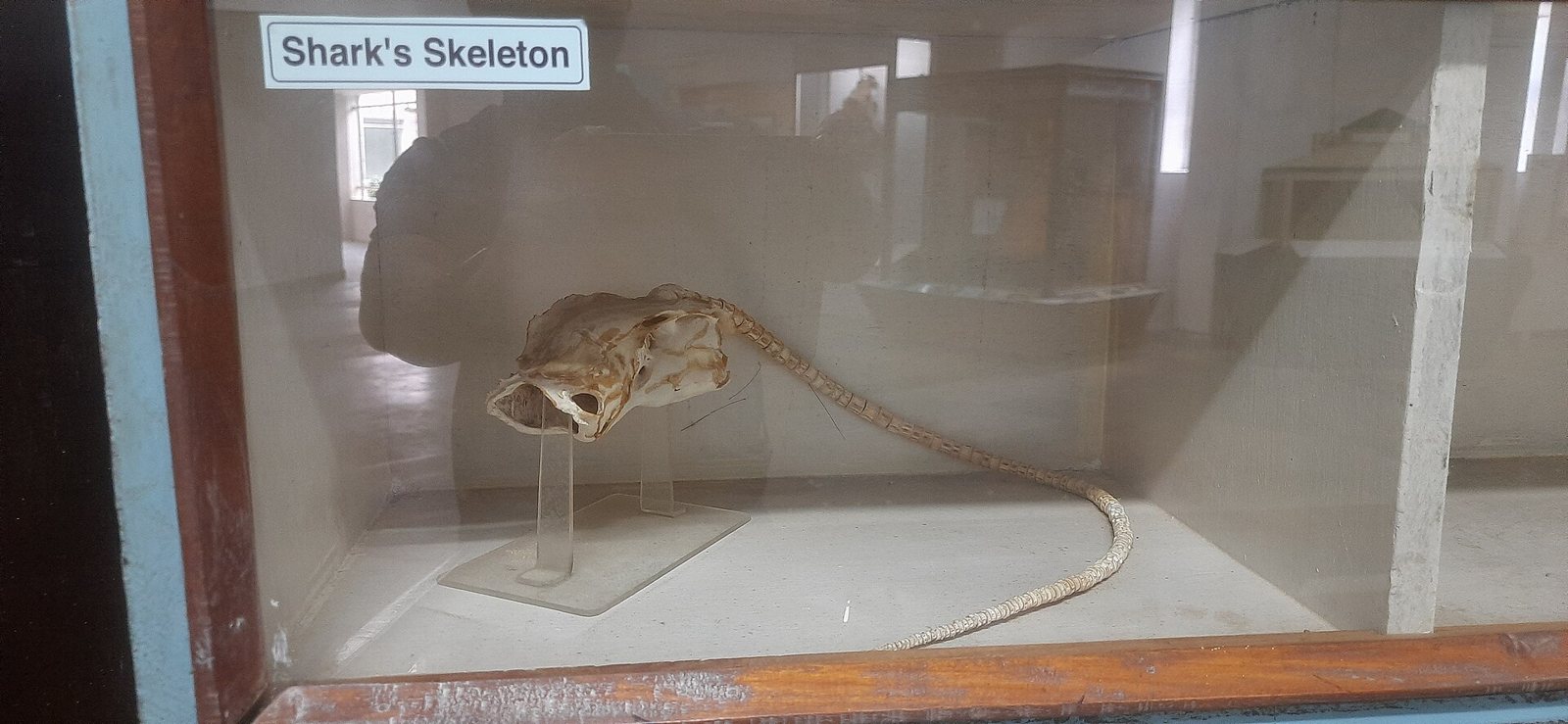
Their flat relatives are built the same way. Rays and skates are also cartilaginous fishes, grouped in the superorder Batoidea, according to Smithsonian Ocean. So, a shark has a skeleton but not much bone, while a snake has bone in abundance. Our shark skull story looks at what a cartilage skull leaves behind.
Seeing snake bones for yourself
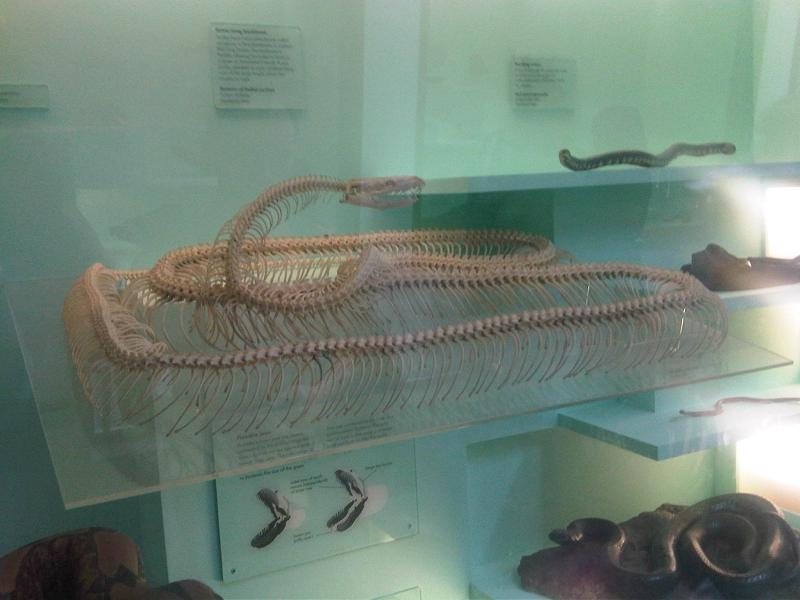
Snake skeletons make striking museum pieces because every one of those vertebrae and ribs is laid out in a long, coiled line. The Natural History Museum in London displays snake skeletons, the Sternberg Museum of Natural History holds a cast of a green anaconda (*Eunectes murinus*) skull, and a cleaned king cobra (*Ophiophagus hannah*) skull still shows its fangs.
If you turn up a small skull or a string of vertebrae in a garden or on a walk, the snake skull story is a good place to compare it. Whether you may keep animal remains you come across is a matter of state and federal wildlife rules, which differ from place to place. Take this as a general pointer, not legal advice, and ask your state wildlife agency or the US Fish and Wildlife Service before you keep anything, and see what to do when you find an animal skull.
Snake bones quiz
Answer every question to check.
Snake skeleton questions, answered
A few quick answers to round out the skeleton.
Do snakes have bones in their head?
Yes, about 30 of them. Several of those skull and jaw bones move independently, so the head can widen around a meal instead of staying a fixed size.
Do snakes have ribs?
Yes, and a great many. Most vertebrae carry a movable pair, so a snake with hundreds of vertebrae also has hundreds of ribs, none of them joined by a breastbone.
Do snakes have legs?
Not working ones. Some boas and pythons keep small hind-limb bones that show on the outside as spurs, which the Florida Museum of Natural History says are used during mating and combat.
Are snakes invertebrates?
No, snakes are vertebrates because they have a backbone. Invertebrates such as jellyfish, octopuses, insects and many worms have none.
Are sharks made of bone or cartilage?
Mostly cartilage. Sharks are still vertebrates, and the same goes for their cousins the rays and skates.
What is the difference between a culebra and a serpiente?
"Serpiente" is the broad word for any snake, while "culebra" usually means a small or medium-sized snake that is generally not venomous. The Real Academia Española defines it that way, and the Diccionario del Español de México adds that some culebras do have venom glands and rear teeth, so the word is no safety test; the species name, such as the common racer (*Coluber constrictor*), is what counts.
From the tip of the snout to the end of the tail
A snake turns out to be one of the bonier animals you can meet: a flexible skull of about 30 pieces, a backbone that can run to hundreds of vertebrae, and a pair of ribs on most of them. For a closer look at the head, read about the snake skull, and to compare a snake's count with your own, see how many bones are in the human body. The skull bones of a person get their own tour in the bones of the skull, and for a snake whose skeleton goes perfectly still on purpose, there are the hognose snakes that play dead.
Terms in this story
Tap a term to see what it means.
Vertebrate. An animal with a backbone. Snakes, sharks and people are all vertebrates.
---