

No. 326
Zombie Deer Disease: What Chronic Wasting Disease Means for Deer, Hunters and Skulls
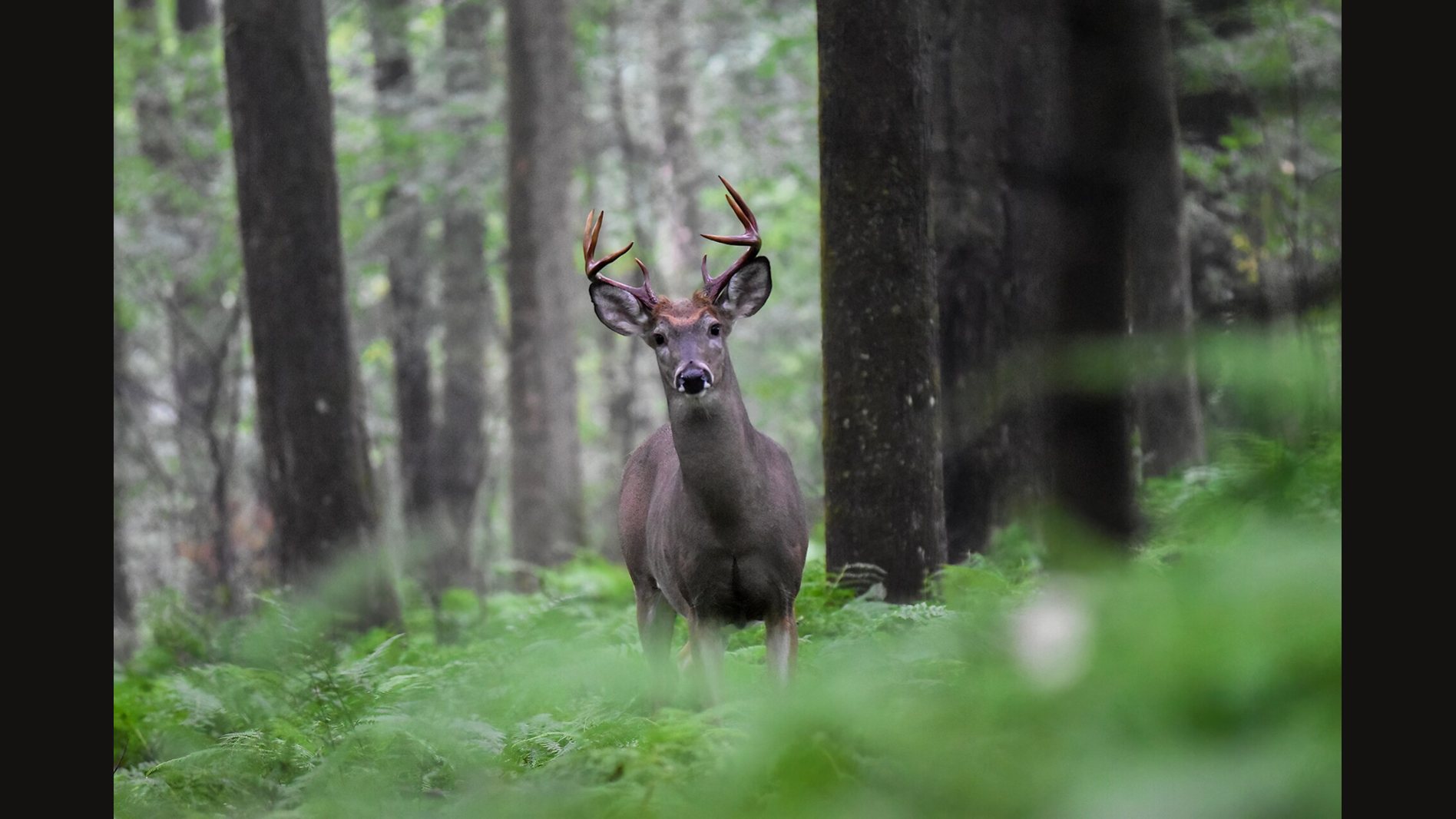
"Zombie deer disease" is the popular nickname for chronic wasting disease, or CWD, a fatal prion disease of deer, elk and moose caused by misfolded proteins. It has been found in 37 US states and five Canadian provinces, according to the US Geological Survey's map page dated June 30, 2026.
For people, the CDC's guidance, dated January 21, 2026, says CWD infections in people have never been reported. The CDC also says it is not known whether people can become infected, so it advises hunters in CWD areas to follow state guidance, strongly consider testing their deer, and not eat meat from an animal that tests positive.
If you hunt, the practical questions are about testing, venison and what you can carry home, including a skull or a rack of antlers. Those rules come from state wildlife agencies, and they differ from place to place.
What chronic wasting disease is
CWD belongs to a family of illnesses called prion diseases. A prion is a misfolded form of a normal protein, and in CWD those misfolded proteins damage the nervous system. The USDA's Animal and Plant Health Inspection Service (APHIS) puts the cause plainly: a misfolded protein, not a bacterium, a virus or a fungus.
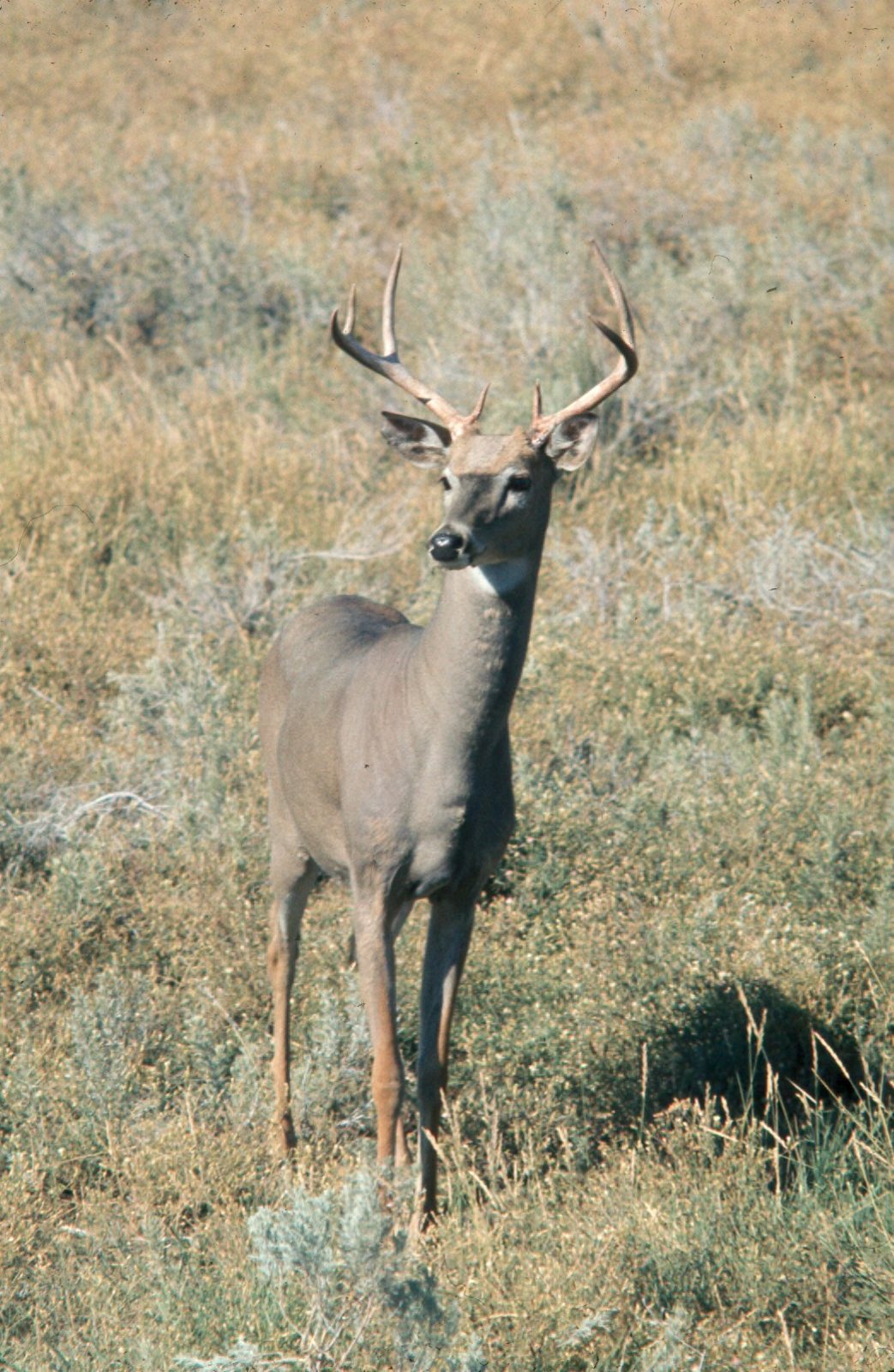
The disease affects cervids, the deer family. The APHIS wildlife page and the CDC name white-tailed deer (*Odocoileus virginianus*), mule deer (*Odocoileus hemionus*), black-tailed deer (*Odocoileus hemionus columbianus*), Rocky Mountain elk (*Cervus canadensis*) and moose (*Alces alces*). If you know these animals mostly from their bones, our stories on the elk skull and the moose skull cover the species themselves.
What makes CWD hard to spot is its long silent stretch. APHIS says an infected animal may look healthy for months or even years while it can still pass the disease to other animals. Then the signs arrive and get steadily worse: weight loss, poor coordination, drooping ears, a lowered head, lethargy, repetitive behavior, drooling, trouble swallowing, and more drinking and urinating than usual. Some animals develop aspiration pneumonia. CWD is always fatal in the animals it affects.
Other illnesses can cause similar signs, so a thin, stumbling deer is not proof of CWD on its own. Only laboratory testing confirms it.
Is CWD the same as mad cow disease? No, though the two are related. Both are prion diseases in the same broader family, but mad cow disease, properly bovine spongiform encephalopathy or BSE, affects cattle, while CWD affects the deer family, as the CDC's overview of prion diseases explains. One difference matters to people: BSE has caused variant Creutzfeldt-Jakob disease in humans, while no confirmed human case of CWD has been reported.
Why people call them zombie deer
The nickname comes from the way an animal looks in the late stages. Severe weight loss, stumbling, a lowered head, drooling and a dulled response to its surroundings can make a deer, elk or moose seem zombie-like, as a Simon Fraser University expert briefing from October 2024 explains. "Zombie deer" is a media name, and it has spread far enough that a Washington Department of Fish and Wildlife hunter survey describes CWD as "sometimes referred to as 'Zombie deer disease.'"
The word "zombie" also turns up in a very different corner of biology, the zombie-ant fungus. That one is a fungus that lives on insects, and it has its own story. *Ophiocordyceps unilateralis* sensu lato is a group of insect fungi studied in carpenter ants. Penn State researchers report that it spreads through the ant's muscle and other tissue, forming a fungal network through the body while leaving the brain itself intact. It steers the ant's behavior, makes it bite onto vegetation, and later grows a stalk from the dead ant's head to release spores.
So, the two share a nickname and nothing else. One is a prion disease of deer and their relatives; the other is a fungus that infects ants.
Where CWD has turned up since 1967
CWD was first recognized in 1967 as a clinical wasting syndrome in captive mule deer at a wildlife research facility in northern Colorado, according to the APHIS control and eradication guide. In 1978 it was identified as a transmissible spongiform encephalopathy, the scientific group of brain diseases that prion diseases belong to. The CDC dates the first report of a wild deer with CWD to 1981.
Chronic wasting disease, from Colorado to 37 states
Tap or hover a step to follow the order.
1967
CWD is first recognized as a clinical wasting syndrome in captive mule deer in northern Colorado.
1978
CWD is identified as a transmissible spongiform encephalopathy.
1981
The first wild deer with CWD is reported.
Mid-1980s
CWD is detected in free-ranging deer and elk in northeastern Colorado and southeastern Wyoming.
May 2001
CWD is found in free-ranging deer in southwestern Nebraska.
2005
The first CWD-positive free-ranging moose is identified in Colorado.
June 30, 2026
The USGS reports detections in 37 US states and five Canadian provinces.
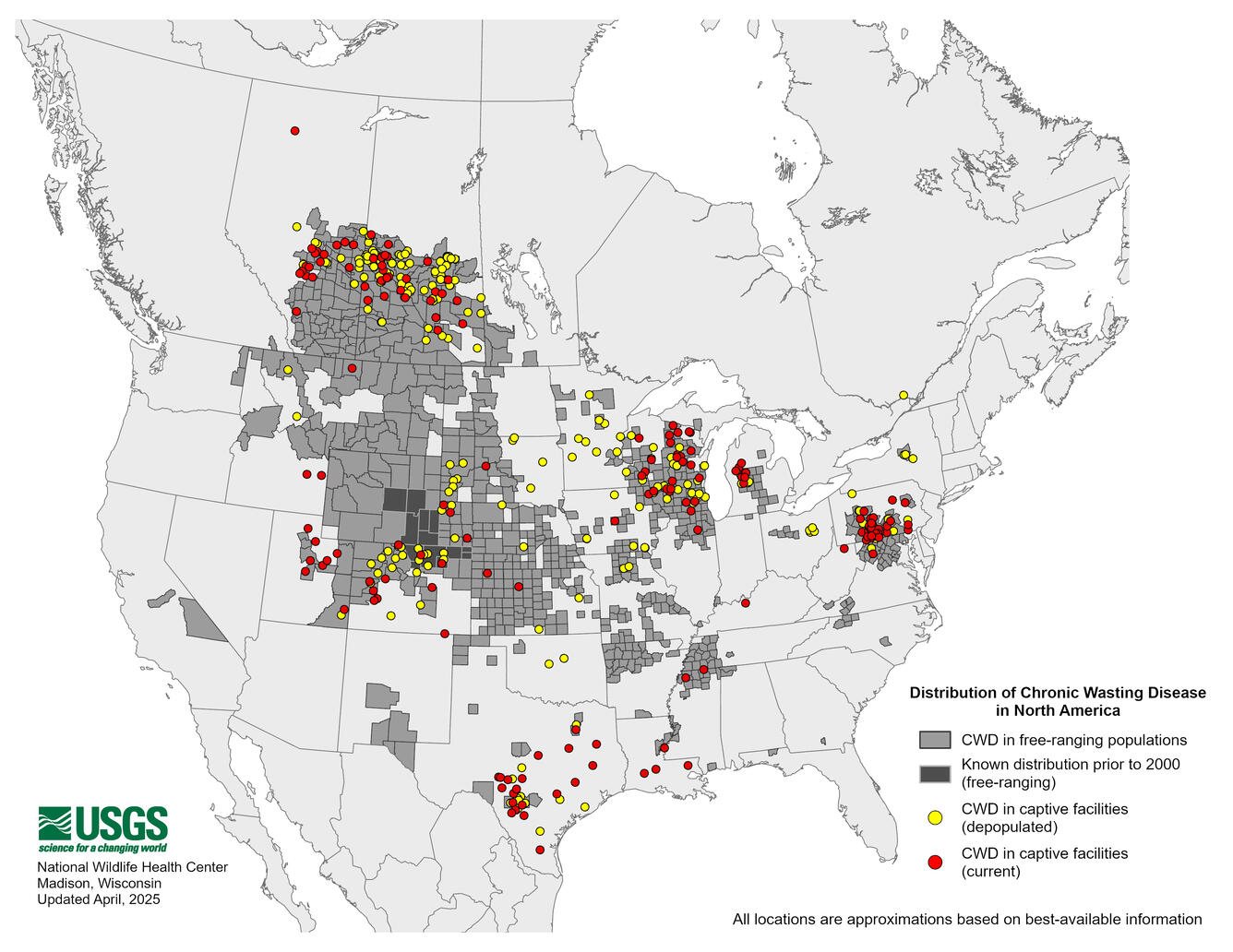
The USGS distribution map page, dated June 30, 2026, counts detections in 37 US states and five Canadian provinces, in free-ranging cervids, captive cervid facilities or both. Its animated map shows the spread from 2007 through 2024.
How fast is it moving? A USGS study of CWD spread reports that observed spread from 2005 through 2022 averaged about 14 miles a year. It ran faster in western regions, including Alberta, Saskatchewan, Colorado, Wyoming, Utah, North Dakota, South Dakota, Kansas, Nebraska and Montana, and slower in eastern regions, including Virginia, Pennsylvania, West Virginia, Michigan and Wisconsin.
Texas is on that map. Texas Parks and Wildlife says CWD was first found in a free-ranging mule deer in West Texas, near the Hueco Mountains, in 2012, and in a captive white-tailed deer in 2015. It now reports confirmed cases in captive and free-ranging white-tailed deer, mule deer, red deer and elk.
A release dated January 10, 2025, from the department and the Texas Animal Health Commission, announced the first confirmed case in Brown County, in a female white-tailed deer at a high-fence release site. In designated Texas zones, TPWD's after-harvest rules can require hunters to bring the intact, unfrozen head of a harvested deer to a check station within 48 hours.
The map changes as new cases are confirmed. Before a hunt, look at the current USGS map and at the wildlife agency for the state where you plan to take an animal.
Can zombie deer disease spread to humans?
The CDC's answer, dated January 21, 2026, has two parts. CWD infections in people have never been reported. And it is not known whether people can become infected.
Scientists are still studying the question. The CDC points to monkey studies involving meat or brain tissue from infected deer or elk, and says that if CWD could pass to people, eating meat from an infected animal would be the most likely route. APHIS, in its wildlife page dated January 13, 2026, also describes human transmission as unconfirmed.
Has anyone died of CWD? No human death from confirmed CWD has been reported, which follows from the CDC's statement that no human infection has ever been reported. The disease is fatal in the deer, elk and moose it infects, and part of the reason scientists keep studying the human question is that a related prion disease, BSE, has caused human illness.
That is why the agencies' advice centers on testing and on what goes into the freezer rather than on fear. No reported human case is the current record, and the precautions below are how hunters keep it simple.
Can you eat a deer with CWD?
No. The CDC says not to eat meat from an animal that tests positive for CWD. For deer taken in areas where CWD is present, it advises hunters to strongly consider testing before eating the venison and to follow the state wildlife agency's local instructions.
Cooking does not make a positive deer safe. The Minnesota Department of Natural Resources says CWD prions resist heat and freezing, and North Carolina Wildlife's CWD questions and answers, updated June 2023, say home cooking cannot make infected meat safe. Roasting, smoking and freezing all fall short; it takes incineration to render the prions noninfectious, and that leaves nothing to eat. A CDC study published in February 2025 detected CWD prions in raw, processed and cooked elk meat.
Two more points from the CDC's guidance: do not eat meat from an animal that looked sick or behaved strangely, and do not eat animals found dead. If a test comes back positive, the wildlife agency for that area is the place to ask what to do with the carcass. Colorado Parks and Wildlife, for example, publishes guidance on disposing of positive animals.
Testing a deer and dressing it in the field
CWD testing is generally done after the animal has been killed. APHIS says a definitive diagnosis uses tissue from the obex area of the brain stem or from the medial retropharyngeal lymph nodes in the neck, and official tests run at approved university, state or federal veterinary diagnostic laboratories.
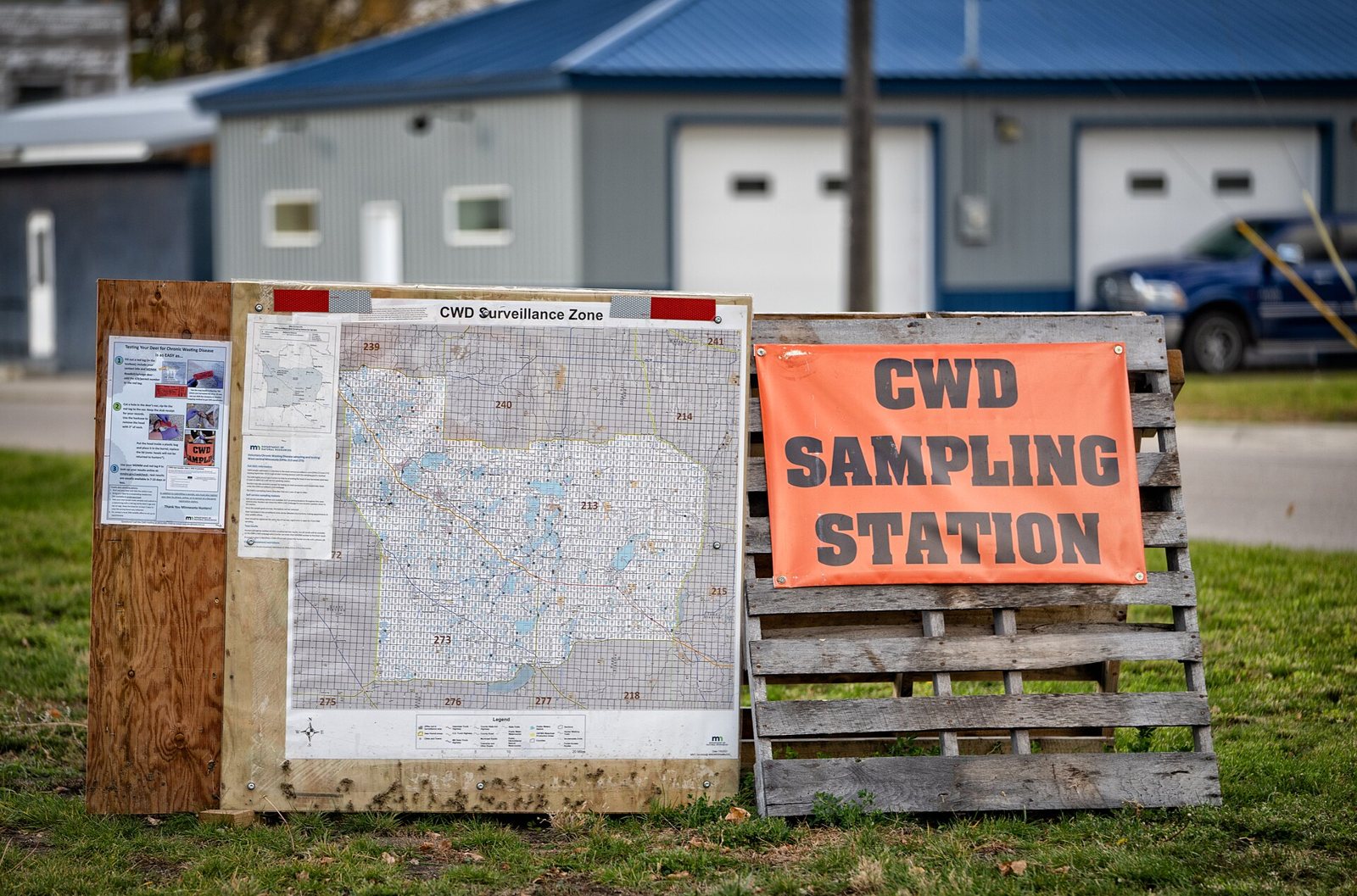
Whether you must test depends on where and when you hunt. Some areas require it; in others it is voluntary. The Minnesota Department of Natural Resources, for instance, publishes sampling instructions for its CWD control zone, and other states have their own systems. Check with the wildlife agency before the season starts. Terry Messmer, a wildlife specialist with Utah State University Extension, also answers hunters' common questions about the disease in the extension's Ask an Expert series.
The CDC's field advice is practical. Do not shoot, handle or eat an animal that looks sick or acts strangely. Wear latex or rubber gloves while field-dressing, avoid the brain and spinal cord, and keep your field-dressing tools separate from your kitchen knives. If a commercial processor handles your deer, ask for it to be processed on its own rather than mixed with other animals.
A hunter's CWD checklist
Tap a card to bring it forward.
- Know the local rules: Check the current wildlife agency rules for the place you will hunt.
- Testing: Find out whether CWD testing is required or recommended there.
- Sick animals: Do not shoot, handle or eat an animal that looks sick or behaves strangely.
- Gloves: Wear latex or rubber gloves while field-dressing.
- Brain and spine: Avoid the brain and spinal cord.
- Tools: Keep field-dressing tools separate from kitchen tools.
- Processing: Ask a processor to handle your animal individually.
- Positive test: Do not eat meat from an animal that tests positive.
- Skulls: Before moving a skull, remove all meat and brain tissue and confirm the rules of both states.
Moving a deer head, skull or antlers across state lines
This is where CWD meets the skull on your wall. Rules differ by state, by where the animal was taken and by CWD management zone. A whole head or an uncleaned skull may be barred from leaving an area, while a cleaned skull plate with the antlers attached is often allowed once all brain tissue, meat and other tissue are gone. A clean skull plate and a whole skull are treated as two different things.
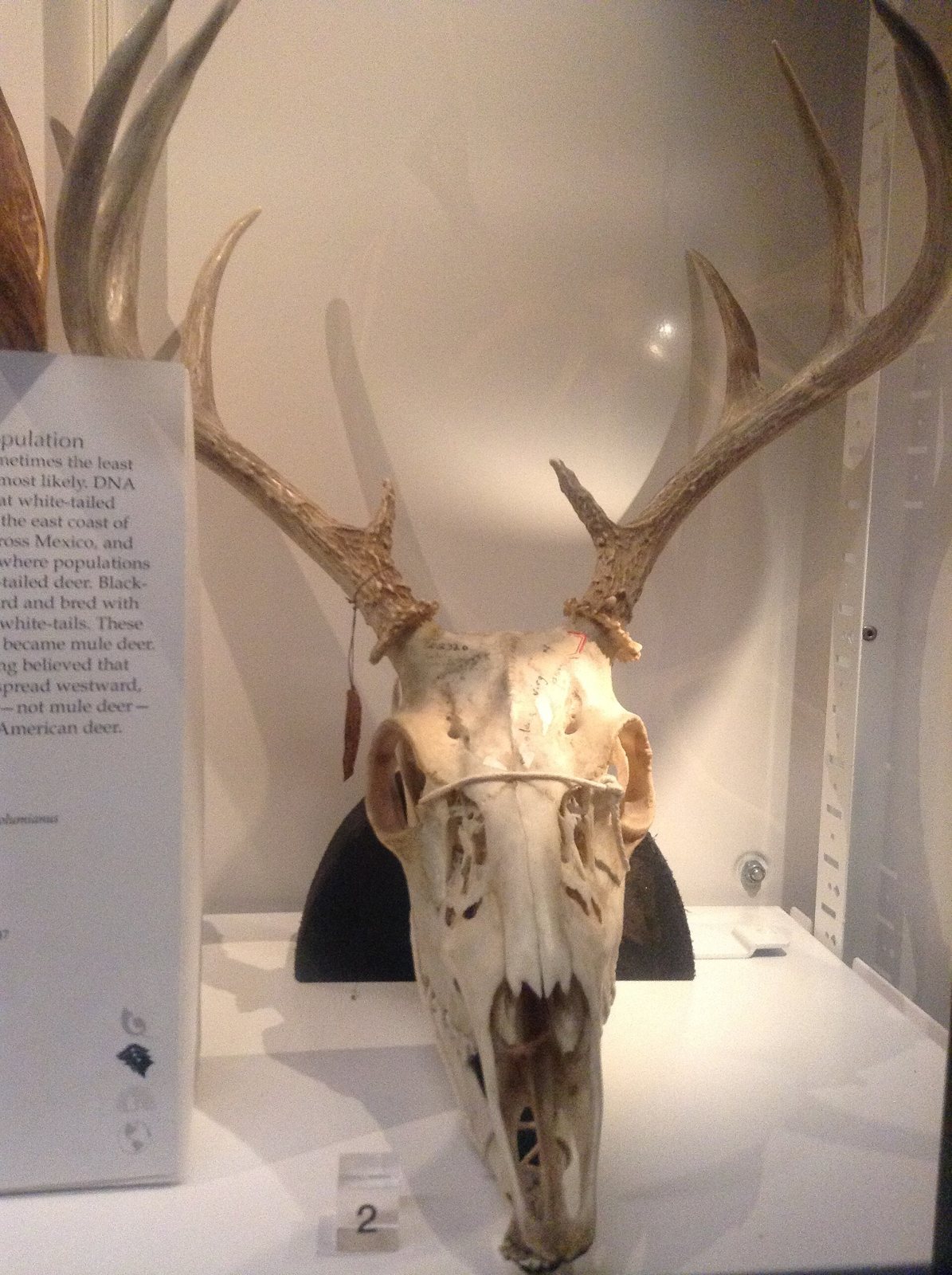
Two states show how the rules are written. The Wyoming Game and Fish Department's 2024 transportation guidance lets deer, elk and moose parts leave Wyoming as edible portions without the head or spinal column, cleaned hides without the head, skulls or skull plates and antlers cleaned of all meat and brain tissue, teeth, or finished taxidermy mounts. Whole carcasses may not leave the state.
Minnesota's current control-zone guidance lets antlers, or clean skull plates with antlers attached, leave the zone before a "not detected" test result comes back. Boned or cut-and-wrapped meat, quarters without the head or spinal column, hides and teeth may leave as well. In a Minnesota management zone, the carcass stays until a "not detected" result arrives.
Tap or hover a row to highlight it.
| Item | Wyoming, 2024 guidance | Minnesota control zone |
|---|---|---|
| ItemAntlers | Wyoming, 2024 guidanceAllowed once cleaned of all meat and brain tissue | Minnesota control zoneAllowed before a "not detected" result |
| ItemSkull plate with antlers | Wyoming, 2024 guidanceAllowed once cleaned of all meat and brain tissue | Minnesota control zoneClean skull plates with antlers attached allowed before a "not detected" result |
| ItemWhole carcass | Wyoming, 2024 guidanceMay not leave Wyoming | Minnesota control zoneIn a management zone, stays until a "not detected" result |
| ItemMeat | Wyoming, 2024 guidanceEdible portions without the head or spinal column | Minnesota control zoneBoned or cut-and-wrapped meat, or quarters without the head or spinal column |
| ItemHides | Wyoming, 2024 guidanceCleaned hides without the head | Minnesota control zoneAllowed |
| ItemTeeth | Wyoming, 2024 guidanceAllowed | Minnesota control zoneAllowed |
Many hunters want exactly that cleaned skull and rack for a European mount of a deer skull, and the cleaning itself is covered in our story on how to clean an animal skull. Plan the cleaning around the transport rules, not the other way around.
> Please read before you move a skull: This is general information and not legal advice. Wildlife transport and possession rules vary between states and countries and can change from one season to the next. Your state wildlife agency, and the US Fish and Wildlife Service where federal rules or lands are involved, can tell you what applies to your animal.
A skull you came across in the woods raises its own questions about land, species and state law. Our story on what to do when you have found an animal skull goes through them, and deer skull identification helps you work out which animal it came from.
Questions people ask about zombie deer
A few more questions come up often, with short answers.
What causes zombie deer disease?
Misfolded proteins called prions cause it, not a fungus or a virus. APHIS describes chronic wasting disease as a fatal prion disease of cervids, and infected animals can carry it through a long silent period before any signs appear.
Is the zombie deer real?
Yes, as a nickname: a "zombie deer" is a deer, elk or moose with chronic wasting disease in its late stages. It is not a new species or a literal zombie, just a sick animal showing weight loss, poor coordination and changes in behavior.
Can I bring a deer skull home from another state?
It depends on the rules of both the state where you hunted and the state you are driving to. Wyoming allows a skull, skull plate or antlers to leave once all meat and brain tissue are removed, and Minnesota allows clean skull plates with antlers attached in the situations its CWD guidance lists, so confirm the current rules before you travel.
Can dogs get CWD from eating deer parts or deer droppings?
No confirmed case of CWD in a domestic dog has been reported, and the CDC says CWD does not appear to naturally infect pets. Still, keep dogs away from deer carcasses, discarded organs, brain and spinal tissue and droppings, and never feed them meat or organs from a positive deer. Infected deer shed prions in feces, saliva and urine, and the Pennsylvania Game Commission notes that prions can pass through a coyote's digestive system and stay infectious, so a dog could carry them to new ground.
Does chronic wasting disease occur outside the United States?
Yes. The USGS map counts detections in five Canadian provinces as well as in 37 US states. In Mexico, a biosecurity manual from SEMARNAT, the federal environment ministry, lists chronic wasting disease as a prion disease of deer and moose.
Zombie deer disease quiz
Answer every question to check.
Chronic wasting disease is a serious problem for deer, elk and moose, and for the people who hunt them the steps are clear: check the local rules, test where it is advised, skip meat from any positive or sick animal, and clean a skull fully before it travels. If the deer skull on your wall has you wondering what it means to people, our story on deer skull meaning picks up from there, and deer skull tattoo meaning follows the same skull onto skin.
Terms in this story
Tap a term to see what it means.
Chronic wasting disease. A fatal prion disease of deer, elk and moose, usually shortened to CWD and nicknamed zombie deer disease.
---