

No. 334
The Camel Skull, and How to Tell It From a Horse Skull
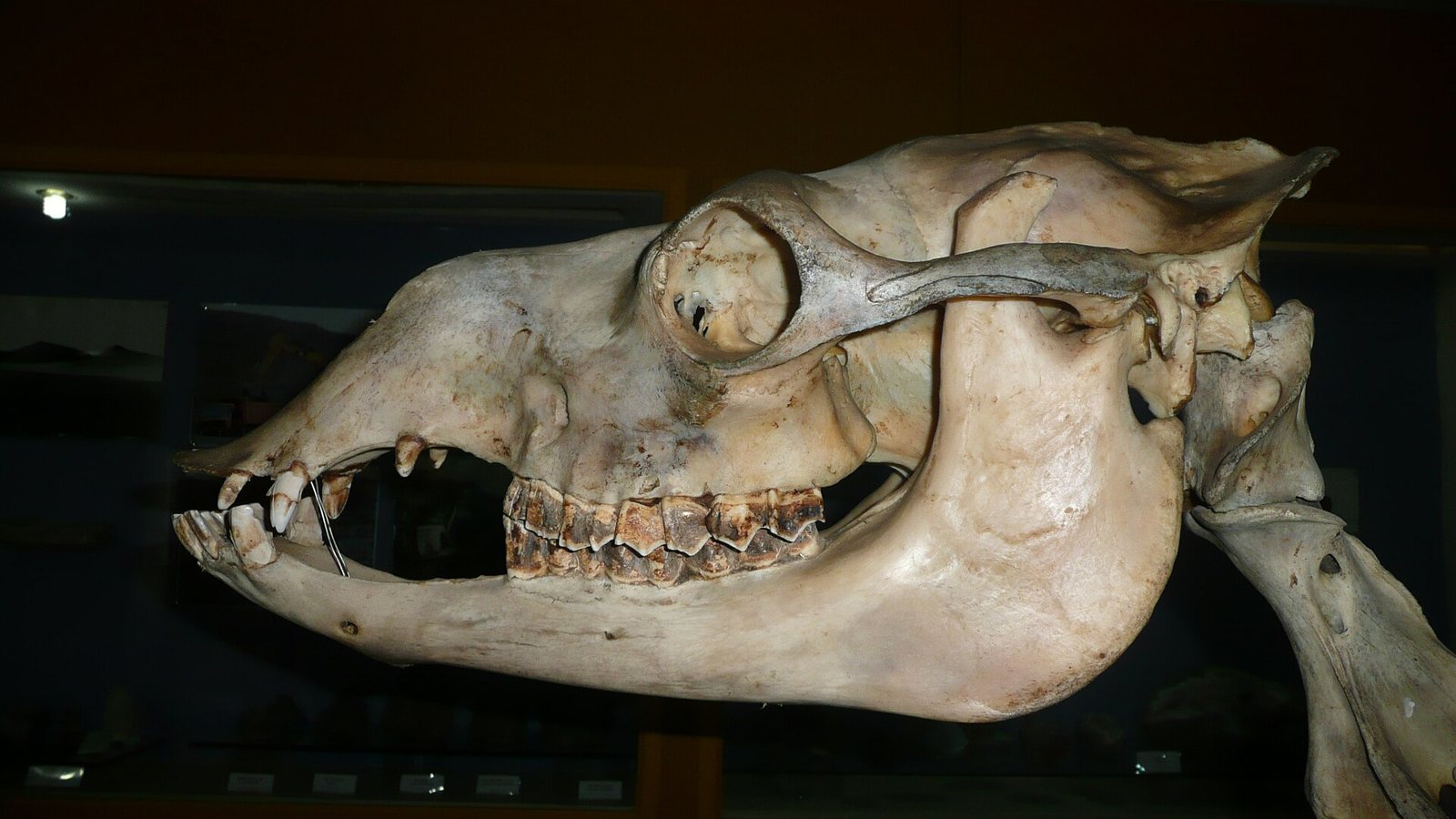
A camel skull has a long face, prominent eye sockets and, unusually, canine teeth in both jaws, plus just one pair of upper incisors. That holds for the dromedary, *Camelus dromedarius*, and the Bactrian camel, *Camelus bactrianus*.
The quickest way to tell a camel skull from a horse skull is to count the front teeth. A camel has one upper incisor on each side; a horse, *Equus caballus*, has three on each side in both jaws.
Those teeth give the camel skull its slightly fanged look, which is often what makes a desert-decor skull or a museum specimen stop people in their tracks. After the teeth and the horse comparison comes a twist in the camel's family history: the whole family started in North America.
What makes a camel skull look like a camel's
Start with the overall shape. A camel skull has a long facial region and prominent eye sockets. Along the upper jaw there is an elevated maxillary diastema, a raised gap between the front teeth and the cheek teeth, created partly by where the upper first premolar sits, according to a study of camelid chewing anatomy in the *Journal of Morphology*.
The teeth tell the rest. An adult dromedary generally has 34 permanent teeth, with the dental formula I 1/3, C 1/1, P 3/2, M 3/3, according to *The Camel*, a reference published by the International Livestock Centre for Africa. A dental formula counts the teeth on one side of the head, upper over lower: incisors, canines, premolars and molars.
Read that way, a camel has one upper incisor per side, three lower incisors per side, a canine in each jaw on each side, three upper and two lower premolars, and three molars top and bottom. The University of Texas runs DigiMorph, a digital collection that includes a scanned dromedary skull, if you want to turn one over on screen.
The fang-like teeth
The camel's front teeth are the part that surprises people. Adult camels have canine teeth in both the upper and the lower jaw, and in male camels those canines are especially prominent.
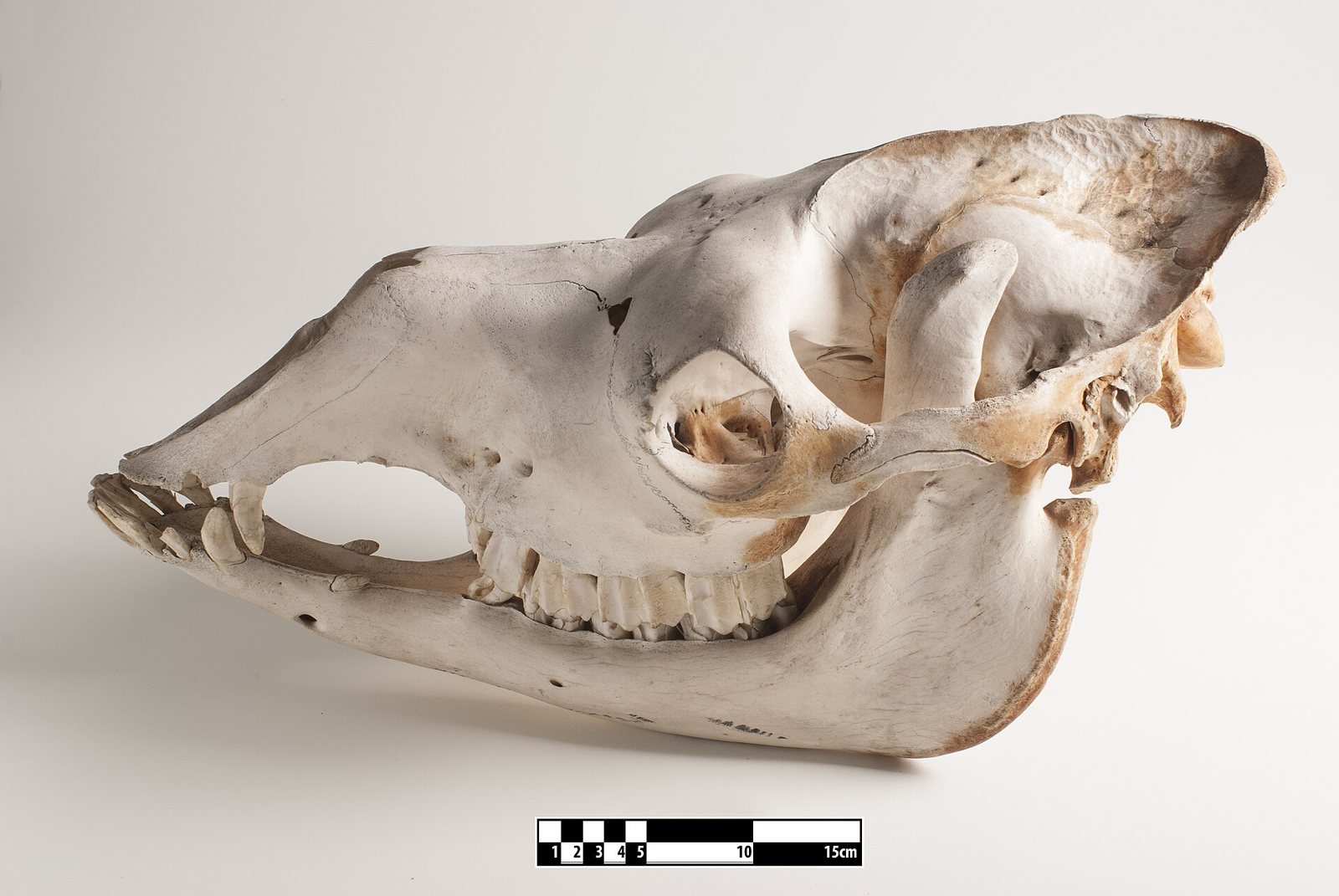
There is a second fang-look-alike behind them. The upper first premolar is caniniform, meaning shaped like a canine, so a camel skull can look as if it carries several fangs on each side. For a desert icon, it is an impressive set of points.
Upper incisors and canines in both jaws is an unusual combination among the camel's ruminant relatives, as *The Camel* notes. If you know the front of a goat skull or a sheep skull, the camel's upper teeth will look strikingly different.
Camel skull or horse skull?
Camel and horse skulls are both long and both belong to large plant-eaters, so they get mixed up, especially in desert decor and in photos. The front teeth settle most cases.
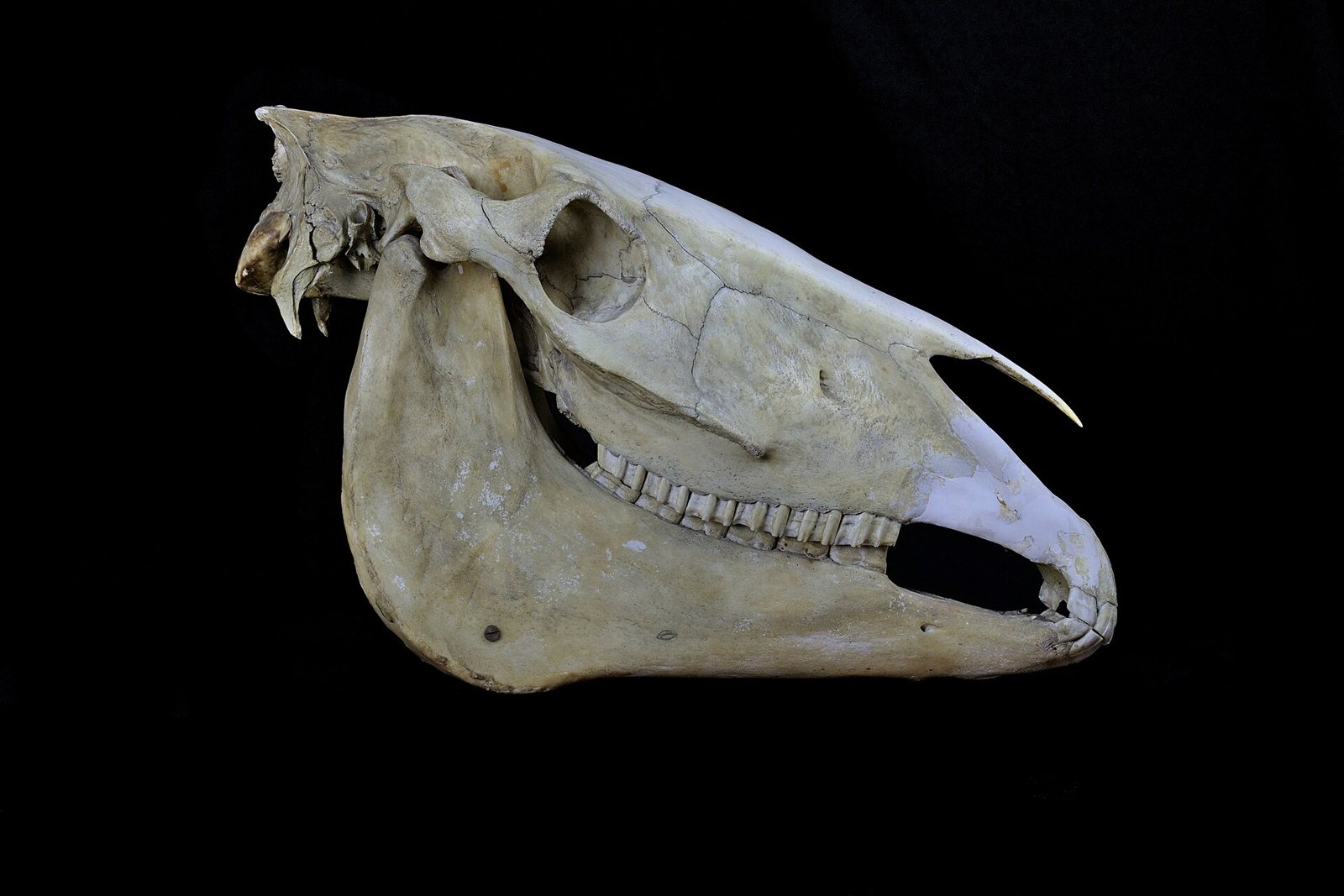
A horse, *Equus caballus*, normally has 36 to 44 teeth, depending on age and sex, according to the University of Michigan's Animal Diversity Web and the University of Florida IFAS publication *Equine Dental Care* (2025). A horse has three incisors on each side of both jaws. Its canines are vestigial or absent in females and more developed in males, as the Australian Museum describes.
Behind the front teeth, a horse has very high-crowned, complex cheek teeth built for grinding. Its nasal bones are long and narrow and project forward to points, and the orbit, the eye socket, sits far back behind the tooth row.
A camel, by contrast, has 34 teeth, one upper incisor per side, canines in both jaws, a caniniform upper first premolar and a long face with that raised gap in the upper jaw. One practical tip: count tooth sockets as well as teeth. Skulls lose teeth, and an empty socket still counts.
Tap or hover a row to highlight it.
| Feature | Camel, *Camelus dromedarius* or *Camelus bactrianus* | Horse, *Equus caballus* |
|---|---|---|
| FeaturePermanent tooth count | Camel, *Camelus dromedarius* or *Camelus bactrianus*Usually 34 | Horse, *Equus caballus*Usually 36 to 44, depending on age and sex |
| FeatureUpper incisors | Camel, *Camelus dromedarius* or *Camelus bactrianus*One per side, two in total | Horse, *Equus caballus*Three per side, six in total |
| FeatureLower incisors | Camel, *Camelus dromedarius* or *Camelus bactrianus*Three per side, six in total | Horse, *Equus caballus*Three per side, six in total |
| FeatureCanines | Camel, *Camelus dromedarius* or *Camelus bactrianus*Present in both jaws; prominent in males | Horse, *Equus caballus*Vestigial or absent in females, more developed in males |
| FeatureCheek teeth | Camel, *Camelus dromedarius* or *Camelus bactrianus*Premolars and molars, with a caniniform upper first premolar | Horse, *Equus caballus*High-crowned, complex grinding teeth |
| FeatureFace | Camel, *Camelus dromedarius* or *Camelus bactrianus*Long facial region with an elevated maxillary diastema | Horse, *Equus caballus*Long skull with long, narrow nasal bones |
| FeatureOrbit | Camel, *Camelus dromedarius* or *Camelus bactrianus*Prominent camelid eye socket | Horse, *Equus caballus*Eye socket far back behind the tooth row |
When a skull is damaged or comes from a young animal, no single feature is enough. Work through several together, and for a difficult specimen ask a museum osteologist or a veterinary anatomist to confirm it. Payal Jain's 2020 forensic study in the *Indian Journal of Veterinary Anatomy* is one example of the identification work done on camel skulls.
How to identify a camel skull
Tap a card to bring it forward.
- Count the upper incisors or their sockets: A camel has one per side; a horse has three per side.
- Look for canine teeth in both jaws: Camels have them in both jaws, and males have especially prominent ones.
- Check the upper first premolar: In a camel it is strongly caniniform, so it looks like an extra fang.
- Examine the cheek teeth: A horse's are tall, complex grinding teeth.
- Compare the nasal bones and eye sockets: A horse has long, narrow nasal bones and an eye socket far behind the tooth row.
- Use several features together: A damaged or young skull may not show every clue, so no single trait should decide it.
For what horse skulls have meant to people over the centuries, see horse skull meaning.
Dromedary or Bactrian camel?
Telling the two living camel species apart from the skull alone is harder, and it takes measuring. In a 2009 study in the *Journal of Camel Practice and Research*, Lei Zhu, Yiwei Luo, Xiuying Zhang and JianLin Wang measured Bactrian camel skulls. Adult male Bactrian skulls averaged 48.99 cm long and 22.27 cm across the widest point of the cheekbones.
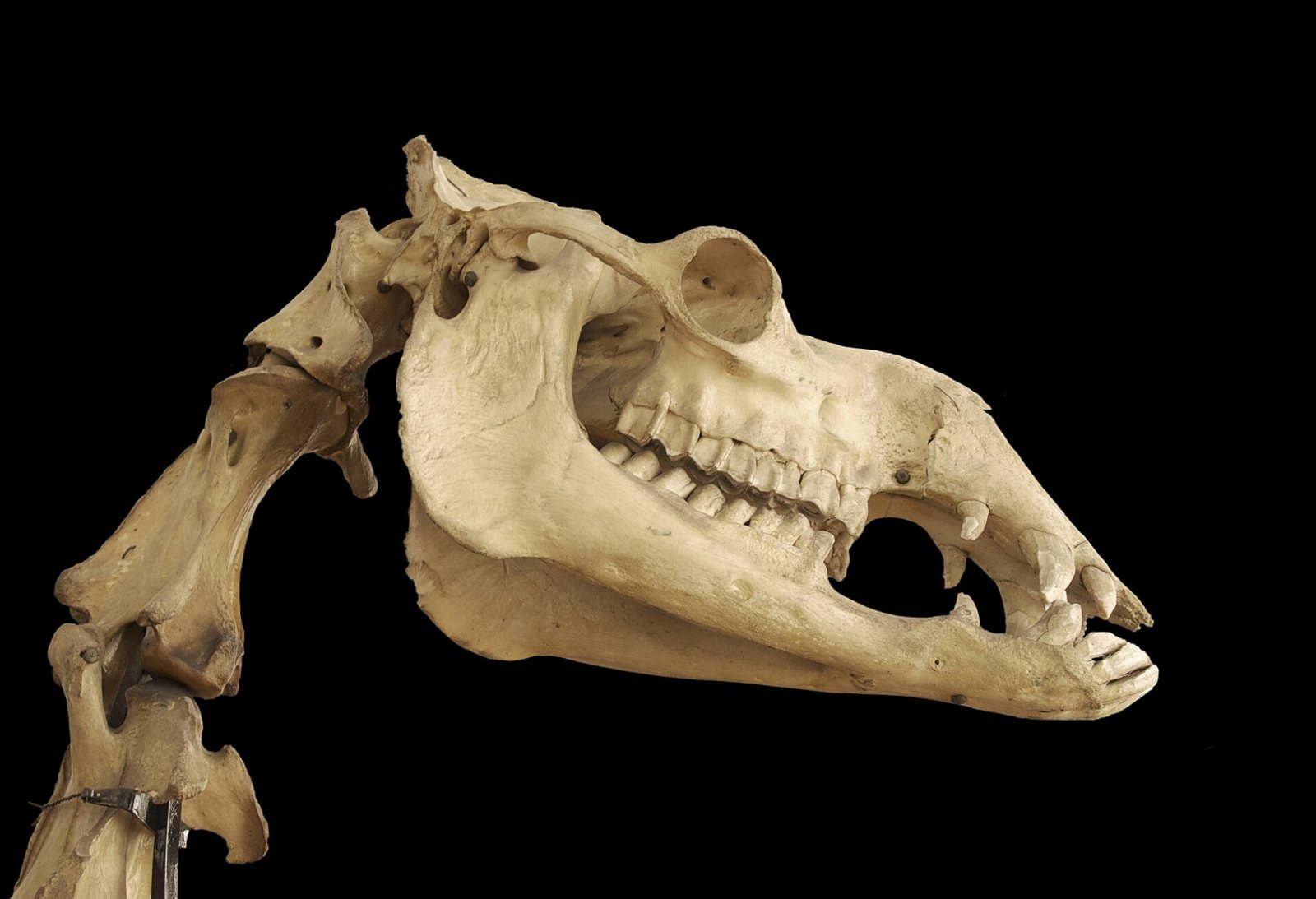
They found that overall skull length is close between the two species. The difference is in the proportions: the dromedary tends to have the longer face, while the Bactrian camel has the longer cranium, a nasion (a landmark at the top of the nose used in skull measurements) set farther back, and a shorter facial region.
Those differences shift from one population and specimen to another. Identifying the species reliably means taking several measurements rather than trusting one feature.
Camels began in North America
Today camels are tied in most minds to Africa and Asia, so this part surprises nearly everyone. According to the U.S. National Park Service article "The Camels", the camel family, Camelidae, first evolved in North America about 44 million years ago, during the Eocene.
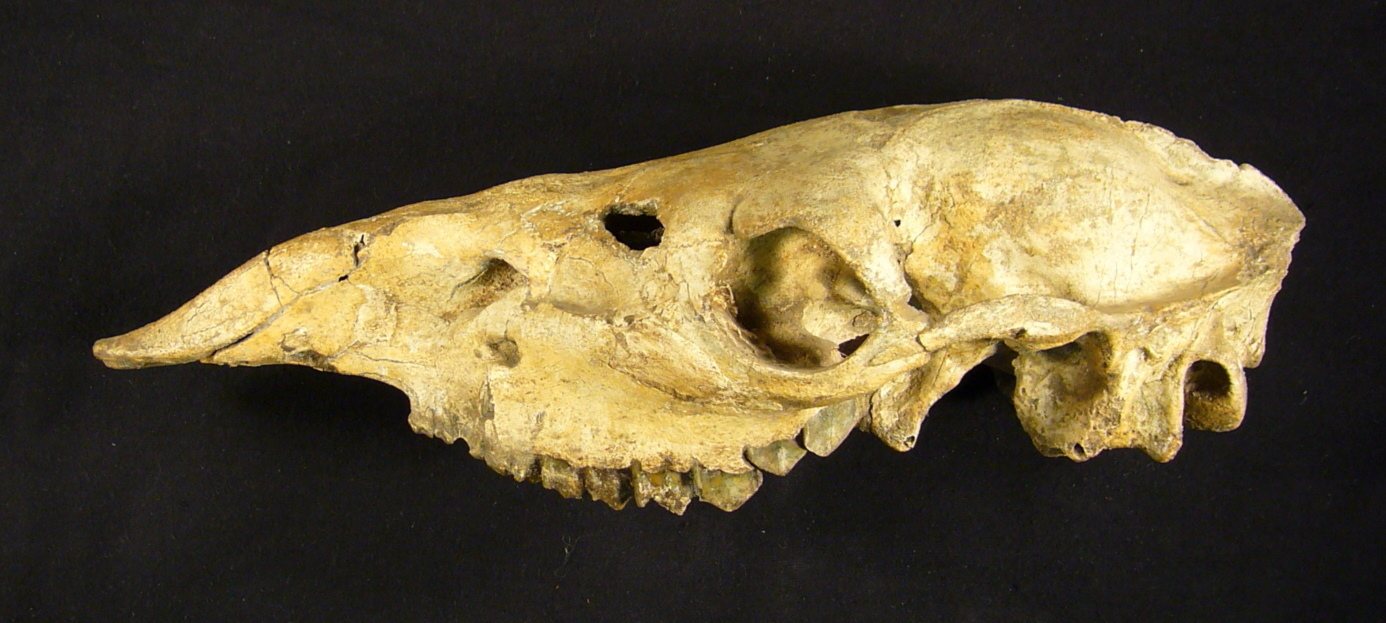
The family spread from there. About 7 to 6 million years ago, *Paracamelus*, an ancestor of the living Old World camels, crossed the Bering land bridge from North America into Eurasia. Other camelids reached South America, where later lineages gave rise to llamas, alpacas, guanacos and vicuñas.
Back home, camels kept going for millions of years. *Camelops* appears in the North American fossil record about 4 to 3 million years ago, and the National Park Service names *Camelops hesternus* as the last of the large North American camels. Its fossils range from Alaska and the Canadian Yukon south to Mexico. At Tule Springs in Nevada, *Camelops* fossils make up about 38 percent of the identified large Pleistocene mammals.
North America's camels died out near the end of the Pleistocene, and *Hemiauchenia*, a camelid described by the Florida Museum of Natural History, disappeared about 10,000 years ago. The Nat, the San Diego Natural History Museum, keeps a fossil camel field guide, and in 2015 Heintzman and colleagues published genomic data from *Camelops*. If you like Pleistocene skulls, the mammoth skull is another giant from the same period.
The camel family's long road from North America
Tap or hover a step to follow the order.
About 44 million years ago
The camel family, Camelidae, evolves in North America during the Eocene.
About 7 to 6 million years ago
Paracamelus, an ancestor of living Old World camels, crosses the Bering land bridge into Eurasia.
About 4 to 3 million years ago
Camelops appears in the North American fossil record.
Late Pleistocene
Camelops ranges from Alaska and the Yukon south to Mexico.
About 10,000 years ago
Hemiauchenia disappears from the North American record.
Where to see camel skulls
Museums hold camel skulls old and new. The Museum of Osteology in Oklahoma City displays a camel skull, photographed by JimJones1971 and shared on Wikimedia Commons. The Smithsonian's fossil *Procamelus* skull is shared on Wikimedia Commons as well.
On screen, the University of Texas DigiMorph dromedary skull was scanned from 706 slices at 0.30 mm spacing. For an older view, the National Gallery of Art holds a public-domain drawing, *Skeleton of a Camel*, by Teodoro Filippo di Liagno, with the skull clearly shown. Check opening hours and access with each institution before you plan a visit.
Finding or bringing home a camel skull
Most people meet camel skulls in museums or as decor, but some readers find skulls outdoors or come across one from abroad. This part is general information, not legal advice, and rules differ by place.
If you find a skull, the rules on removing and keeping it depend on the species, who owns the land and where you are. Ask the land manager and your state wildlife agency before you remove or keep it. Our story on what to do if you found an animal skull covers the first steps.
Bringing any animal skull into the United States is a separate question, and two federal agencies are involved: the USDA Animal and Plant Health Inspection Service (APHIS) and the U.S. Fish and Wildlife Service. The Fish and Wildlife Service counts animal parts as wildlife for import and export. Confirm the current requirements with both USDA APHIS and the Fish and Wildlife Service before importing any animal skull.
Camel skull questions
A few more questions tend to follow once the teeth are counted.
Do camels have canine teeth?
Yes. Adult camels have canine teeth in both the upper and lower jaws, and they are most prominent in males. The upper first premolar can also be strongly caniniform, which is why a camel skull can look like it has extra fangs.
How many teeth does a camel have?
An adult dromedary usually has 34 permanent teeth, with the dental formula I 1/3, C 1/1, P 3/2, M 3/3. That means one upper and three lower incisors, one upper and one lower canine, three upper and two lower premolars, and three upper and three lower molars on each side.
Did camels come from North America?
Yes. The camel family evolved in North America about 44 million years ago, according to the National Park Service. Ancestors of today's camels crossed into Eurasia over the Bering land bridge, and other camelids moved south, where llamas, alpacas, guanacos and vicuñas descend from later lineages.
Camel or horse?
Answer every question to check.
More big skulls to compare
A camel skull rewards a slow look, from the fangs at the front to the long face behind them, and it carries a family story that runs from Nevada and the Yukon all the way to Africa and Asia. For how animal skulls differ from ours, read human vs animal skulls. For other big skulls that turn up in desert decor, try cow skull meaning and bison skull meaning, and for another dental puzzle, see the pug skull, which fits a full set of dog teeth into a very short jaw.
Terms in this story
Tap a term to see what it means.
Dental formula. Shorthand for the number of incisors, canines, premolars and molars on one side of the upper and lower jaws; for an adult dromedary it is I 1/3, C 1/1, P 3/2, M 3/3.
---