
No. 253
Goat Skull: Goat or Sheep, How to Tell, and the Goat Skull in Art
To tell a goat skull from a sheep skull, start with the horn cores, the bony spikes the horns grew on. On a domestic goat, *Capra hircus*, they are usually long, narrow and less curved, often oval to almost triangular in cross-section with a sharp edge along the front. On a sheep they are generally shorter, more strongly curved and rounder in section.
That comparison comes from a PLOS One study of sheep and goat bones and matches the goat account at Animal Diversity Web. Breed, sex, age and damage can all change how a skull looks, so a complete skull with both horn cores gives you the best chance of a clear answer.
Then look at the mouth. An adult goat has no upper front teeth at all, only a tough dental pad, a feature it shares with sheep. And if your skull came with a story, from Georgia O'Keeffe's "ram" to Baphomet, the goat has a long history in art as well as on the farm.
What a goat skull looks like
Hold a goat skull in profile and it reads as long and fairly narrow. Two horn cores rise from the top of the head, above and behind the eye sockets. The face in front of the eyes is long, and the snout ends in an upper jaw with no front teeth. Instead the upper jaw carries a dental pad, a firm, toothless plate the lower front teeth press against.
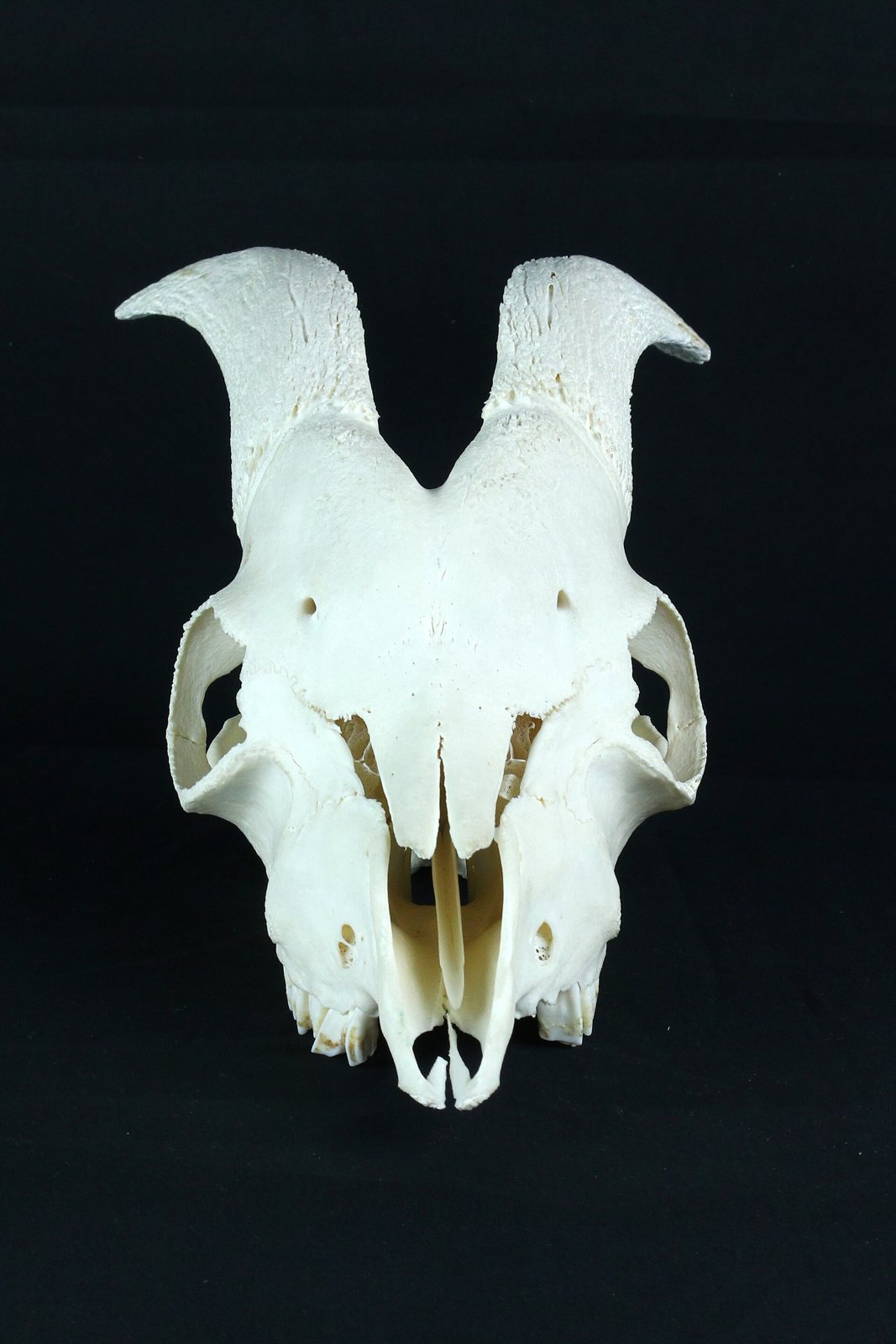
Behind the front teeth of the lower jaw there is a clear gap before the cheek teeth begin. Anatomists call that gap a diastema, and it is one of the easiest features to see on a cleaned jaw.
The horns themselves vary a great deal. Animal Diversity Web notes that horn form differs widely among breeds and between males and females, so a skull from a large billy goat can look very different from a doe's. If the keratin sheath, the horny outer covering, is still in place, you are looking at the horn itself rather than the bony core underneath.
Goat or sheep: start with the horn cores
The horn core is usually the most useful single feature. In goats it is longer, sharper and less tightly curved. In sheep it is generally shorter and more strongly curved, supporting horns that can form a tight spiral or coil. The PLOS One researchers put numbers on it: goats have higher ratios of horn-core length to outer curvature, while sheep have shorter, more curved cores.
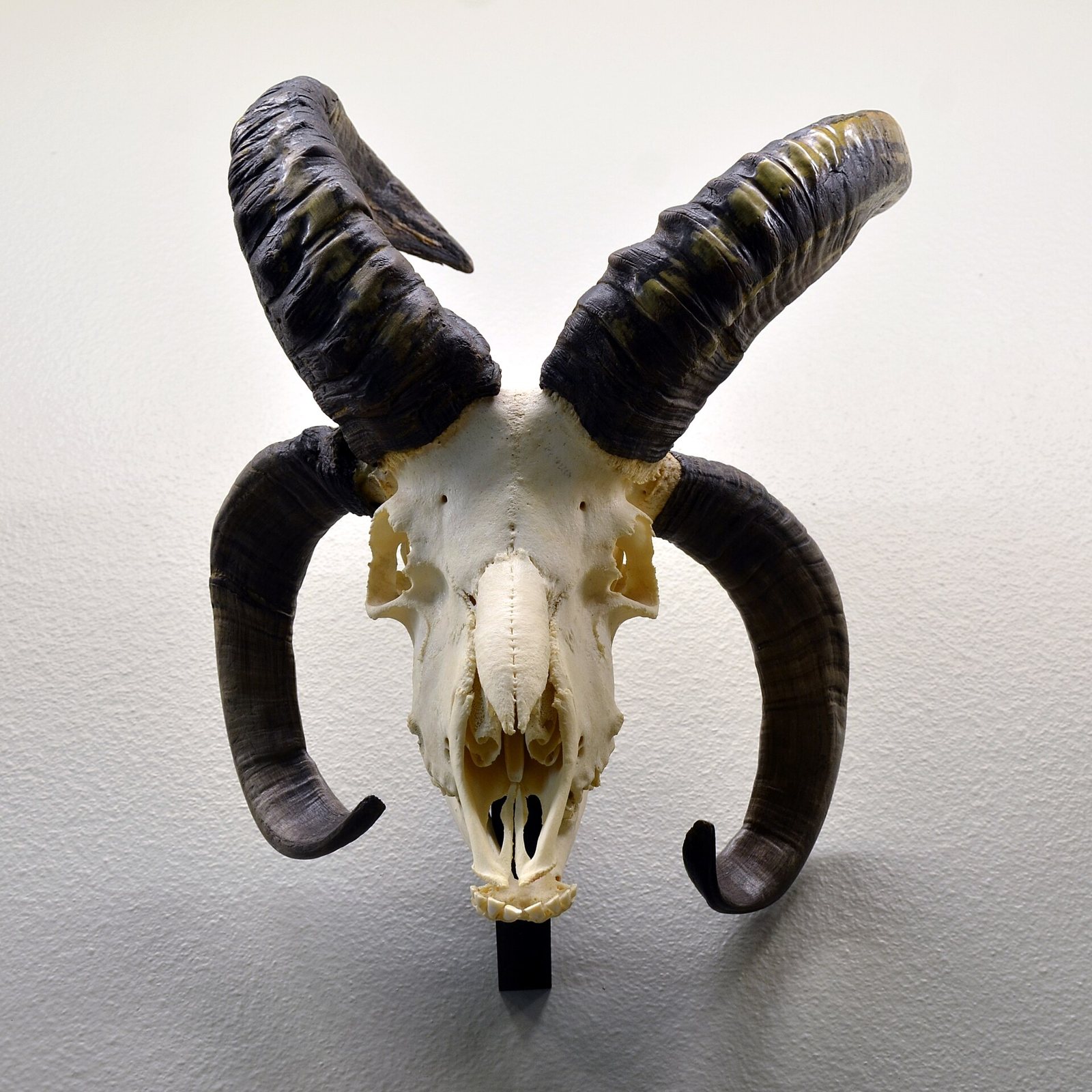
Cross-section helps too. If you could slice a goat horn core, it would usually be oval to sub-triangular, often with a sharp keel running along the front and outer side. A sheep core is closer to a circle.
Beyond the horns, zooarchaeologists, the specialists who identify animal bones from archaeological sites, compare a few finer details. These are tendencies, not rules, and they work best on a clean, complete skull. The coronal suture, the seam between skull bones running across the forehead, tends to bow forward at the bregma (the point where the seams meet on top of the head) in sheep and to run more nearly straight in goats. The lambdoid suture at the back shows the reverse tendency.
The area below the eye socket can help as well. The sub-orbital crest usually sits on the jugal, or cheek, bone in sheep, while in goats it lies toward the junction with the lacrimal bone near the inner corner of the eye. Sheep usually have a lacrimal fossa, a shallow pit in front of the eye socket, and goats generally lack one. The Historic England sheep and goat osteometry manual sets out how archaeologists record sheep and goat skull measurements.
Sheep and goats are close relatives, and incomplete skulls can be hard to separate. Nose shape alone will not settle it. If your skull is broken, missing its horn cores or simply puzzling, a natural history museum or a zooarchaeologist can compare it side by side with known specimens.
Tap or hover a row to highlight it.
| Feature | More typical of goat | More typical of sheep |
|---|---|---|
| FeatureHorn core | More typical of goatLong, sharp, less curved | More typical of sheepShorter, more strongly curved |
| FeatureHorn-core section | More typical of goatOval to sub-triangular, often keeled | More typical of sheepMore circular or sub-circular |
| FeatureFront of the upper jaw | More typical of goatNo upper incisors, dental pad | More typical of sheepNo upper incisors, dental pad (the same in both) |
| FeatureCoronal suture (specialist tendency) | More typical of goatMore nearly straight across the forehead | More typical of sheepOften bows forward at the bregma |
| FeatureLacrimal region (specialist tendency) | More typical of goatUsually lacks a lacrimal fossa | More typical of sheepLacrimal fossa commonly present |
| FeatureReliability | More typical of goatBest with a complete skull and horn cores | More typical of sheepBest with a complete skull and horn cores |
There is one more wrinkle. A "ram" is a male sheep, so a skull sold as a ram skull should be a sheep. Plenty of horned skulls get called ram skulls anyway, and our story on ram skull meaning looks at the ram itself and what its skull has stood for.
The teeth, and the missing top front row
Do goats have top teeth? Yes, at the back, and no, at the front. Cornell University's goat teeth fact sheet explains that adult goats have no upper front incisors. A tough dental pad fills that space, and goats grip plants by pressing their lower front teeth up against it. Farther back, the upper jaw has a full set of premolars and molars for grinding.
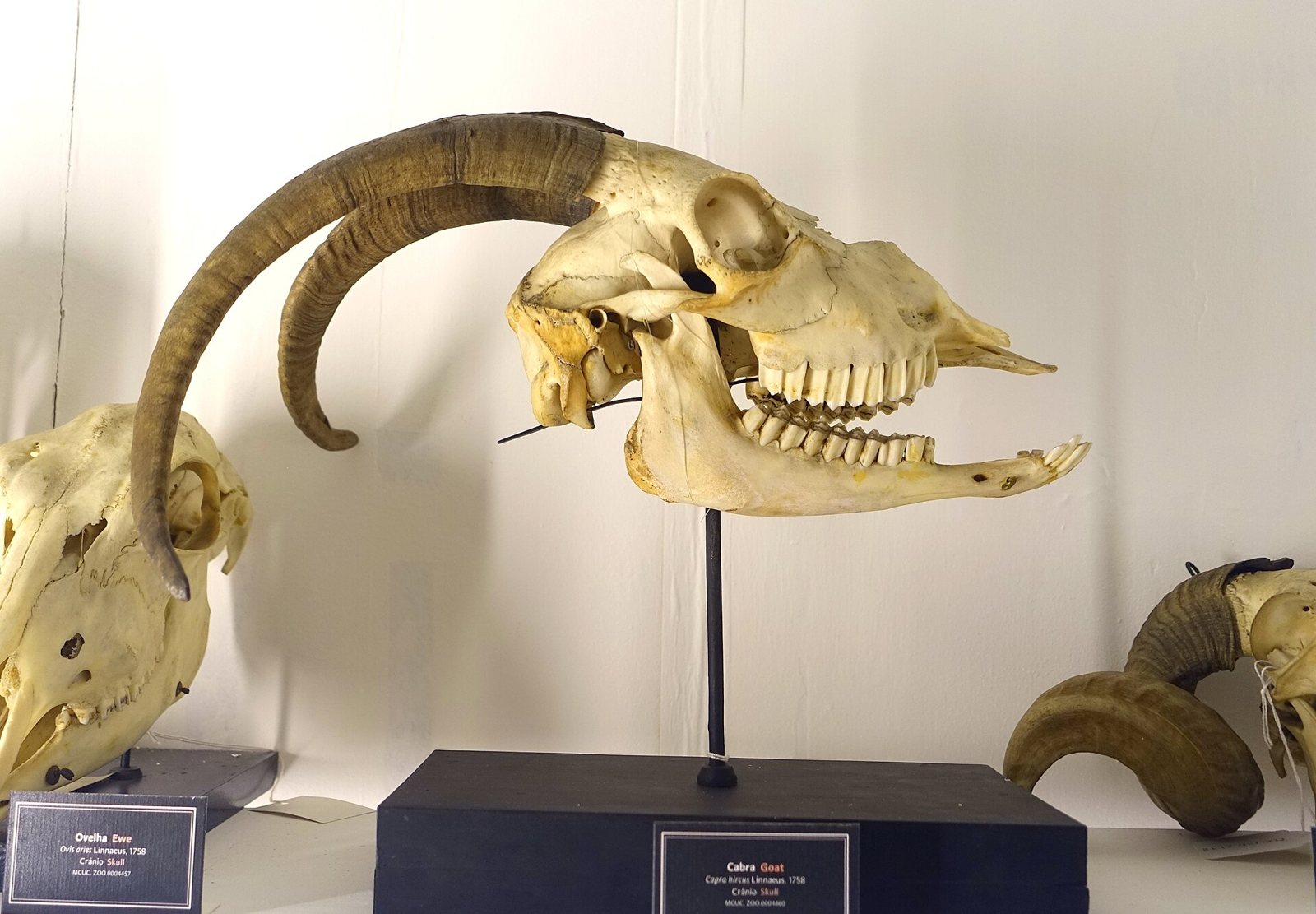
The usual permanent dental formula is 0/4 incisors, 0/0 canines, 3/3 premolars and 3/3 molars on each side, upper jaw over lower, which Cornell writes as 0033/4033. That adds up to 32 teeth. People often describe the lower front row as eight incisors, although, anatomically, the outermost pair are canines shaped like incisors. The University of Wisconsin's National Goat Handbook covers the same teeth.
Remember that sheep lack upper front incisors too, so the dental pad tells you that you have a goat or a sheep, not which one. For that, go back to the horn cores.
Wild goats and the ibex
Not every goat skull came from a farm. Ibexes are wild goats in the same genus, *Capra*. The Alpine ibex is *Capra ibex*, and the Spanish ibex is *Capra pyrenaica*. The American Museum of Natural History describes an ibex skull as carrying permanent horns made of a bony core inside a keratin sheath, the same basic build as a domestic goat's horns.
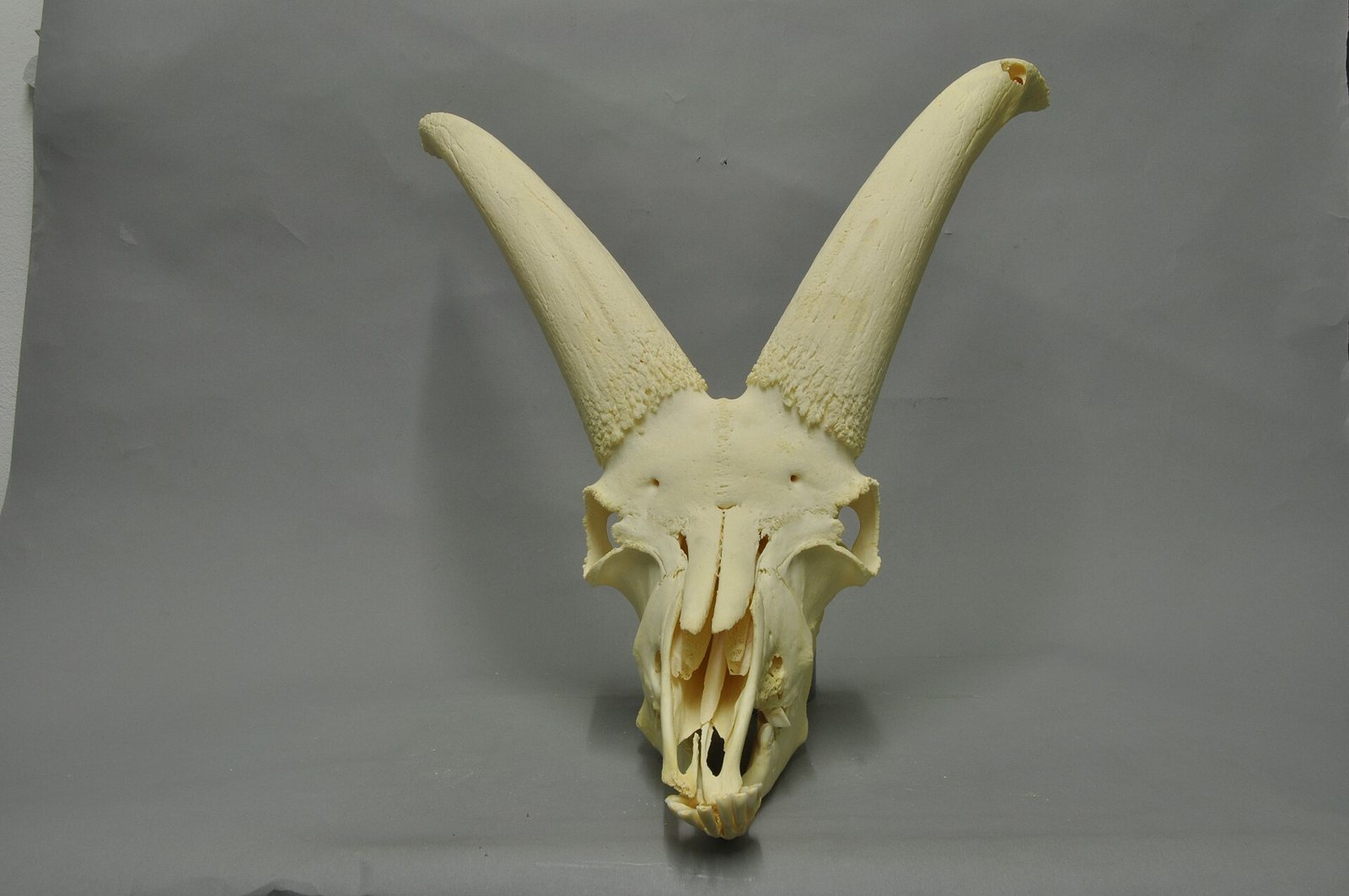
Adult male ibexes typically grow large, ridged horns that curve backward, while females have smaller horns. Museum collections hold ibex skulls from the Swiss Alps, Germany and other places, including an Alpine ibex skull and horns at the University of St Andrews. The CENIEH comparative anatomy collection in Spain includes a female Spanish ibex skull and lower jaw.
An ibex skull is a goat skull in the broad sense, but it is not a domestic goat skull, and the two are not interchangeable as comparisons. If those big ridged horns are on your skull, compare it with ibex specimens rather than farm goats.
Goat skulls and the first herders
Goat bones hold one of the earliest records of people keeping animals. Melinda A. Zeder, of the Smithsonian's National Museum of Natural History, and Brian Hesse reported in Science in 2000 that initial goat domestication was documented in the highlands of western Iran about 10,000 calibrated years ago.
Their evidence came from the ages and sexes of goats in archaeological bone collections. People selectively killed young males while keeping more females and mature males alive, the pattern of a managed herd rather than a hunt. At Ganj Dareh, that herding pattern appears about 9,900 calibrated years ago.
Later genetic work by Kevin G. Daly, Melinda Zeder and colleagues looked at remains from Ganj Dareh and Tepe Abdul Hosein in the Zagros Mountains. Their 2021 genome study placed management of genetically domestic goats at about 8200 BCE, at a time when the bones could still look wild. A domestic goat, in other words, did not immediately grow a domestic-looking skull. Archaeologists combine skull shape with mortality patterns, measurements, radiocarbon dates and genetics to tell wild from herded animals.
The goat skull in art
One well-known goat skull in American art hides behind another animal's name. Georgia O'Keeffe painted *Ram's Head, Blue Morning Glory* in 1938, and the Georgia O'Keeffe Museum later identified the skull that inspired it as a Spanish goat skull. The title says ram; the bone says goat. O'Keeffe was a painter, not a zoologist, and the museum's collection record for the painting keeps her title.
In works like this one, a goat skull becomes a study of bone, of the land around it, of mortality, form and renewal. Our story on O'Keeffe's skull paintings follows the bones through her work.
Baphomet and the goat's head
The goat's head also appears in occult imagery, most famously in one 19th-century drawing. Éliphas Lévi, a figure of 19th-century French occultism, published a goat-headed Baphomet in *Dogme et rituel de la haute magie* in the 1850s. The historian Julian Strube, writing in the journal Correspondences in 2016, argues that Lévi's image was a historically specific blend of magic, religion, science, politics and the "Astral Light," rather than simply "the devil."
Today a goat skull in a tattoo, a metal album cover, home decor or occult-inspired design may point to Baphomet, to change, wildness, death or personal identity, or simply to the visual power of horns and bone. Meaning depends on the person who made it and where it appears. There is no single meaning attached to every goat skull, and our story on skulls in witchcraft looks at the wider occult side.
Goat skulls through time
Tap or hover a step to follow the order.
About 10,000 calibrated years ago
Zeder and Hesse document initial goat domestication in the highlands of western Iran.
About 9,900 calibrated years ago
A herding pattern of culling young males and keeping females appears at Ganj Dareh.
About 8200 BCE
Genome evidence supports the management of genetically domestic goats in the Zagros Mountains.
1850s
Éliphas Lévi publishes his goat-headed Baphomet in Dogme et rituel de la haute magie.
1938
Georgia O'Keeffe paints Ram's Head, Blue Morning Glory, inspired by a Spanish goat skull.
If you found the skull yourself
Please take this as general information, not legal advice. Whether you can keep an animal skull depends on the species, the place and the person or agency that manages the land.
A goat or sheep skull on a farm edge or hillside most likely sits on someone's land, so ask the landowner or land manager before you pick it up. A wild species such as an ibex brings wildlife law into it, and the state or national wildlife agency is the one to ask. Our page on finding an animal skull explains how to work out who that is. Once you know the skull can stay with you, the skull cleaning guide covers the next step.
Goat skull questions
A horned skull on the table usually prompts a few more questions.
Does the nose shape prove a skull is a goat?
No, nose shape alone does not settle it. Sheep and goats are close relatives with similar faces, so the horn cores, the forehead seams and the area below the eyes, taken together on a complete skull, tell you far more.
Can you tell a goat skull from the eye sockets?
The region around the eye socket can help, but only as a tendency. Sheep usually have a shallow lacrimal pit in front of the eye socket that goats generally lack, and the ridge below the eye sits in a slightly different place, so check these alongside the horn cores rather than on their own.
Are the horns on a skull from a ram or a goat?
If the horn cores are long, sharp and only gently curved, they are more likely from a goat; if they are short and coiled in a tight spiral, they are more likely from a ram, the male sheep. Breed and age blur the line, which is why a damaged skull may need a museum's opinion.
Goat skull quiz
Answer every question to check.
Horns first, then the rest
A goat skull usually gives itself away through its horn cores: long, sharp, gently curved and often keeled, where a sheep's are short, round and tightly curled. The missing top front teeth tell you it is one of the two, the finer seams and pits help a specialist decide, and an ibex is a wild cousin with horns to match. If your horned skull leans more toward cattle or bison, our stories on cow skull meaning and bison skull meaning pick up the trail.
Terms in this story
Tap a term to see what it means.
Capra hircus. The scientific name of the domestic goat.
---