

No. 323
The Pug Skull: Why a Flat-Faced Dog's Skull Is So Short
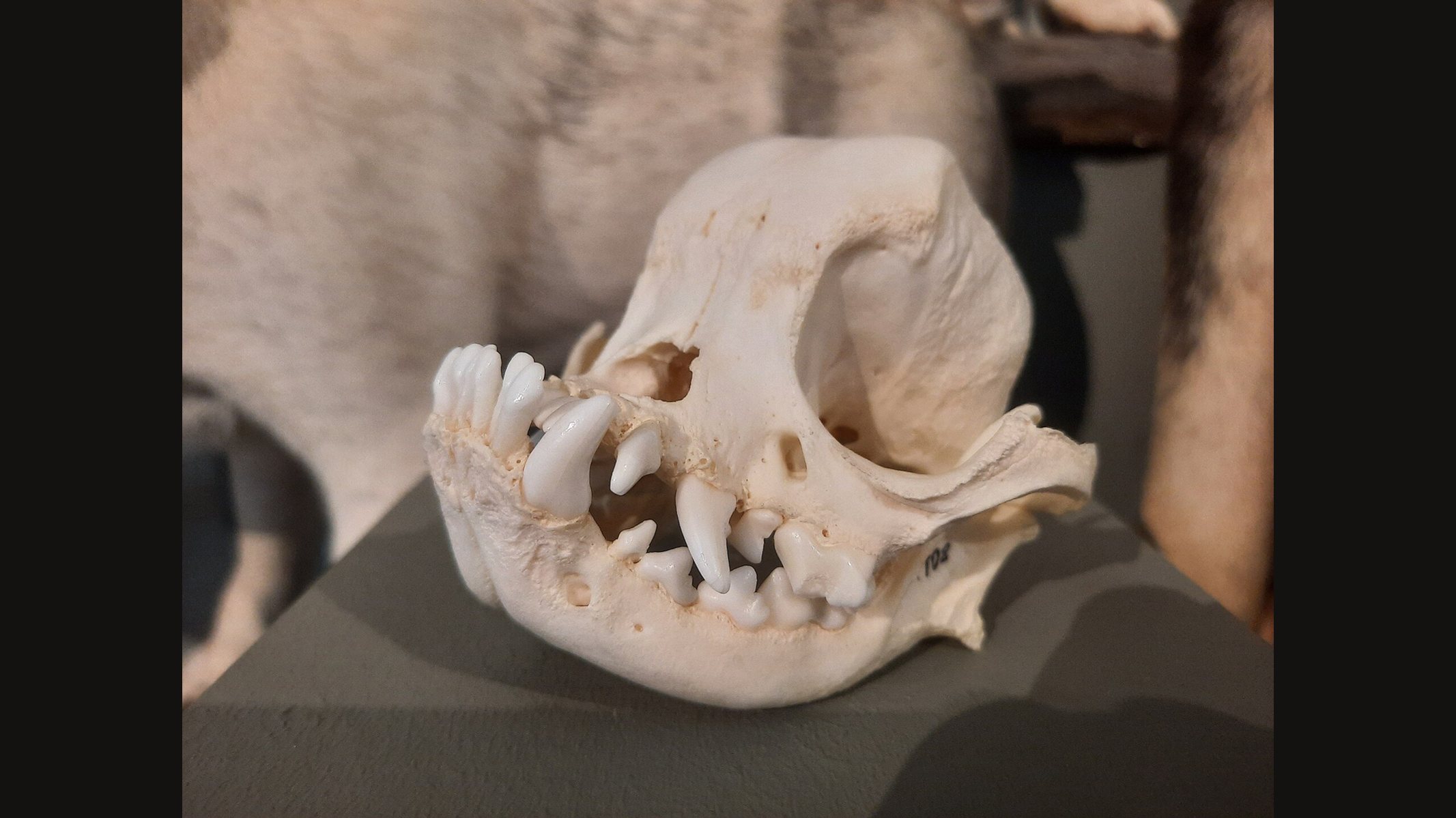
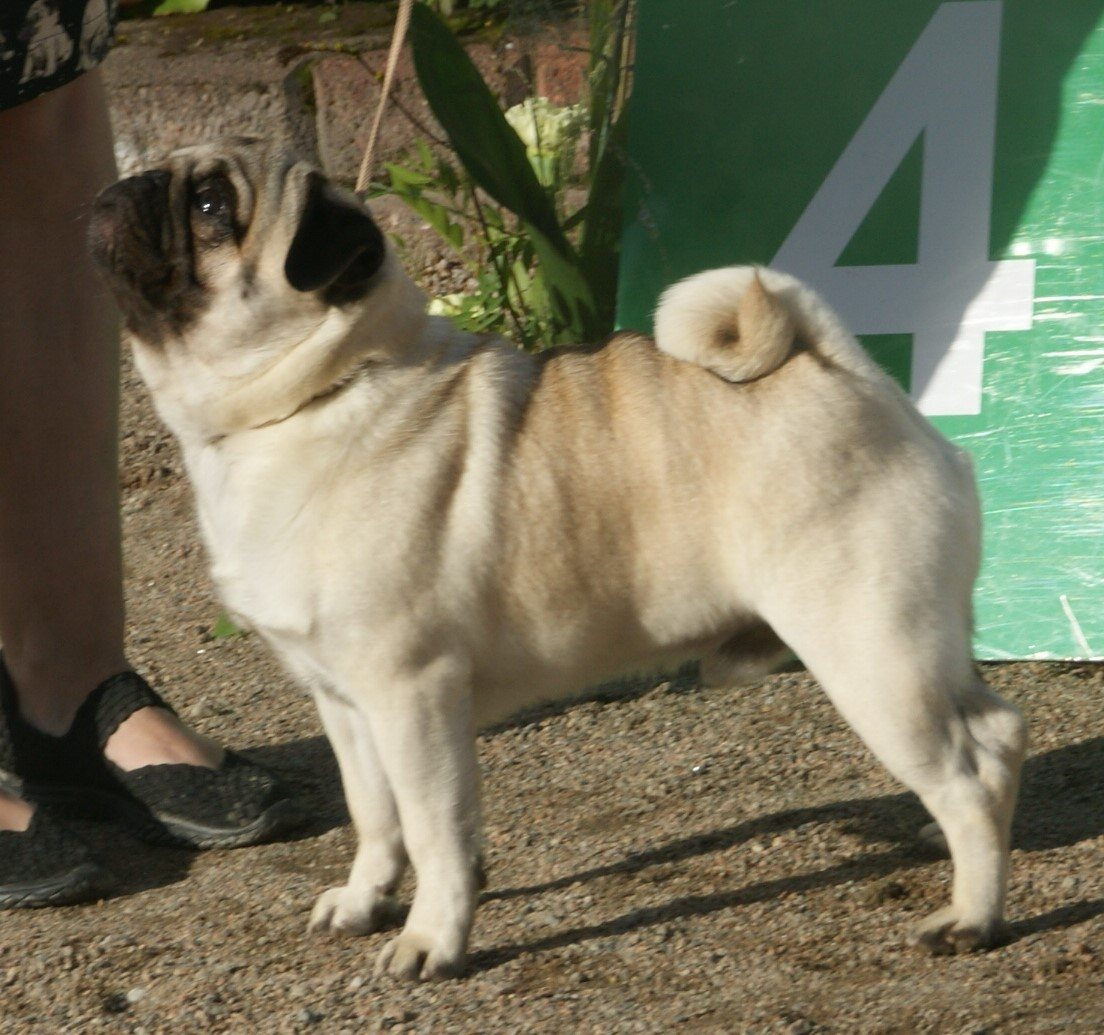
A pug's skull is short because the pug, *Canis lupus familiaris*, has been bred for a brachycephalic, or short-headed, shape. The muzzle bones are shortened, while the braincase behind them stays broad and rounded, as Schoenebeck and Ostrander describe in *PLoS Genetics*.
Set beside a long-nosed dog or a wolf, a pug skull has a much shorter muzzle, wider cheekbones and shallow, forward-facing eye sockets. It still carries the same 42 adult teeth as other dogs, according to the MSD Veterinary Manual.
That short face leaves less room for two things in particular, the teeth and the airway. Both follow from the bone, and both are worth understanding whether you share your sofa with a pug or a French Bulldog, or you just saw a pug skull photo and did a double take.
Short, medium and long dog skulls
Veterinarians sort dog skulls into three broad shapes. A brachycephalic skull is short and broad, with a greatly shortened face; the pug is the classic example, alongside French Bulldogs and Bulldogs. A mesocephalic, or mesaticephalic, skull has middle proportions, as in a Labrador Retriever or a Beagle, and the gray wolf, *Canis lupus*, is generally placed here too. A dolichocephalic skull is long and narrow, as in a Greyhound.
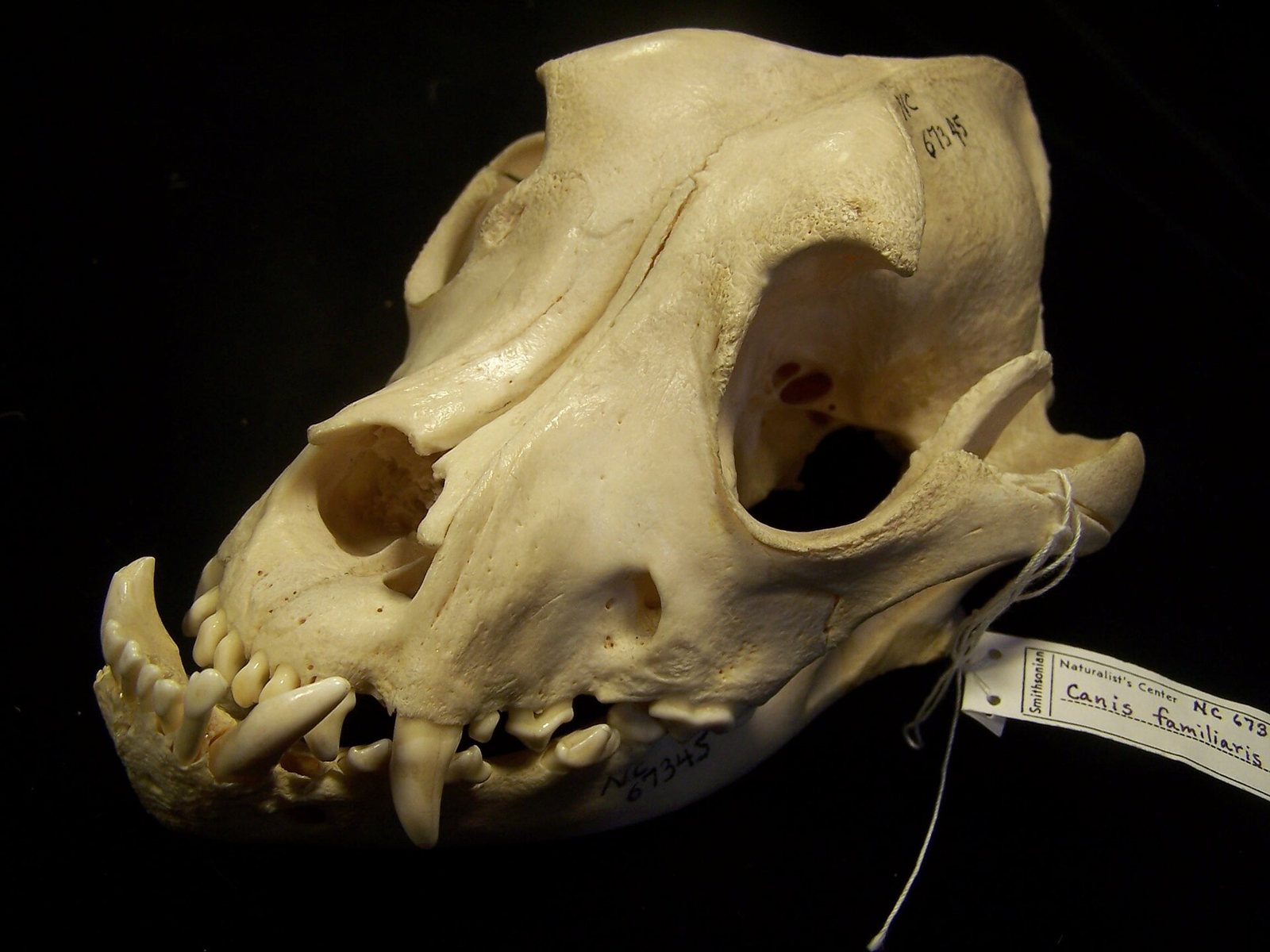
The measurement behind those labels is the cephalic index: skull width divided by skull length, multiplied by 100. There is no single official cutoff. One recent veterinary study, by Moraes and colleagues in *Veterinary Sciences* in 2025, called a dog dolichocephalic below 55%, mesocephalic from 55% to 80% and brachycephalic above 80%. An anatomical study by Wagner and colleagues used a breadth-to-length index instead, with 0.84 or higher as brachycephalic and 0.65 or lower as dolichocephalic. The categories are useful; the exact lines depend on the study.
Tap or hover a row to highlight it.
| Skull type | What it looks like | Example | Measurement used in one veterinary study |
|---|---|---|---|
| Skull typeBrachycephalic | What it looks likeShort, broad skull with a very short face | ExamplePug, *Canis lupus familiaris* | Measurement used in one veterinary studyCephalic index above 80% |
| Skull typeMesocephalic or mesaticephalic | What it looks likeMiddle proportions | ExampleLabrador Retriever, Beagle, gray wolf, *Canis lupus* | Measurement used in one veterinary studyCephalic index 55% to 80% |
| Skull typeDolichocephalic | What it looks likeLong, narrow skull with a long muzzle | ExampleGreyhound, *Canis lupus familiaris* | Measurement used in one veterinary studyCephalic index below 55% |
Pug, long-nosed dog and wolf, side by side
"Normal dog skull" is a slippery phrase, because domestic dogs run from very long-nosed to very short-faced. The useful comparison is with a specific dog.
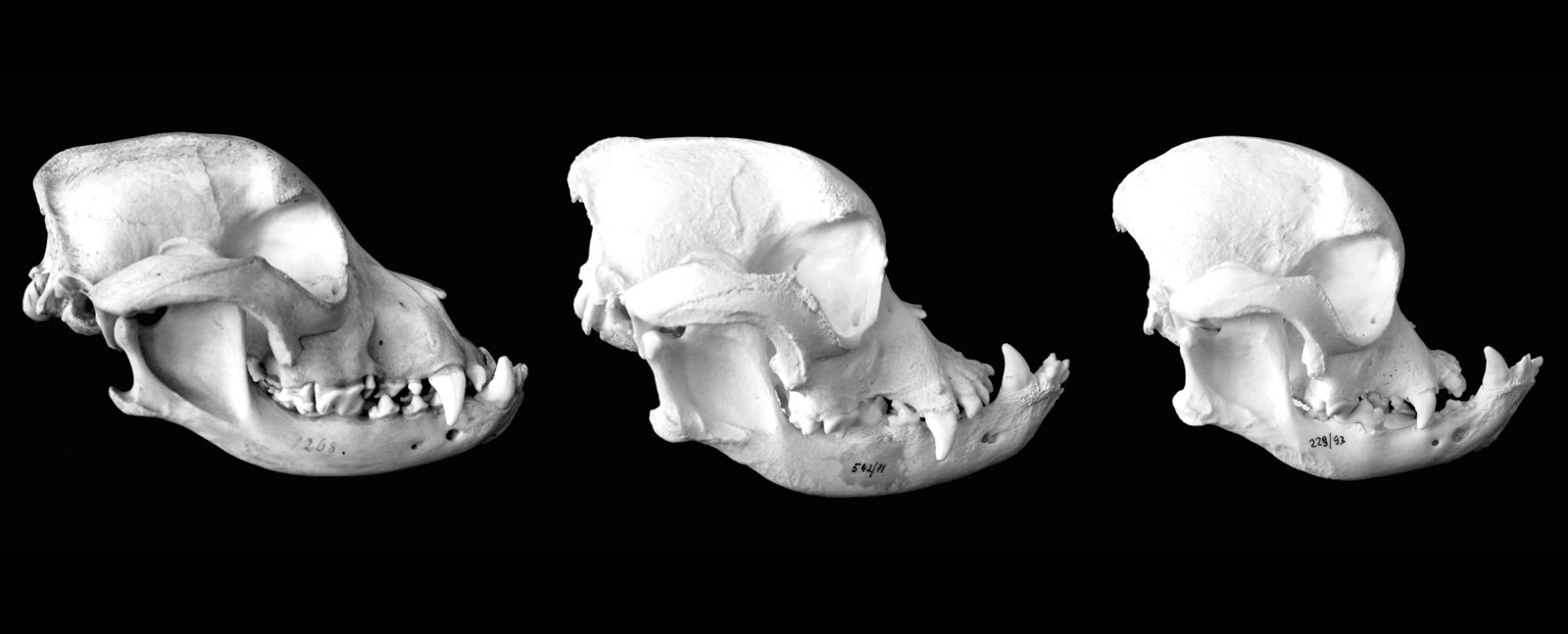
Against a Greyhound, the pug skull looks almost folded. The pug has a very short muzzle, shortened nasal and maxillary bones, a broad cranium, wide zygomatic arches (the cheekbones) and a rounded braincase. The Greyhound's rostrum, the snout part of the skull, is long and narrow, and the whole skull is proportionally longer and less broad. The wolf has a much longer, more all-purpose muzzle than the pug, which is why Schoenebeck and Ostrander use wolf and pug skulls to show how far dog breeds have moved from their wild ancestor.
One image on Wikimedia Commons makes the point at a glance. Dmccabe's photograph lines up the skulls of a pug, Boxer, Rottweiler, wolf, Collie and Standard Poodle from shorter to longer, and the pug sits at the far end like a punctuation mark.
Size alone will not tell a dog from a wolf, though. The San Diego Natural History Museum compares canid skulls by size, shape and teeth together, and large domestic dogs overlap wolves in size. A 2016 study by Janssens and colleagues tested the angle of the eye socket as another way to separate them. For the full identification process, see our dog skull identification and wolf skull stories.
The eye sockets
The eyes are the first thing many people notice in a pug's face, and the skull explains why. CT scans in a 2024 study of breed-specific skull shape show that brachycephalic dogs have shallow, wide orbits, the bony sockets that hold the eyes. Their rims project forward and outward, so the eyes sit more prominently and face more to the front.
Dolichocephalic dogs have deeper orbits set into a longer facial skeleton. On a bare skull, this is one of the easiest differences to see: a pug's eye sockets look like wide, shallow bowls near the front of the face, rather than deep hollows halfway along a long snout.
Do pugs have a full set of teeth?
Yes. An adult pug has the standard canine set, usually 42 permanent teeth, with the dental formula I 3/3, C 1/1, P 4/4, M 2/3. That works out to 12 incisors, 4 canines, 16 premolars and 10 molars, per the MSD Veterinary Manual, and puppies start with 28 deciduous teeth before the adult set arrives.
The difference is space. A pug's maxilla and mandible are shorter, so the same 42 teeth have less jaw to fit into. The UC Davis School of Veterinary Medicine, the MSD Veterinary Manual and VCA describe crowding, overlapping and rotated premolars in brachycephalic and small breeds, along with teeth that erupt abnormally or stay partly embedded, and baby teeth that hang on after the adult teeth come in.
A rotated tooth is a neat illustration of the geometry. When the dental arch is too short for the normal row of teeth, a premolar can turn partly sideways to fit. On a skull, that shows up as teeth set at odd angles along the jaw.
Crowding also creates narrow gaps where food and plaque collect, which raises the risk of gum disease. None of this is anyone's fault; it comes with the shape of the jaw. A pug with missing, visibly displaced or painful teeth should be seen by a veterinarian, and the same goes for an owner who wants their own dog's dental x-rays explained.
What the skull shape has to do with breathing
The same short skull also shapes the airway. The University of Cambridge BOAS Research Group studies brachycephalic obstructive airway syndrome, or BOAS, a breathing disorder linked to short-headed dogs.
The key point is about proportion. When the bony muzzle gets shorter, the soft tissues inside the nose and throat do not necessarily shrink to match, as Cambridge's pathophysiology notes explain. That can leave relatively bulky nasal turbinates (the scrolls of tissue inside the nose), a thick or elongated soft palate, enlarged tonsils and narrowed passages, all packed into a smaller space. Cambridge researchers describe obstruction that can involve the nostrils, nasal cavity, turbinates, soft palate, pharynx and larynx.
In pugs, narrowed nostrils, blocked nasal passages, a thick or long soft palate and later changes in the larynx can make breathing harder work. Harder breathing pulls soft tissue inward, which can narrow the airway further. Dogs also pant through that same airway to cool down, so UC Davis notes that affected dogs can struggle to regulate their temperature in heat or during exercise.
Noisy breathing is not automatically harmless just because a dog is a pug. If you are worried about your dog's breathing, ask your vet for an assessment; that is the person who can look at your own dog.
What a short skull changes
Tap a card to bring it forward.
- Muzzle bones: The nasal and maxillary bones are shortened, while the braincase stays broad and rounded.
- Eye sockets: The orbits are shallow and wide, with rims that project forward and outward.
- Teeth: The usual 42 adult teeth fit into shorter jaws, so they can crowd, overlap or rotate.
- Airway: Soft tissues inside the nose and throat may not shrink with the bone, which can narrow the passages.
How the pug's face changed
Pugs have not always looked exactly the way they do now. In 2021, Wagner and colleagues published a study in *The Anatomical Record* of nine pug skulls held in European collections. Seven represented older types, dating from before 1883 through 1948, and two from the 1990s represented modern types. The authors report that pug snout length changed markedly from the mid-19th century onward.
The sample is small and uneven across the decades, so it does not give a year-by-year rate of change. What it does show is that some modern pug skulls are more extremely short-faced than some older pug skulls, and that the breed's muzzle length shifted a great deal while the modern breed was taking shape.
Breed standards helped hold that look in place. A 2015 review by Packer and colleagues records the Kennel Club describing the pug muzzle as "relatively short, blunt, square" and the American Kennel Club as "short, blunt, square." The same review links selection for short muzzles with BOAS risk.
Pug skulls in the museum record
Tap or hover a step to follow the order.
Mid-19th century onward
Wagner and colleagues report a marked change in pug snout length from this period.
Before 1883
Several older pug skulls in the study come from the Museum für Naturkunde Berlin sample.
1904
One pug specimen in the study's historical sample dates from this year.
1948
The older-type pug skulls in the study extend through this date.
1990s
Two modern-type pug skulls in the study come from this decade.
2021
Wagner and colleagues publish comparative measurements of historical and modern-type pug skulls.
Seeing a pug skull, or finding one
If you want to see the real thing, a pug skull photographed by Chris Dodds at the Osteology Museum of Oklahoma in 2012 is shared on Wikimedia Commons under a CC BY-SA 2.0 license. The University of Zürich Zoological Museum also lists a pug skull, specimen ZMUZH 10166, in its records on MorphoMuseuM. Check opening hours and access with each museum before planning a visit.
Coming across a dog skull outdoors is a different matter from viewing one in a museum. This is general information, not legal advice: rules on picking up and keeping animal remains differ by country, state and land owner, so ask the land manager or your state wildlife agency before you take anything home. Our story on what to do if you found an animal skull covers the first steps, and how to clean an animal skull covers preparation once you know a skull may be kept.
How well do you know the pug skull?
Answer every question to check.
Pug skull questions
Readers who have looked closely at a pug skull tend to ask a few more things.
Why do pugs have flat faces?
Pugs have flat faces because generations of human selection favored a broad, round head and a short muzzle, a shape called brachycephaly. Selection shortens the facial bones, but it does not always shrink the soft tissues, teeth or inner nasal structures in the same proportion.
Why are pug teeth crooked?
Pug teeth are often crooked because a full set of 42 adult teeth has to fit into shortened jaws, so teeth crowd, overlap and turn. Retained baby teeth can add to the crowding. If a tooth looks painful or out of place, a veterinarian can check it.
How can you tell a skull came from a pug?
A pug skull has a very short muzzle, a broad, rounded braincase, wide zygomatic arches and shallow, forward-facing eye sockets, usually with a full but crowded tooth row. Several features together are more reliable than any one, and our dog skull identification story walks through the comparison with other breeds.
More skulls to compare
A pug skull is one of the clearest examples of how much people can change an animal's shape through breeding, and it rewards a close look at every bone. To see how dog skulls differ from ours, read human vs animal skulls, and for the names of the bones themselves, start with the bones of the skull. If tooth counting caught your interest, the camel skull is a fine next puzzle, and the coyote skull and fox skull show two wild canids for comparison.
Terms in this story
Tap a term to see what it means.
Brachycephalic. Short-headed; a dog skull that is broad and short with a greatly shortened face, as in the pug.
---