

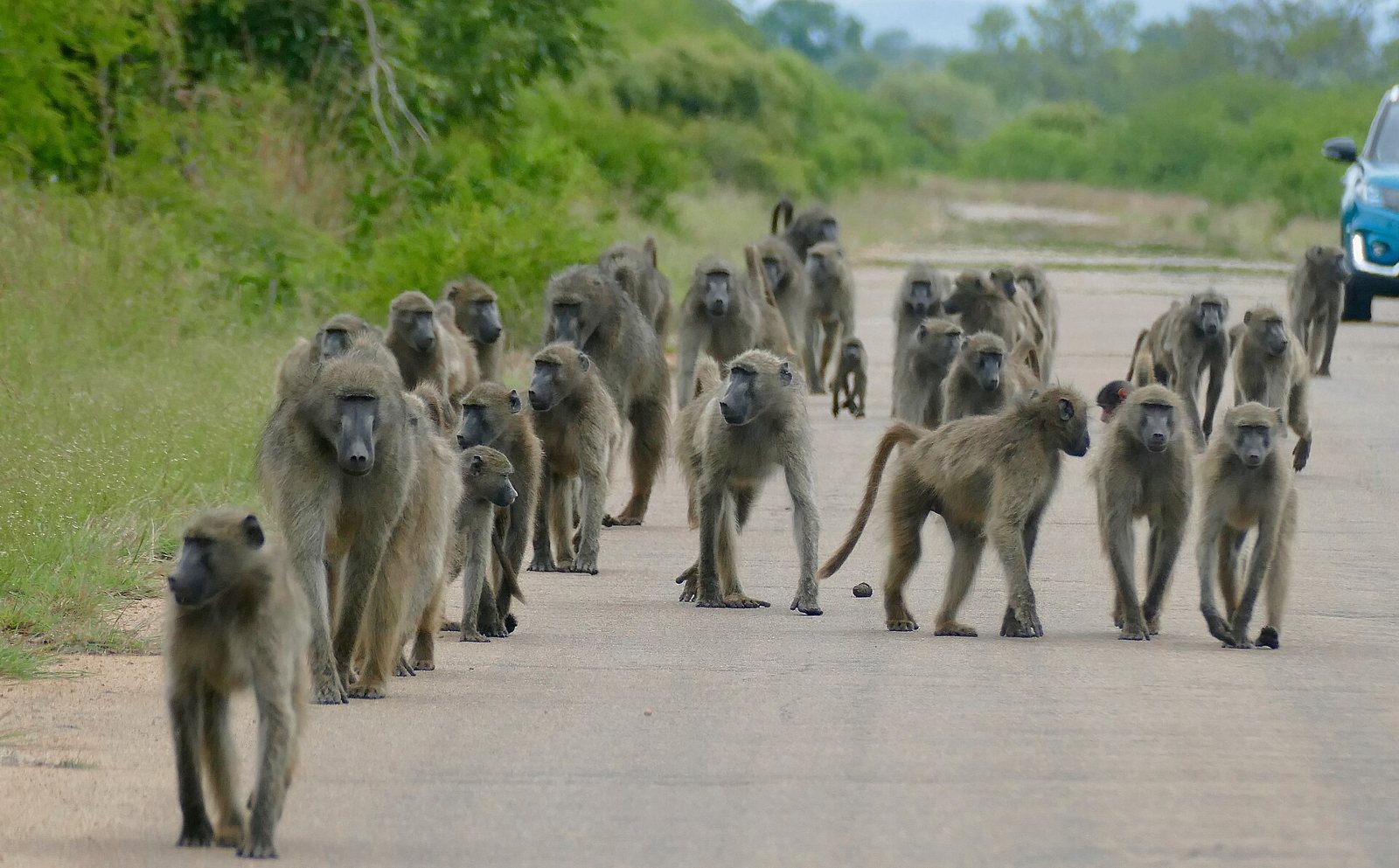
No. 313
Baboon Skull: Why It Has a Dog-Like Muzzle and Huge Canines
A baboon skull has a long, dog-like muzzle because that is simply the baboon's face. Baboons, the monkeys of the genus *Papio*, have a long projecting snout, a large facial region and powerful jaws worked by strong jaw-closing muscles. The long fangs are the upper canines, and in adult males they are far bigger than in females, because males use them in threat displays and in contests with other males.
The University of Minnesota Veterinary Anatomy Museum puts the resemblance plainly: a baboon looks like a dog in the length of its muzzle. Then it points to what gives the skull away as a primate, a prominent bony ridge around the eye sockets and a crest along the midline of the skull where those big jaw muscles attach. So, if a skull on a shelf looks like a dog that has been reading philosophy, there is a good chance it is a baboon.
What a baboon skull is built like
Seen from the side, the face is the headline. The muzzle projects well forward of the eyes, the jaws are deep and strong, and the facial part of the skull is large compared with the braincase behind it. Above the eyes runs the pronounced orbital ridge, a thick rim of bone framing each eye socket from the front. Along the top, the midline crest gives the jaw-closing muscles more bone to grip.
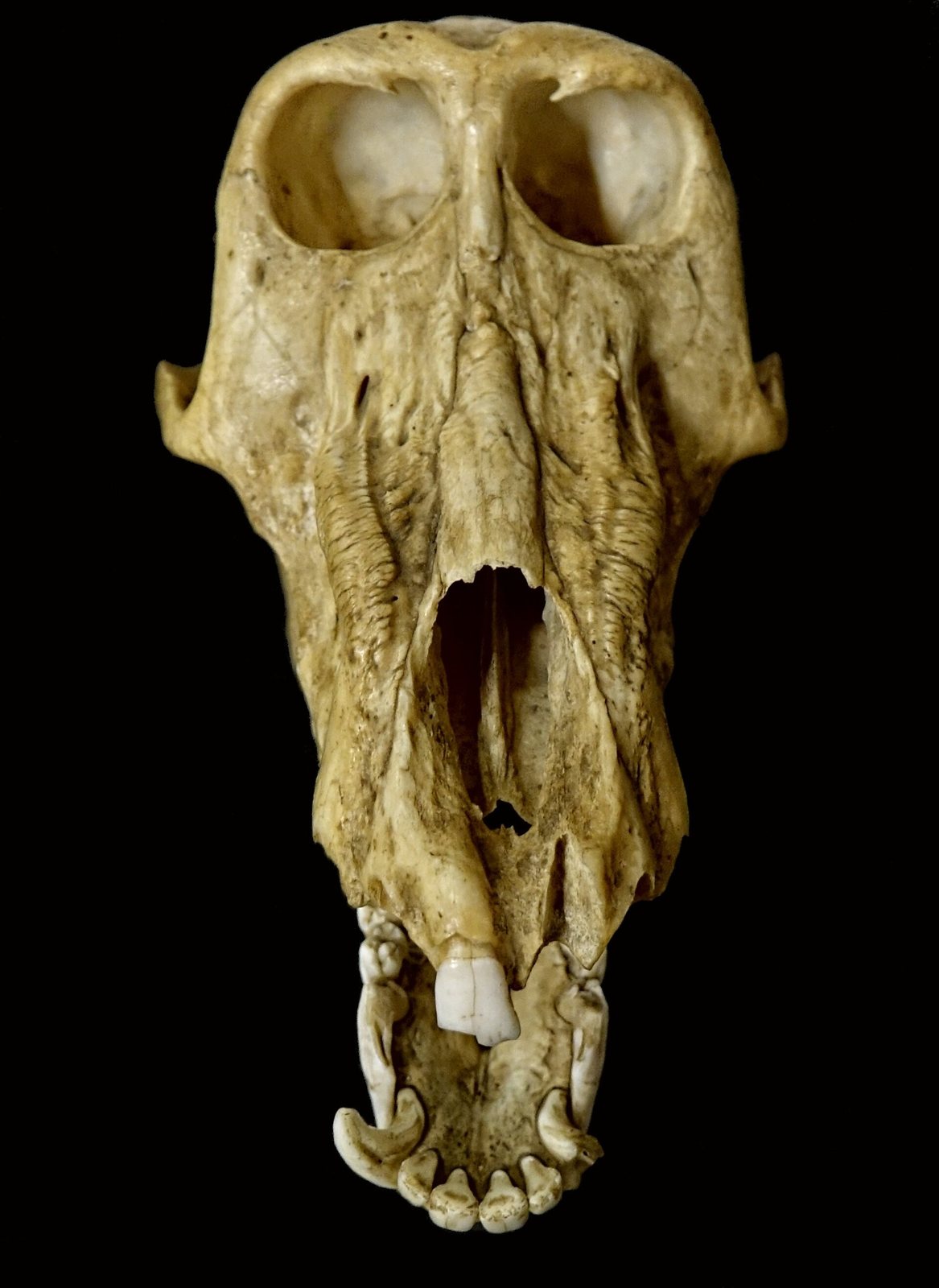
The teeth tell the rest. Animal Diversity Web, run by the University of Michigan Museum of Zoology, gives baboons 32 teeth, with the dental formula I2/2, C1/1, P2/2, M3/3. A dental formula counts the teeth on one side of the mouth, upper over lower: two incisors, one canine, two premolars and three molars, top and bottom, doubled to make 32. Keep that number in mind; it matters when a dog skull is the other suspect.
Two more details stand out. The upper incisors are tightly packed together at the front. Behind them comes a wide diastema, a gap in the tooth row, and then the canines. The upper canines are especially prominent in males, which is where most of the drama comes from.
"Baboon" also covers several species, so no two skulls in a collection will look quite the same. Among them are the olive baboon, *Papio anubis*, the yellow baboon, *Papio cynocephalus*, the chacma baboon, *Papio ursinus*, and the hamadryas baboon, *Papio hamadryas*. Proportions vary between them, as well as between males and females.
The canines: how long they get and why males carry the big ones
The fangs are what most people notice first, and they are mostly a male feature. The University of Wisconsin's Primate Info Net describes adult male yellow baboons as having long, sharp canines, and connects their use with aggressive encounters between males and with feeding on large vertebrate prey.
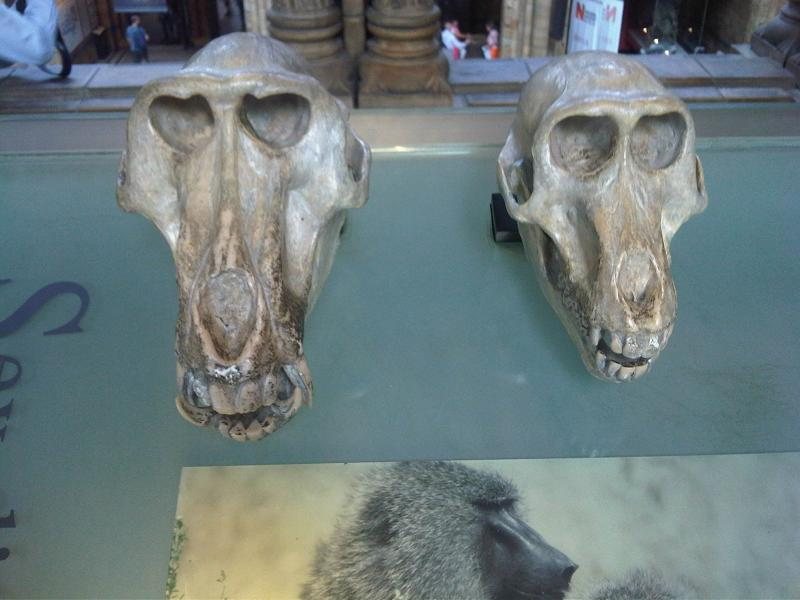
The difference between the sexes can be measured. In a 2017 study of Guinea baboons, *Papio papio*, near Simenti in Senegal, Julia Fischer, Dietmar Zinner and colleagues measured the exposed height of the canines, from the tip of the tooth to the gum. Their figures show adult male upper canines averaging 29.2 mm, against 9.3 mm in adult females. Lower canines averaged 21.0 mm in males and 11.3 mm in females. The males also had clearly larger snouts.
In Kenya, a 2015 study of wild male yellow baboons by Leigh and colleagues, Canine Length in Wild Male Baboons, recorded canines as long as 3.6 cm, with adult males averaging 2.75 cm. The same study showed canine length falling with age as the teeth wear down. An old male's fangs can be shorter than a young adult's, which is worth remembering when judging a skull by its teeth.
Why carry teeth that size? The explanation these studies support is sexual selection: traits that help males compete with other males for mates get passed on. Big canines work in threat displays and in physical contests between males. They are not oversized eating teeth, and they are not the main teeth a baboon uses to grind the plant-heavy part of its diet.
Tap or hover a row to highlight it.
| Measurement | Males | Females |
|---|---|---|
| MeasurementGuinea baboon, upper canine, average exposed height (Senegal, 2017) | Males29.2 mm | Females9.3 mm |
| MeasurementGuinea baboon, lower canine, average exposed height (Senegal, 2017) | Males21.0 mm | Females11.3 mm |
| MeasurementYellow baboon, longest measured canine (Kenya, 2015) | Males3.6 cm | FemalesNot measured |
| MeasurementYellow baboon, adult average canine length (Kenya, 2015) | Males2.75 cm | FemalesNot measured |
Baboon, dog or lion? Reading the teeth
A long muzzle with big canines makes people think of a dog first, and sometimes a big cat. The tooth row sorts it out quickly.
Dogs and their relatives usually have 38 to 42 teeth, according to Animal Diversity Web's account of the Canidae, with more incisors and premolars than a baboon and a pair of carnassials, the large shearing cheek teeth that slice like scissors. Their cheek teeth follow a different pattern altogether. The Canadian government's *Identification Key for Skulls* files the two in separate groups, with primates such as *Pan* in one place and canids such as *Canis* in another. A dog skull can have a long face too, but its teeth will never line up in the baboon's 32. For the dog side of the comparison, see dog skull identification.
A lion skull looks different again. Cats have a short rostrum, the snout part of the skull, and fewer cheek teeth, with 30 teeth in the typical cat formula, per Animal Diversity Web. A lion's long canines belong to a carnivore's system for cutting and gripping. A baboon's sit in a primate tooth row, with that wide gap in front of them. Both skulls have impressive fangs, but they come from different orders of mammals, and the rest of the teeth show it. The lion skull story covers how to tell a lion from a tiger.
Next to a chimpanzee
A chimpanzee, *Pan troglodytes*, also has a primate's teeth, but its face is shorter and more human-like than a baboon's long muzzle. Its canines are present and sizeable, yet less dramatically different between males and females than a baboon's. For the great apes in detail, read the chimpanzee skull and gorilla skull stories, and for the wider comparison with our own species, human vs animal skull.
Tap or hover a row to highlight it.
| Feature | Baboon, Papio | Chimpanzee, Pan troglodytes | Dog and other canids, Canis |
|---|---|---|---|
| FeatureSkull profile | Baboon, PapioLong, projecting muzzle; prominent orbital ridge | Chimpanzee, Pan troglodytesMore human-like primate face | Dog and other canids, CanisElongated facial region |
| FeatureTeeth | Baboon, Papio32 | Chimpanzee, Pan troglodytesPrimate dentition | Dog and other canids, CanisUsually 38 to 42 |
| FeatureDental formula | Baboon, PapioI2/2, C1/1, P2/2, M3/3 | Chimpanzee, Pan troglodytesPrimate-style dentition | Dog and other canids, Canis3/3, 1/1, 4/4, 1-2/2-3 |
| FeatureCanines | Baboon, PapioEspecially large in adult males | Chimpanzee, Pan troglodytesPresent, less dramatically different between the sexes | Dog and other canids, CanisGripping canines with carnassial teeth |
| FeatureQuick clue | Baboon, PapioWide gap between upper incisors and canines | Chimpanzee, Pan troglodytesShorter muzzle than a baboon | Dog and other canids, CanisCarnassial pair and a different cheek-tooth pattern |
Baboons in ancient Egypt
Long before museums put baboon skulls in cases, Egyptians gave baboons a place in their religion. The baboon was linked with Thoth, a god of wisdom, writing, measurement and learning. The Metropolitan Museum of Art's 1995 *Bulletin* An Egyptian Bestiary records baboons venerated as the "great white one" in Early Dynastic Egypt. It also explains that Egypt's own wild hamadryas baboons, *Papio hamadryas*, disappeared during the Middle Kingdom, after which baboons were brought in from regions to the south. Their intelligence and their distinctive gaze helped tie them to Thoth.
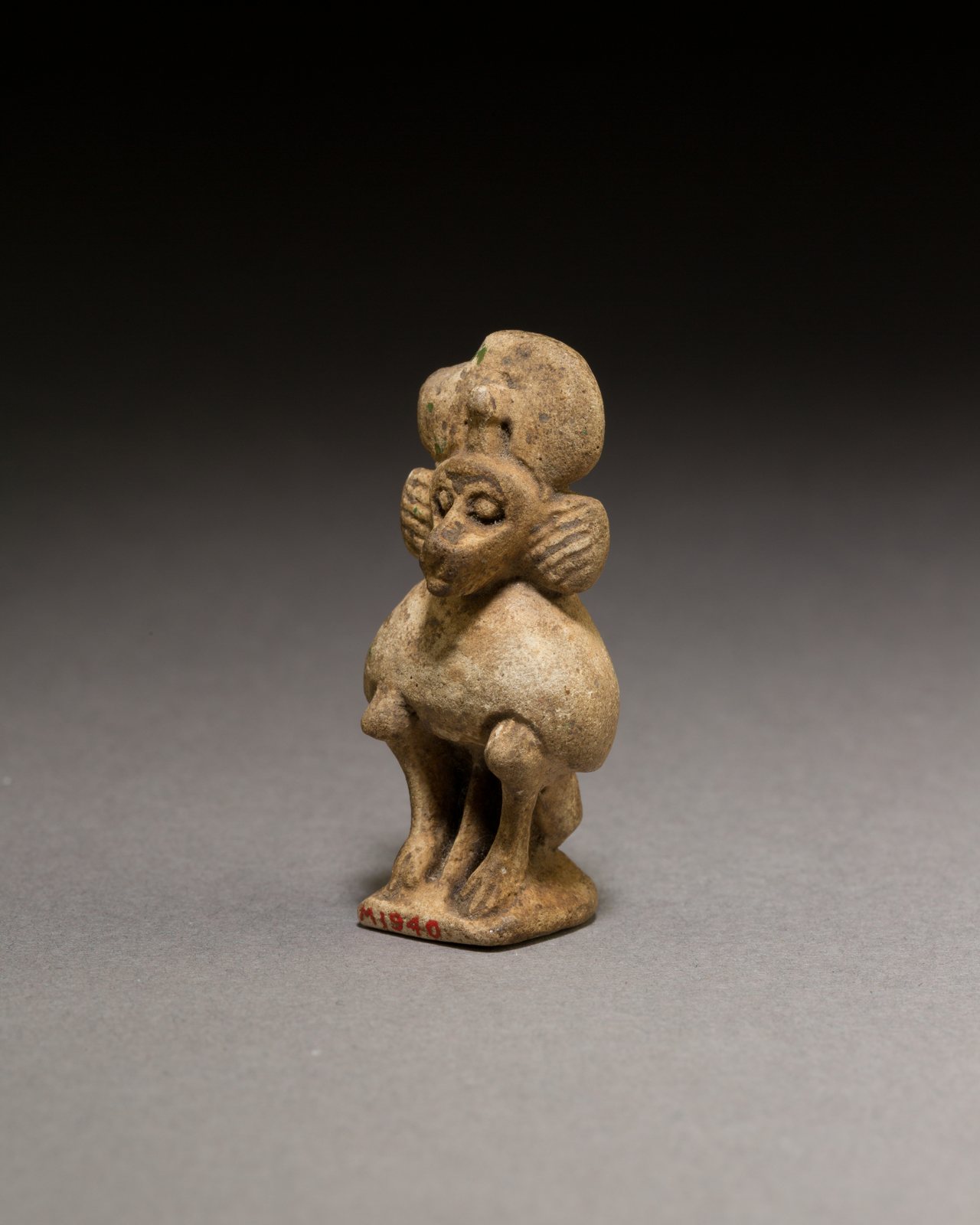
The Met's faience figure *Thoth as baboon* dates to the Ptolemaic Period, 332 to 30 BCE, and shows the god in his baboon form.
Animal mummies became far more common during the first millennium BCE. The Met's record for an animal mummy explains that animals associated with particular gods were sometimes raised in temple precincts, then killed and mummified in large numbers and buried in catacombs as gifts to the gods. Not every wrapped bundle held a whole animal. Some contained only a few bones, feathers, sticks or sand. The Smithsonian National Museum of Natural History holds a baboon-shaped mummy from 332 to 30 BCE that, when scanned, held linen scraps and a wooden stick rather than a baboon. The museum notes that the baboon symbolized Thoth and that gifts of baboon mummies honored him. For how Egyptians prepared human mummies, read how Egyptian mummies were made.
Baboons in ancient Egypt and in the museum
Tap or hover a step to follow the order.
Early Dynastic Egypt
Baboons were venerated as the "great white one," according to the Metropolitan Museum's Egyptian Bestiary.
Middle Kingdom
Egypt's resident wild hamadryas baboons disappeared.
After the Middle Kingdom
Baboons were imported from regions to the south.
332 to 30 BCE
The faience Thoth as baboon now at the Met was made, in the Ptolemaic Period.
1911
The Encyclopaedia Britannica printed an illustration of a chacma baboon skeleton showing the great length of its face.
2017
A study of Guinea baboons in Senegal measured the large difference in canine height between males and females.
Baboon skulls in museums today
Illustrators were drawing attention to that long face more than a century ago. The eleventh edition of the *Encyclopaedia Britannica*, in 1911, printed an illustration of a chacma baboon skeleton chosen to show the great relative length of the facial part of the skull.
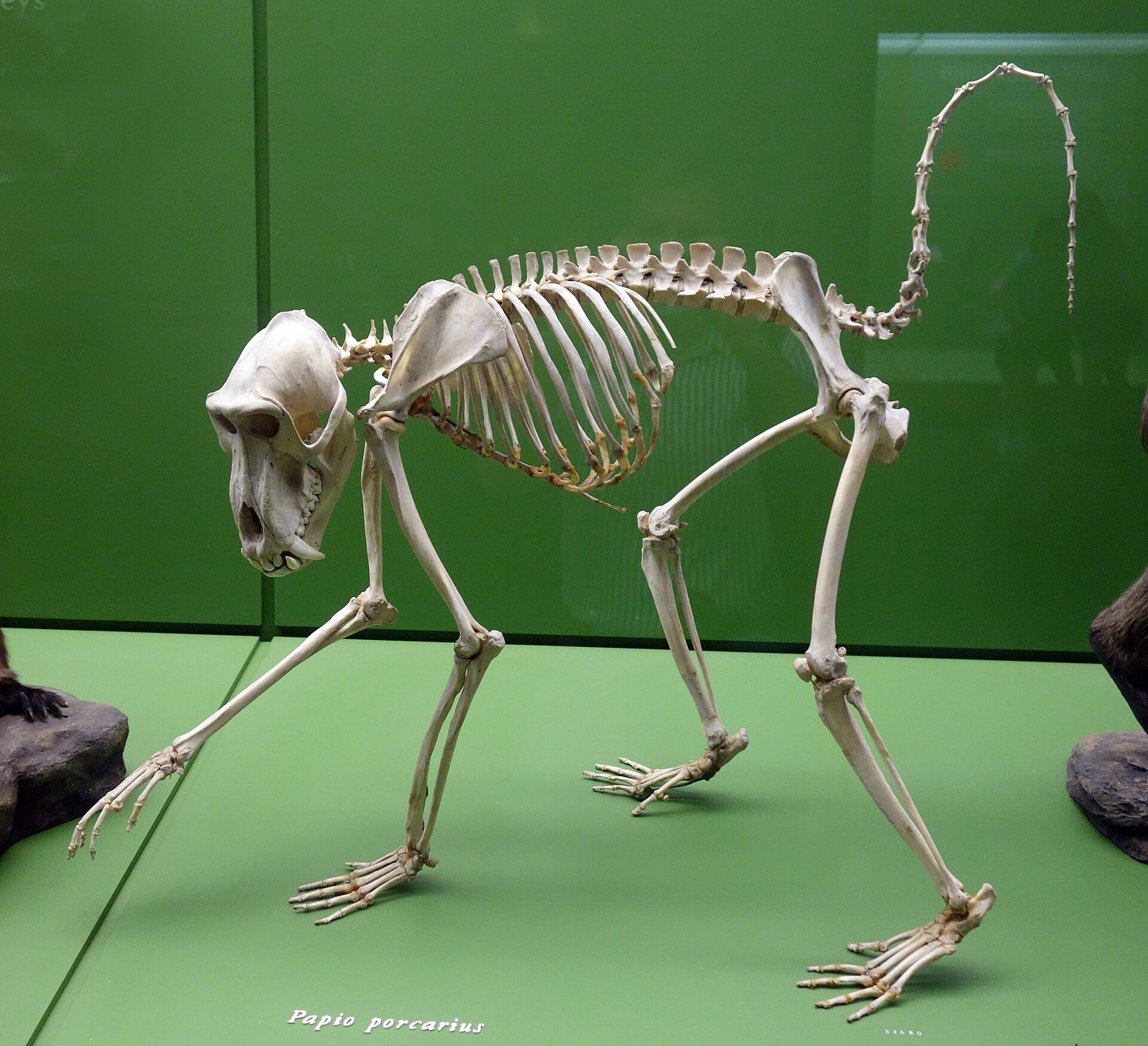
Real specimens live in natural history collections. The American Museum of Natural History holds a hamadryas baboon skeleton, specimen M-52680_-_skeleton_(AMNH_M-52680).jpg), and modern photographs such as this chacma baboon skull and Didier Descouens's views of a yellow baboon skull from the face and the base let you study the teeth and the eye ridges up close. For display and teaching, museums and classrooms usually rely on casts and replicas rather than real bone.
Keeping a baboon skull: the rules
What follows is general information, not legal advice, and the law varies by country and by state.
Baboons are listed under CITES, the international agreement on trade in endangered wild animals and plants, which regulates international trade in the parts and derivatives of listed animals. Owning, moving or trading a real baboon skull can require permits under CITES and from the U.S. Fish and Wildlife Service. Whether a given specimen is allowed depends on where it came from, which species it is, where it is now and whether it is being taken, transported or traded, and none of that can be settled from a photograph.
Before you hold, transport or import a real specimen, confirm the rule with the wildlife authority where you live. For anything crossing a border, check the current CITES species database and your national CITES management authority; in the United States, that is the U.S. Fish and Wildlife Service. For general information on skulls that turn up outdoors, read found an animal skull.
FAQ
Short answers on the look of a baboon skull, males and females, and the dog resemblance.
What does a baboon skull look like?
A baboon skull has a long, prominent muzzle, strong jaws, a thick bony ridge around the eye sockets and 32 teeth. Adult males usually have much longer, sharper upper canines than females. The profile can look like a dog's, but the teeth and the eye sockets are a primate's.
How can you tell a male baboon skull from a female?
Look at the canines first: adult males have far longer upper canines, about three times the height of a female's in the Senegal Guinea baboons. Males in that study also had larger snouts. Wear shortens canines with age, so an old male can have smaller fangs than you might expect.
Why does a baboon skull look so much like a dog's?
Both animals have a long face, so the outline is similar from the side. The likeness stops there: a baboon has 32 teeth in a primate pattern with a gap before the canines, while a dog has 38 to 42 teeth and carnassial cheek teeth. The baboon's ridge around the eyes is another giveaway.
A baboon skull at a glance
A baboon skull is a primate built around a long face and, in males, a set of canines meant for display and rivalry. Count the teeth, look for the gap and the ridge over the eyes, and the dog resemblance falls away.
Baboon skull quiz
Answer every question to check.
Terms in this story
Tap a term to see what it means.
Muzzle. The projecting snout of the face. In baboons it is long enough to remind people of a dog.
---