

No. 314
The Capybara Skull: Size, Teeth and the World's Largest Rodent
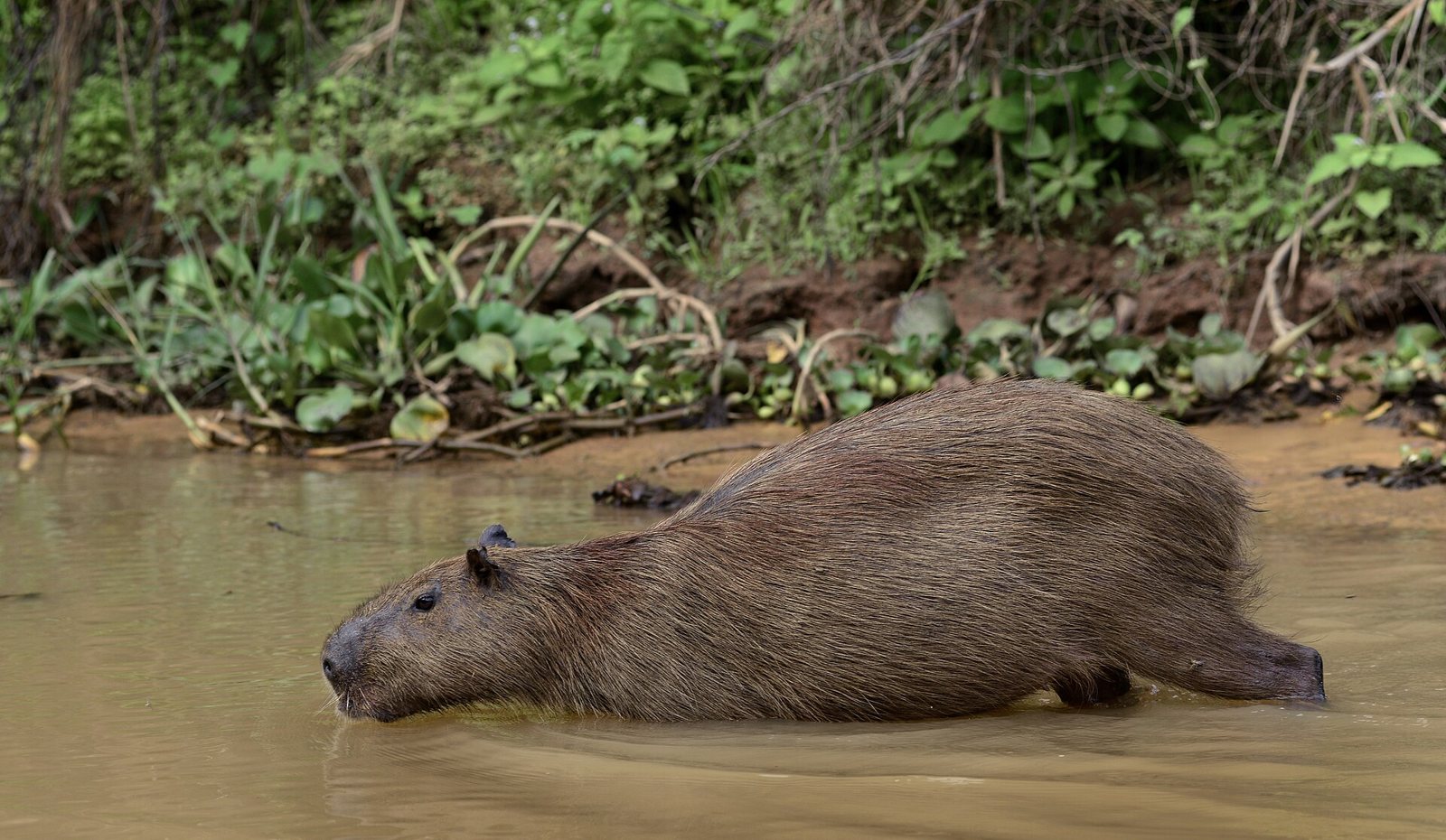
A capybara skull is big, heavily built and rectangular, with a long face, wide cheekbones and four broad front teeth. The greater capybara, *Hydrochoerus hydrochaeris*, is the world's largest living rodent, about 1.3 m long and more than 60 kg according to the Natural History Museum in London, and its skull matches that size. One documented skull from Uruguay measured 270 mm, or 27 cm, in greatest length.
Inside that skull sit 20 teeth, and every one of them, front incisors and back grinders alike, keeps growing for the animal's whole life. The calmest animal on the internet has some of the busiest teeth in the rodent world.
The shape of a capybara skull
From the side, a capybara skull looks long and blocky, a little like a stretched brick with teeth. A 2020 CT and radiographic study by Pereira and colleagues describes a sturdy, rectangular skull with a long facial region, broad zygomatic arches (the cheekbones that curve out to the sides), circular eye sockets and a large infraorbital foramen, an opening in front of each eye socket. Toward the back, the tympanic bullae, the bony capsules around the middle ear, are relatively small, and the paracondylar process at the back of the skull is large.
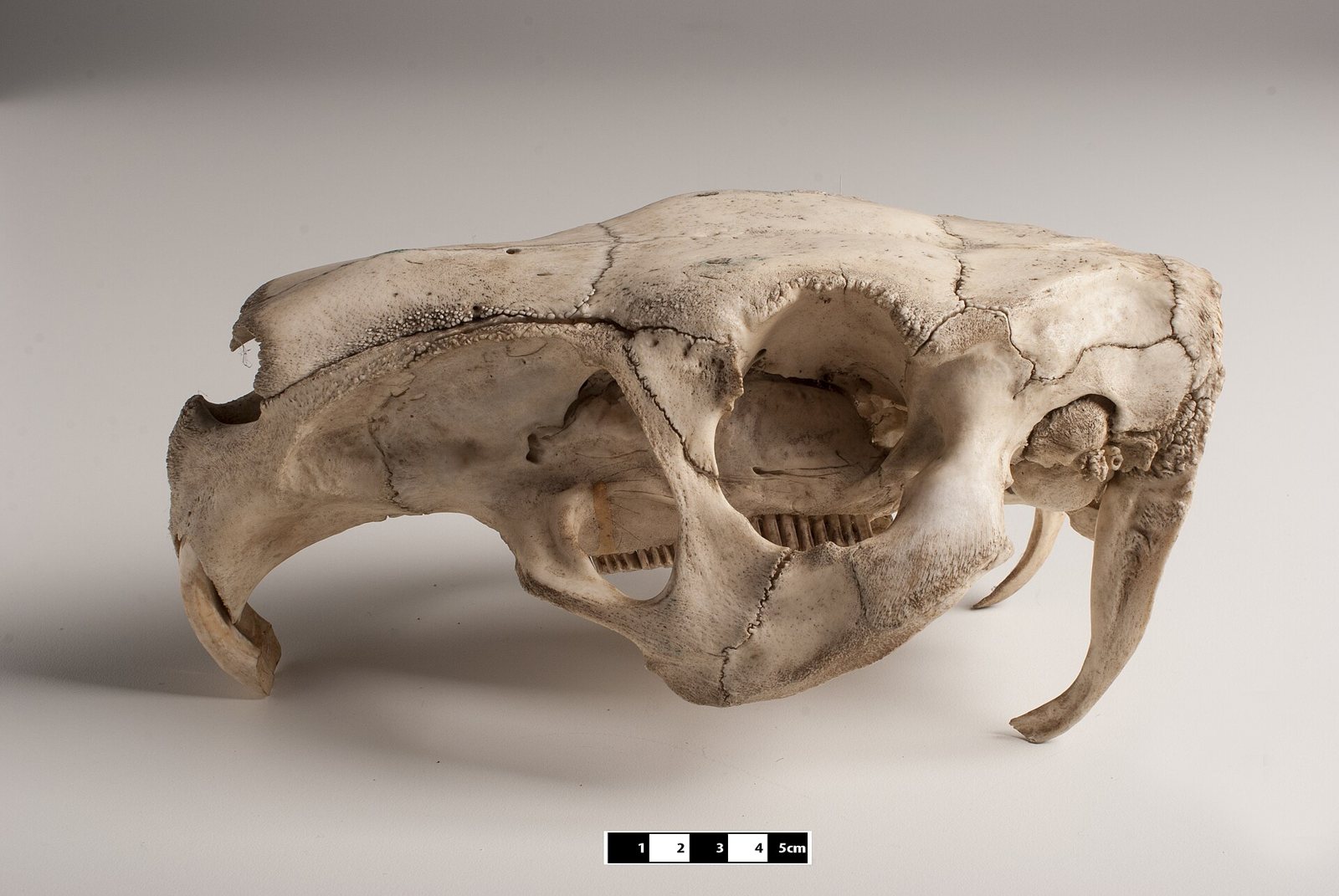
The face makes up the bigger share of that length. A UNESP study of eight skulls reported a mean length of 137.90 mm for the facial part and 87.76 mm for the cranium, the part that holds the brain. The single biggest figure comes from the species account in *Mammalian Species*, which records a skull from Uruguay at 270 mm in greatest length.
That 270 mm skull is one documented specimen, not an average for the species. Skull size varies with the age of the animal and from one individual to the next, so a younger capybara's skull will come in smaller.
The animal goes by several names. In Spanish it is the capibara or the carpincho, both listed in Argentina's national species record for *Hydrochoerus hydrochaeris*.
Tap or hover a row to highlight it.
| Feature | Capybara data |
|---|---|
| FeatureScientific name | Capybara dataHydrochoerus hydrochaeris |
| FeatureCommon names | Capybara dataCapybara, capibara, carpincho |
| FeatureLiving rodent ranking | Capybara dataLargest living rodent |
| FeatureDocumented skull length | Capybara data270 mm in a Uruguay specimen |
| FeatureAdult dental formula | Capybara dataI 1/1, C 0/0, P 1/1, M 3/3 |
| FeatureTotal teeth | Capybara data20 |
| FeatureTooth growth | Capybara dataIncisors and cheek teeth grow continuously |
| FeatureSkull shape | Capybara dataHeavily built and rectangular |
| FeatureKey openings and arches | Capybara dataLarge infraorbital foramen, broad zygomatic arch |
| FeatureFossil giant relative | Capybara dataNeochoerus pinckneyi, Pinckney's capybara |
| FeatureLargest fossil rodent relative | Capybara dataJosephoartigasia monesi, with a 53 cm skull |
Twenty teeth, and how they work
A capybara has 20 teeth. Its dental formula is I 1/1, C 0/0, P 1/1, M 3/3, which is shorthand for one incisor, no canine, one premolar and three molars on each side of the upper and lower jaw. Multiply those by four quarters of the mouth and you reach 20.
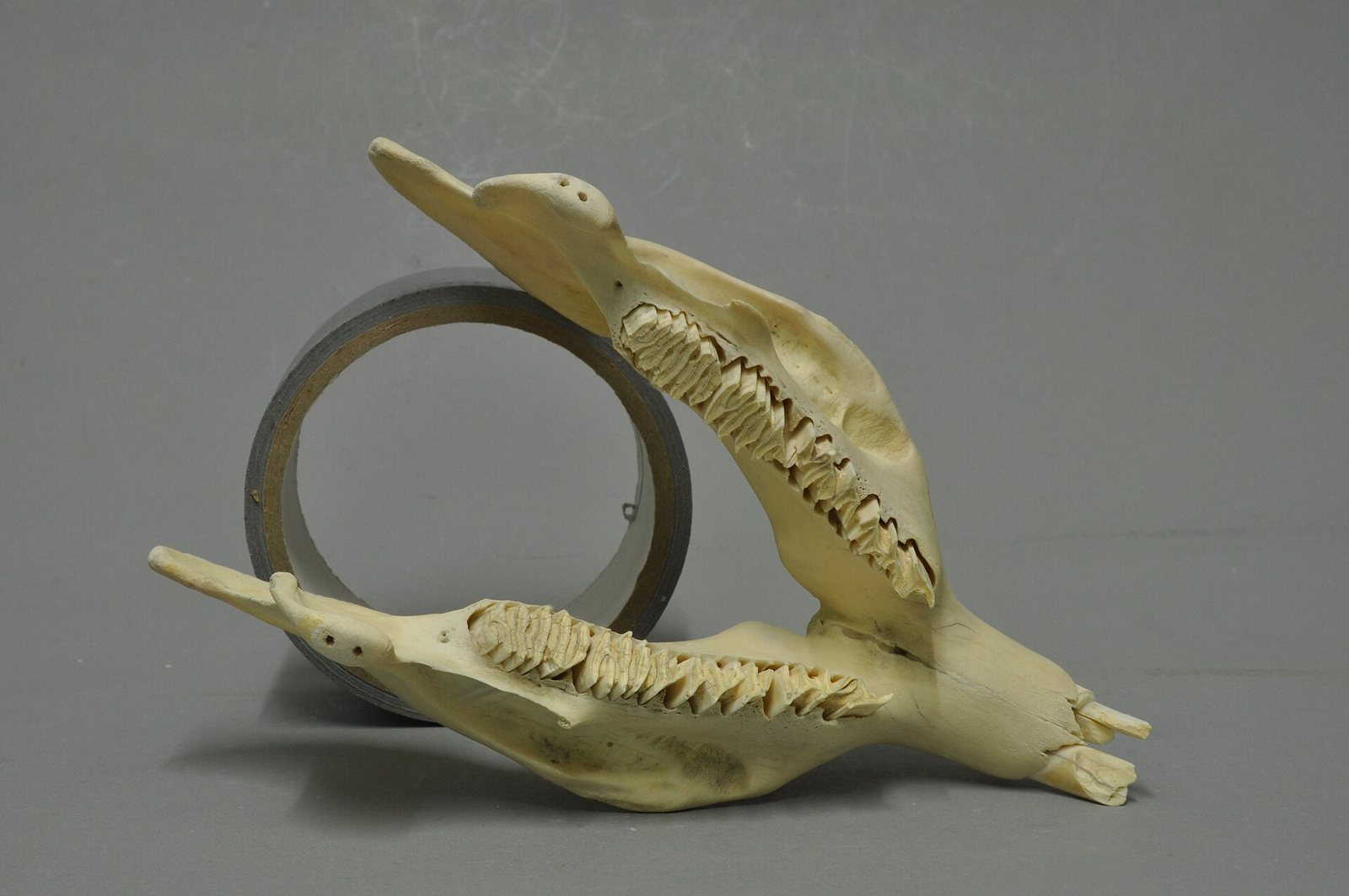
The four incisors get the attention. They are broad and chisel-shaped, and a long, toothless gap called the diastema separates them from the cheek teeth farther back. The incisors work against each other like shears, cropping grass, while the cheek teeth do the grinding. Those cheek teeth have large, laminated grinding surfaces, built in layers, that suit a diet of abrasive grasses and aquatic plants.
A skull with only the famous front teeth in mind can be a surprise when you turn it over. Behind that gap sit sixteen cheek teeth, four premolars and twelve molars, all of them grinding.
Teeth that never stop growing
Grass is hard on teeth, and the capybara answers that by never finishing them. Its incisors and cheek teeth are elodont, meaning they have open roots and keep growing throughout life. A 2026 paper in the *Brazilian Journal of Microbiology* describes the capybara's teeth as open-rooted and continuously growing, and gives the full count as 20. The growth makes up for the wear that comes from gnawing, cropping grass and grinding tough vegetation.
The roots show it. A 2019 UNESP anatomical and radiographic study reported large open roots in all the teeth it examined, and described the lower incisors as substantially larger than the upper ones. Margherita De Silva's dissertation at the University of Bologna describes the same open-rooted, ever-growing teeth. Every tooth is being built at the root while it wears away at the top.
Capybara, beaver, guinea pig or rat?
A big rodent skull with large front teeth could belong to several animals, and the capybara has close look-alikes in miniature. Its nearest comparison is the guinea pig. According to De Silva's dissertation, both share the same 20-tooth formula, I 1/1, C 0/0, P 1/1, M 3/3, and both have continuously growing, open-rooted teeth. The capybara stands apart in a trapezoidal lower jaw with a bulging angular process at the back corner, a more developed upper third molar, and a skull that is far larger overall.
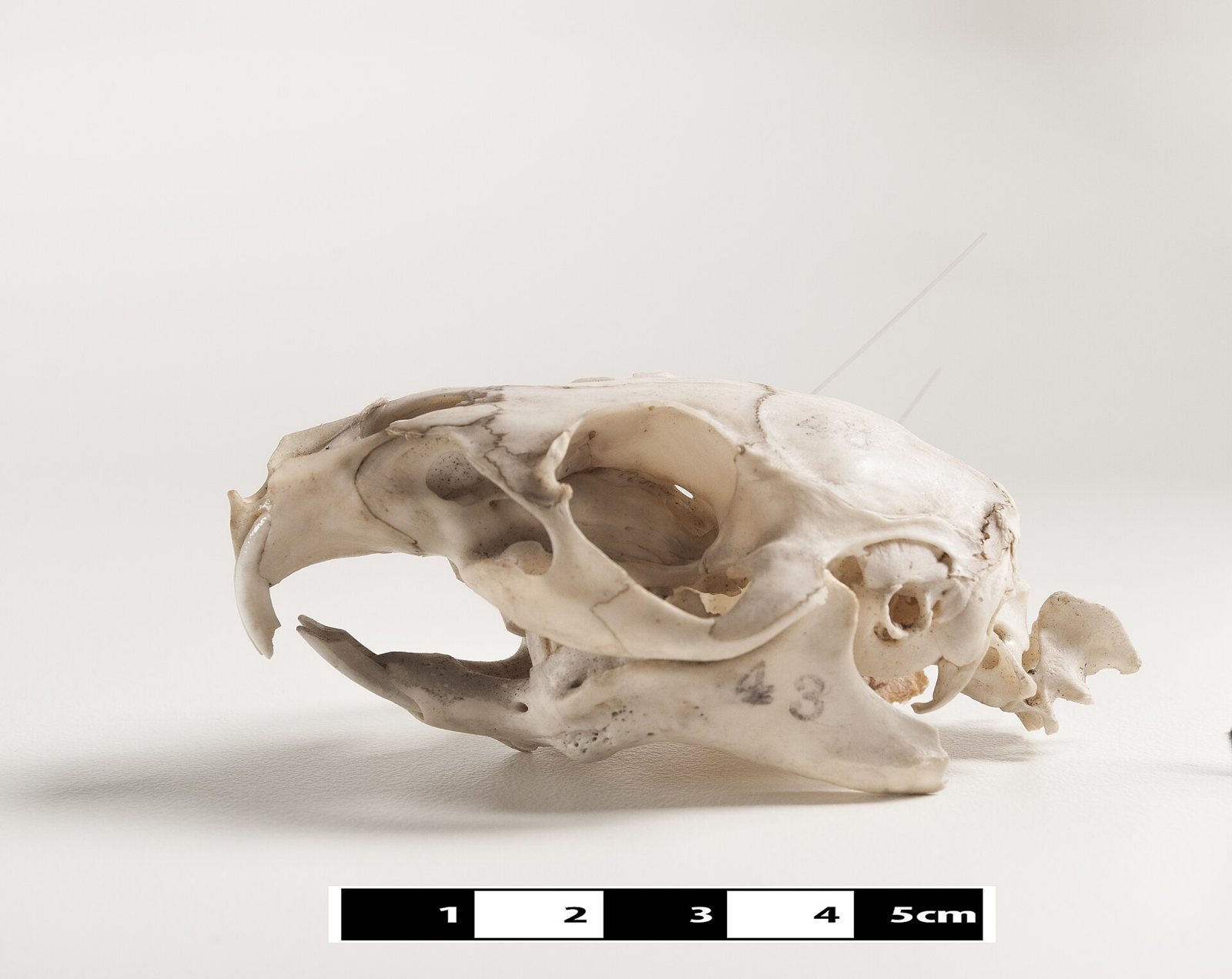
Beavers are the other big rodent people reach for. The Maryland Department of Natural Resources' 2022 Key to Common Maryland Mammal Skulls identifies a beaver by its long ear canals that point upward, while a muskrat's are short and do not. That key covers Maryland mammals, so it does not include capybaras or guinea pigs and cannot identify a capybara on its own. For the beaver's side of the comparison, including its orange teeth, see our story on the beaver skull. For a much smaller rodent skull, the rat skull story covers what to look for.
Location matters too. Capybaras live in South America, so a large rodent skull turned up somewhere else should not be called a capybara on size alone. Look at the teeth, the shape of the jaw, the infraorbital opening and the ear canals together, and ask a natural history museum or a university mammal collection to confirm an unusual specimen.
Telling a capybara skull from its look-alikes
Tap a card to bring it forward.
- Count the teeth: A capybara has 20, with one incisor, one premolar and three molars per side of each jaw and no canines.
- Check the growth: Its incisors and cheek teeth are open-rooted and grow throughout life.
- Look at the lower jaw: A capybara's is trapezoidal, with a bulging angular process.
- Find the upper third molar: It is more developed in a capybara than in a guinea pig.
- Check the infraorbital opening: A capybara's is large.
- Look at the ear canals: In the Maryland key, a beaver's are long and point upward.
- Ask a museum: A natural history museum or university mammal collection can confirm an unusual specimen.
Giant capybaras of the past
Today's capybara is the largest rodent alive, but it had bigger and more widespread relatives, and some of their skulls turned up in the United States.
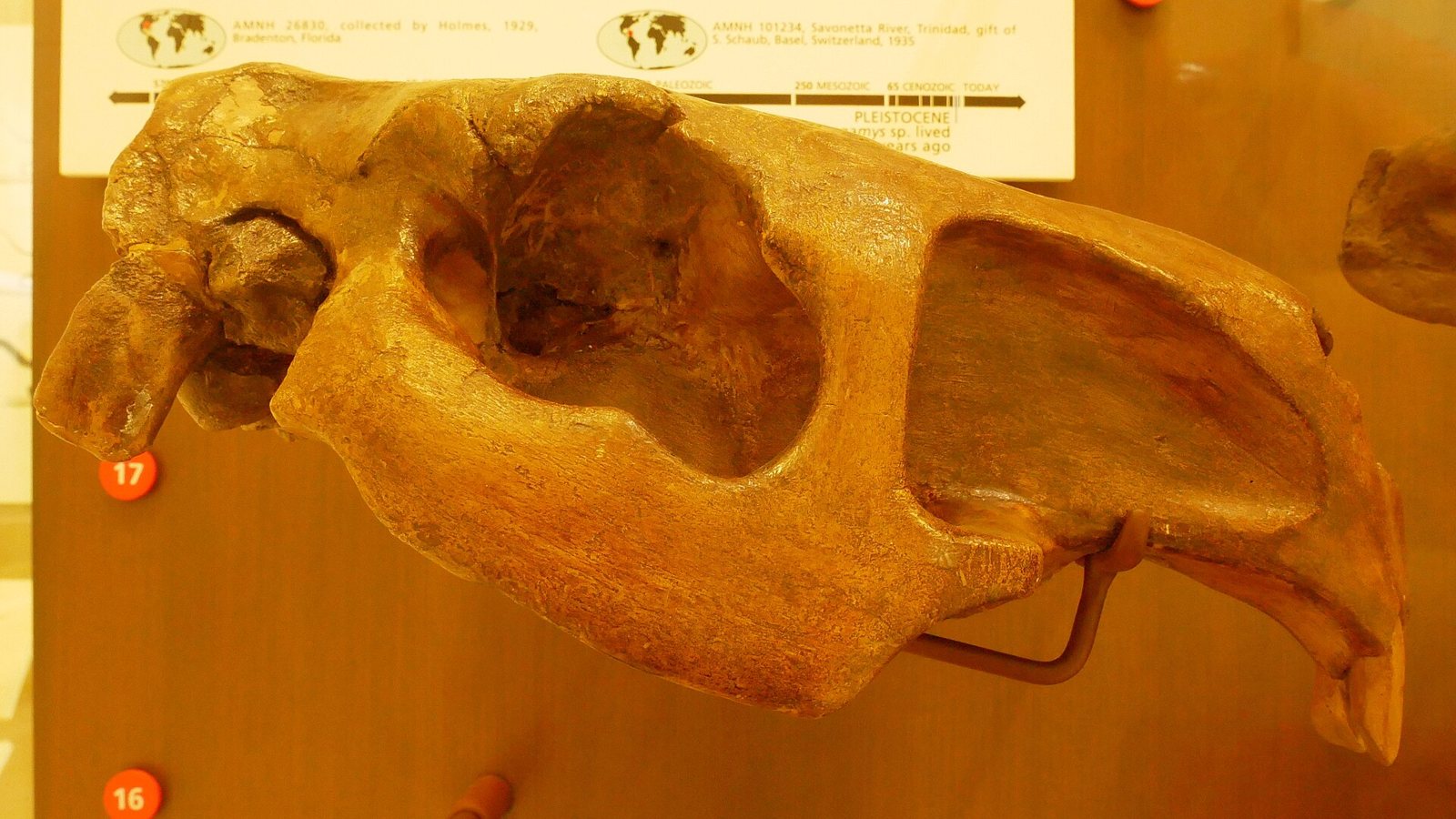
The Florida Museum of Natural History displays a restored skull of *Neochoerus pinckneyi*, Pinckney's capybara, from the West Palm Beach Site in Palm Beach County, Florida, where excavation was documented in 1969. The darker parts of the display skull are fossil bone, and the lighter parts are reconstruction modelled on modern capybara skulls. The same species turns up farther north: the Charleston Museum holds *Neochoerus pinckneyi* teeth and skull fragments from Berkeley County, South Carolina, associated with the Cooper River.
California had one too. The San Diego Natural History Museum reported a fossil capybara from San Diego County, dated to roughly 80,000 to 130,000 years ago and later named *Hydrochoerus hesperotiganites*. Its skull had been flattened by geological compaction, and the name means "western pancake capybara."
The heavyweight of the story is not a capybara in the strict sense. *Josephoartigasia monesi* was an extinct South American rodent, a close caviomorph relative of the capybara rather than a member of its genus. Rinderknecht and Blanco described it in 2008 from an exceptionally preserved 53 cm skull from Uruguay. They estimated its body mass at nearly 1,000 kg, which made it the largest known rodent in the fossil record when the paper was published. It lived roughly 4 to 2 million years ago, and its skull is about twice the length of the 270 mm capybara skull above.
The capybara skull, from illustration to fossil
Tap or hover a step to follow the order.
1911
Encyclopaedia Britannica publishes a capybara skull illustration, now in the public domain in the United States.
1969
Excavation at the West Palm Beach Site in Florida recovers a major Neochoerus pinckneyi skull.
2008
Rinderknecht and Blanco describe Josephoartigasia monesi from a 53 cm skull from Uruguay.
2019
UNESP researchers publish anatomical and radiographic observations of capybara teeth.
2020
Pereira and colleagues publish a CT and radiographic study of capybara skull anatomy.
2022
The Maryland Department of Natural Resources publishes its common mammal skull key.
2026
A Brazilian Journal of Microbiology paper summarizes the capybara's ever-growing teeth and 20-tooth formula.
Seeing a capybara skull up close, and keeping one
If you want a good look at a real one, several collections share theirs. The Museum of Veterinary Anatomy at the University of São Paulo, FMVZ USP, has a photographed capybara skull and a full capybara skeleton on Wikimedia Commons, and Museum Wiesbaden in Germany has another skull. For a view you can turn around on screen, the NIH 3D site hosts a capybara skull model generated from CT scan data. And the fossil relatives are on display in Florida and held in Charleston.
Keeping a skull you come across is a different matter, and the answer depends on where you are. Rules vary by country, by state, by who manages the land and by the specimen itself. Before you remove or keep a skull, ask the relevant wildlife agency or the land manager. Our story on what to do when you find an animal skull covers wildlife remains in general, and how to clean an animal skull comes after that question is answered.
> Legal note: This section is general information and not legal advice. The rules on animal remains change from one country, state and landholding to the next, so the agency or land manager in charge has the final word on any skull you are holding.
Capybara skull quiz
Answer every question to check.
Quick answers about capybara skulls
These are the questions that come up once the size and the teeth sink in.
What does a capybara skull look like?
A capybara skull is sturdy, rectangular and elongated, with broad zygomatic arches, circular eye sockets and a large infraorbital foramen. At the front sit four large, chisel-shaped incisors, separated from the cheek teeth by a long diastema.
What gives away a capybara skull?
The combination of a very large rodent skull, 20 open-rooted teeth, a trapezoidal lower jaw with a bulging angular process and a well-developed upper third molar points to a capybara. No single feature settles it, so a museum or university mammal collection is the place to confirm one.
What was the biggest rodent ever?
The largest known fossil rodent at the time it was described was *Josephoartigasia monesi*, an extinct South American relative of the capybara. Rinderknecht and Blanco estimated it at nearly 1,000 kg from a 53 cm skull found in Uruguay.
Why is the San Diego fossil called the pancake capybara?
Its skull was flattened by geological compaction, and the species name *Hydrochoerus hesperotiganites* means "western pancake capybara." The San Diego Natural History Museum dates the fossil to about 80,000 to 130,000 years ago.
Where to go next
If the capybara has you curious about other rodent skulls, the beaver skull story covers North America's big gnawer and its orange teeth, and the rat skull story covers a rodent skull at the small end of the scale. If a skull of your own started the question, begin with found an animal skull.
Terms in this story
Tap a term to see what it means.
Hydrochoerus hydrochaeris. The scientific name of the greater capybara, the world's largest living rodent, also called capibara or carpincho in Spanish.
---