


No. 312
Lion Skull vs Tiger Skull: How to Tell Them Apart
A tiger skull, *Panthera tigris*, is usually higher and more arched along the top, with a shorter, broader muzzle and long nasal bones that reach back past the points of the upper jaw. A lion skull, *Panthera leo*, is usually flatter along the top. That is the quick answer, and it is often enough to make a good first guess at a museum case.
The careful answer adds one condition. Lions and tigers have the same 30 teeth, and their skull sizes overlap, so no single feature settles it. A 2025 study in *Zoologica Scripta* by Dominika Formanová and Anna Kubátová, Identification of tiger and lion skulls, advises using as many features as possible. The good news is that the features are learnable, and one of them involves seeing whether the jaw rocks on a table.
The profile and the nose
Start with the skull in side view. In his 1981 account of the tiger for the series *Mammalian Species*, the zoologist Vratislav Mazák described the tiger skull as more vaulted than a lion's, with a more convex forehead region and a shorter, broader rostrum. The rostrum is the snout part of the skull, everything in front of the eye sockets. Formanová and Kubátová saw the same pattern in their sample: tiger skulls were usually arched, and lion skulls were flatter.
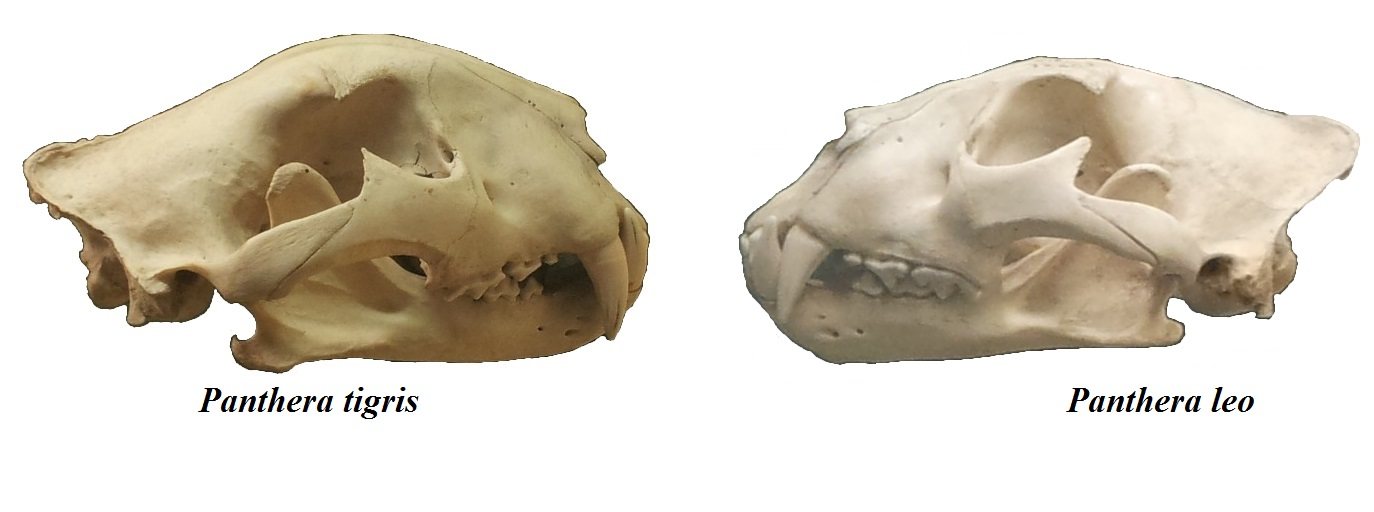
The nose bones carry a second clue. Mazák noted that the tiger's nasal bones are long and project beyond the frontal processes of the maxillae, the narrow arms of the upper jawbone that reach up toward the forehead. He also described the tiger's nasal opening, seen from the front, as narrow and heart shaped.
Sutures help here too. A suture is the wavy seam where two skull bones meet. Formanová and Kubátová compared two of them: the seam between the nasal bones and the frontal bone, and the seam between the upper jaw and the frontal bone. In their tigers, the nasal-frontal seam ran farther back than the jaw-frontal seam. In their lions, it did not. On a clean museum skull you can often follow both lines with your eye, which makes this one of the more satisfying checks.
The underside of the skull and the jaw
Turn the skull over and the 2025 study offers more. The authors compared these characters: the two sutures above, the ratio of the greater palatine foramen, the direction of the foramina ovalia, the shape of the openings, the palatine notch, the overall skull shape and how stable the lower jaw sits.
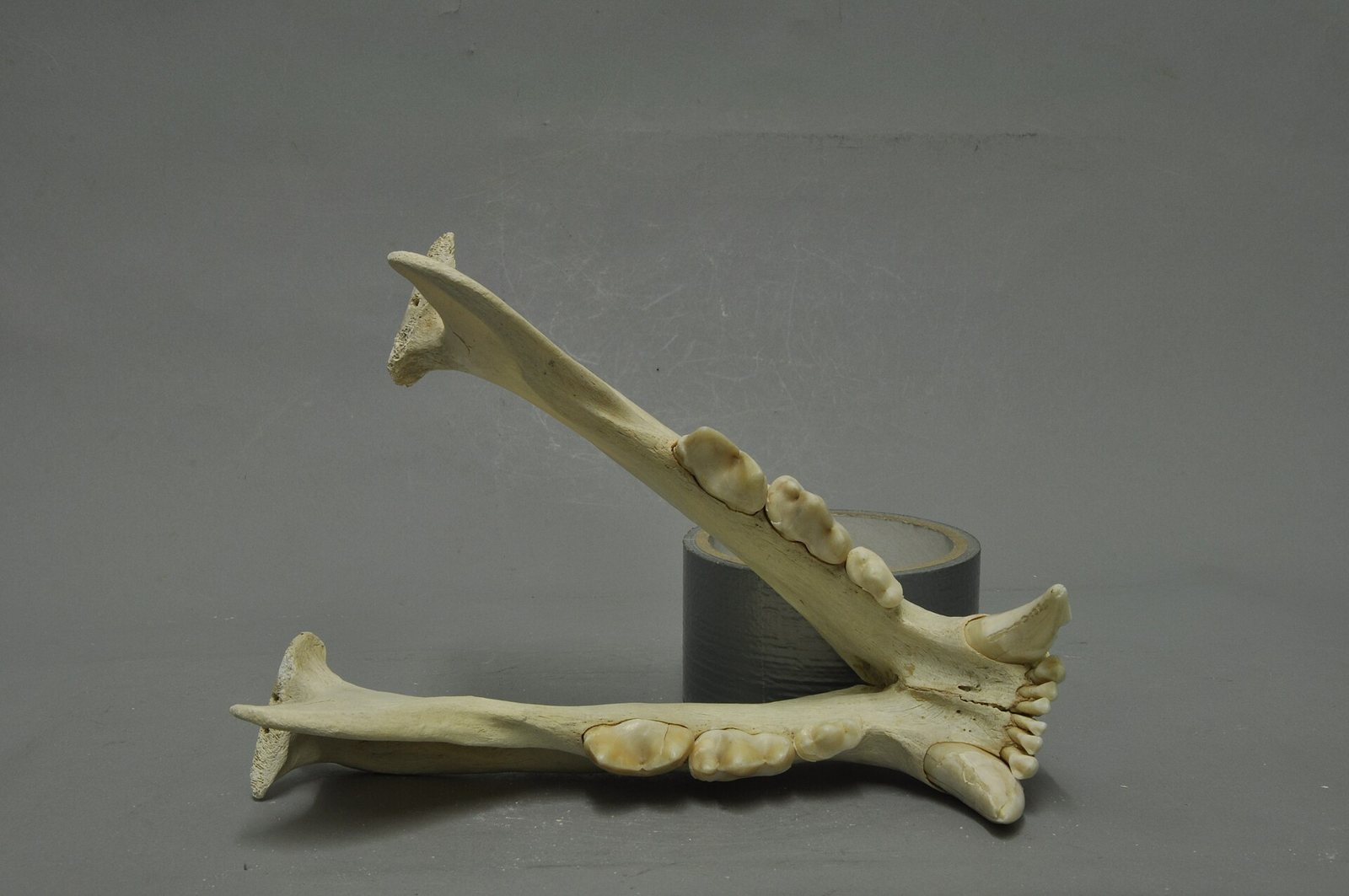
Some of these need a word of explanation. The greater palatine foramina are small holes in the bony roof of the mouth, the palate, which carry nerves and blood vessels. The foramina ovalia are oval openings farther back on the base of the skull. The palatine notch is the gap at the back edge of the palate.
Their practical summary reads like a field checklist. Tigers tended to have a greater palatine foramen ratio below 0.42, foramina ovalia facing forward, circular openings in plain view, a narrow palatine notch, an arched skull and a stable lower jaw. Lions tended to have a ratio above 0.50, foramina ovalia turned more to the side, openings that look straight or partly hidden, a wider palatine notch, a flatter skull and a lower jaw that rocks.
That last one is the detail people remember. Set a lion's lower jaw on a flat surface and it may rock like a chair with one short leg, while a tiger's jaw tends to sit still. It is a tendency, not a verdict. A worn, damaged or unusual jaw can behave differently, which is why the authors lean on the whole set of features together.
Tap or hover a row to highlight it.
| Feature | Tiger, Panthera tigris | Lion, Panthera leo |
|---|---|---|
| FeatureProfile | Tiger, Panthera tigrisMore vaulted and arched | Lion, Panthera leoUsually flatter |
| FeatureNasal-frontal suture | Tiger, Panthera tigrisRuns farther back than the jaw-frontal suture | Lion, Panthera leoDoes not run farther back |
| FeatureGreater palatine foramen ratio | Tiger, Panthera tigrisBelow 0.42 | Lion, Panthera leoAbove 0.50 |
| FeatureForamina ovalia | Tiger, Panthera tigrisFace forward | Lion, Panthera leoTurned more to the side |
| FeaturePalatine notch | Tiger, Panthera tigrisNarrow | Lion, Panthera leoWider |
| FeatureLower jaw on a flat surface | Tiger, Panthera tigrisUsually stable | Lion, Panthera leoMay rock |
| FeaturePermanent teeth | Tiger, Panthera tigris30 | Lion, Panthera leo30 |
Size and teeth
Which is bigger, a lion skull or a tiger skull? Neither species wins reliably. Mazák gave adult tiger skull lengths as usually between 285 and 360 mm, and he noted that large male tiger skulls can be as massive as lion skulls. Sex, age, subspecies, population and plain individual difference all overlap, and Formanová and Kubátová state directly that the two cannot be told apart by size alone. A big skull tells you that you have a big cat, and not much more.
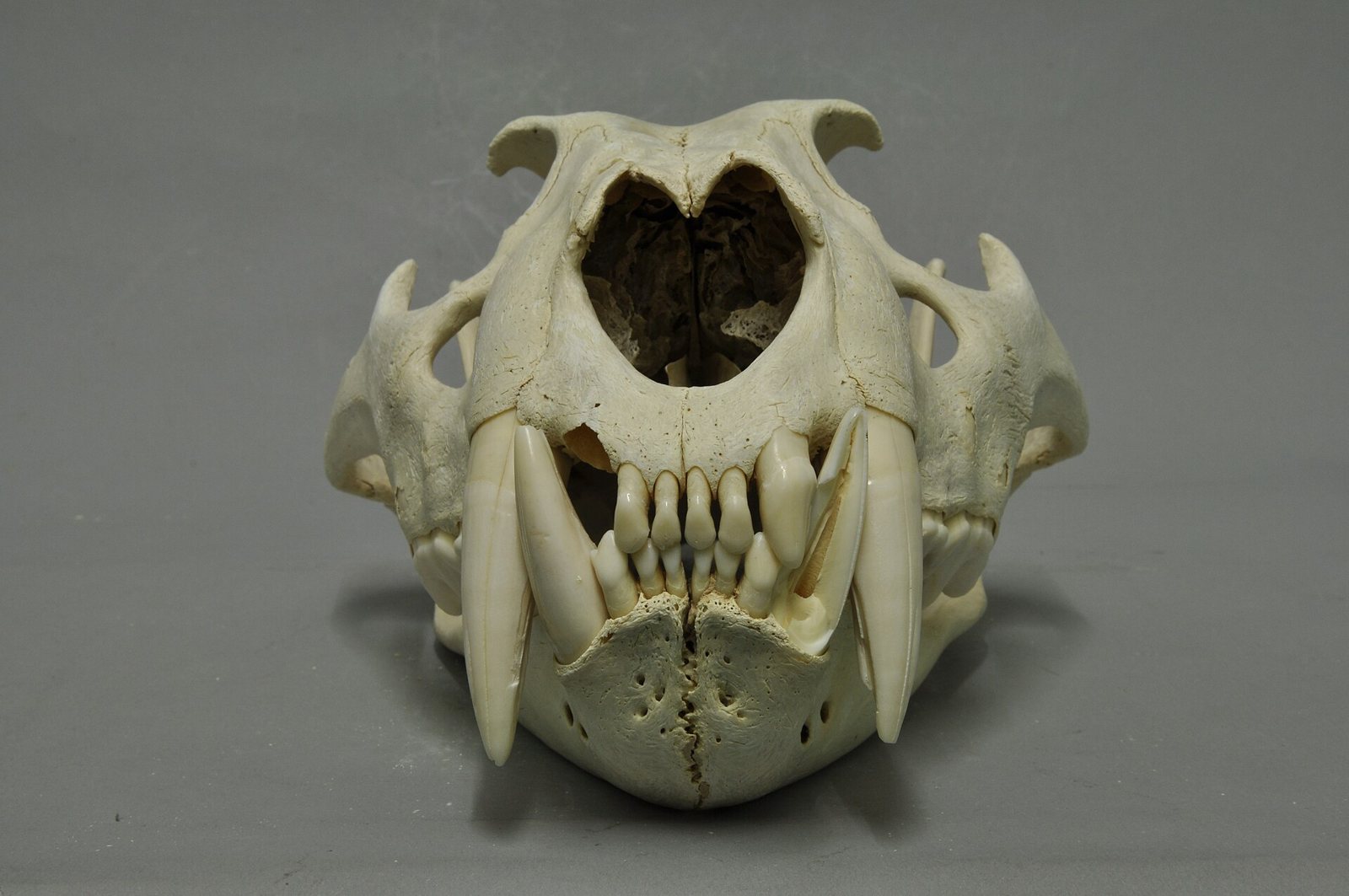
The teeth do not settle it either. Both species normally have 30 permanent teeth, with the dental formula I3/3, C1/1, P3/2, M1/1. A dental formula counts the teeth on one side of the mouth, upper over lower: three incisors, one canine, three upper and two lower premolars, and one molar. Double it and you get 30. Lions and tigers share that pattern, so counting teeth confirms "big cat" but cannot pick between them.
Scale still has a use when the question is a different animal. A skull that fits easily in your hand belongs to a much smaller cat, and cat skull identification or the bobcat skull story will serve you better. Big canines alone are not proof of a cat at all: a baboon skull carries fangs that surprise people, set in a primate's tooth row.
Male or female lion?
Adult male lions generally have larger, heavier skulls than females, but sizes overlap enough that size should not decide the question. A 2012 study by Blaire Van Valkenburgh and colleagues, on craniomandibular variation and sexual dimorphism, found strong size differences between the sexes across *Panthera*, lions included, and upper canine size has been used to judge sex in lion skull collections.
A more specific clue comes from Virginia L. Naples and Bruce M. Rothschild, writing in *Mammalia* in 2012. Males commonly show fine, pore-like porosity in the bone of the upper jaw, above and in front of the roots of the upper canines. Females may show some, but it is usually less common, smaller and gathered around the bulge over the canine root, and it fades as a female reaches adult size. In males it stays prominent.
The simplest clue of all is a good museum label. Museums Victoria records an adult male *Panthera leo leo* skull under registration C 37031-1, and the Wellcome Collection holds a photograph identified as a male lion skull. When a collection has already recorded the sex, trust the record over a guess from a photo.
A mountain lion is a different cat
A mountain lion is a cougar or puma, *Puma concolor*, and it is not a lion in the genus *Panthera* at all. Its skull also has 30 teeth with the same formula, so the count will not separate it from a lion or a tiger.
What does separate it, according to the Oregon State University Mammal Collection, is the pattern on top of the braincase: the temporal ridges, where the jaw muscles attach, join in a V at the front and continue back as a large sagittal crest. Put that together with the overall shape and the smaller scale and a puma usually stands apart. Young, broken or incomplete skulls deserve more caution. For everything else about this animal's skull, see the mountain lion skull story.
Reading a big cat skull
Tap a card to bring it forward.
- Several features, not size: Lions and tigers overlap in size, so combine clues before you decide.
- The profile: An arched, vaulted top points to a tiger; a flatter top points to a lion.
- The nasal-frontal suture: In tigers it tends to run farther back than the jaw-frontal suture.
- The underside: Check the width of the palatine notch and which way the foramina ovalia face.
- The lower jaw: Set it on a flat surface; a lion's jaw may rock, a tiger's tends to sit still.
- The crest on top: Ridges meeting in a V and a large sagittal crest suggest a mountain lion.
Lions in museum drawers and fossil beds
Some of the most interesting lion skulls are old ones. In 1937, workmen at the Tower of London found two lion skulls in the moat. The animals had belonged to the royal menagerie, the collection of exotic animals kept at the Tower. The Natural History Museum in London dated one lion to between 1280 and 1385 and the other to between 1420 and 1480, and genetic testing identified both as pure-bred Barbary lions, *Panthera leo leo*. The museum describes the older skull as the oldest lion found in the United Kingdom since wild cave lions disappeared there after the last ice age. These were captive animals, kept and buried a long way from where lions live, and their skulls are now among the best evidence of what those lions were.
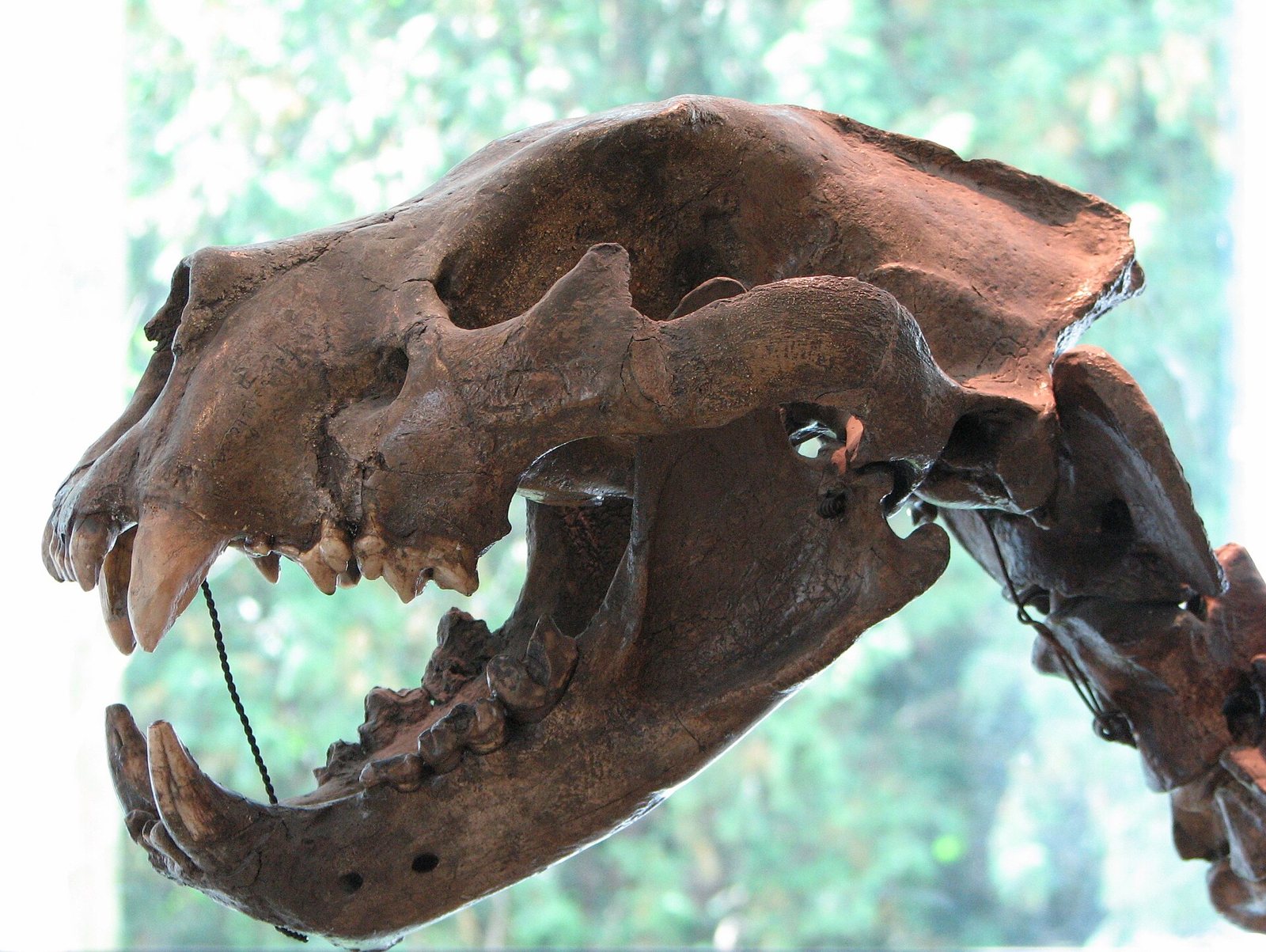
The same museum's archive holds a photograph from December 1902 catalogued as the skull of a British cave lion, under the name *Felis spelaea*.
In Oregon, the U.S. Geological Survey's photograph of the Paleontology Museum at John Day Fossil Beds National Monument shows a modern lion skull set beside fossil sabertooth cat skulls and a rhinoceros skull. It is a good lesson in how wide "big cat skull" can be. Sabertooths belong to very different extinct lineages, and the Smilodon skull story covers the most famous of them. The National Park Service also catalogues a fossil known as the John Day "Tiger," *Pogonodon platycopis*, from Oregon's Blue Basin, dated in the catalogue to 28 million years ago. The "Tiger" is an old nickname; the animal was not a modern tiger.
If you want to look closely at a real lion skull without a plane ticket, the California Academy of Sciences skull collection has an online record for *Panthera leo*, specimen CAS:MAM:21446, collected in Botswana in 1974.
Big cat skulls through time
Tap or hover a step to follow the order.
About 28 million years ago
The fossil cat Pogonodon platycopis, later nicknamed the John Day "Tiger," lived in what is now Oregon's Blue Basin.
1280 to 1385
The older of the two Tower of London Barbary lions lived, according to the Natural History Museum's dating.
1420 to 1480
The younger Tower of London Barbary lion lived.
December 1902
A photograph catalogued as a British cave lion skull, Felis spelaea, entered the Natural History Museum archive.
1937
Workmen found the two lion skulls in the moat at the Tower of London.
1974
The lion skull now recorded as CAS:MAM:21446 at the California Academy of Sciences was collected in Botswana.
2012
Naples and Rothschild described a jaw porosity clue for telling male lion skulls from female ones.
2025
Formanová and Kubátová published a set of skull characters for telling lions from tigers.
Owning or keeping a lion skull
This is general information, not legal advice, and the law differs from country to country and state to state. Whether anyone may hold a lion skull depends on how the specimen was obtained, where it is now, and whether it is being sold, shipped, imported or exported.
Lions and tigers are listed under CITES, the international treaty on trade in endangered wild animals and plants. The U.S. Fish and Wildlife Service explains that CITES-listed wildlife parts need permits to cross a border, and that applies to personal-use shipments too. Federal, state, Tribal and local rules can add their own requirements. The 2022 Big Cat Public Safety Act, as the Fish and Wildlife Service describes it, deals with live big cats, lions, tigers and cougars among them, rather than skulls.
The practical step is the same for everyone: keep whatever paperwork came with a specimen, and ask the U.S. Fish and Wildlife Service or your country's wildlife authority before you hold, pass on or move one. For general information about skulls people come across outdoors, read found an animal skull.
FAQ
Short answers on the look of a lion skull, the teeth, photos and the Tower of London lions.
What does a lion skull look like?
A lion skull, *Panthera leo*, usually has a flatter top than a tiger's, a wide palatine notch at the back of the palate, and oval openings on the skull base that turn toward the sides. Its lower jaw may rock when set on a flat surface, and it has 30 permanent teeth. Individual lions vary, so these features work best read together.
Do lion and tiger teeth differ?
Not in number or arrangement. Both normally have 30 permanent teeth with the formula I3/3, C1/1, P3/2, M1/1, so the count tells you that you have a large cat but not which one. The skull shape, sutures and underside carry the difference.
Can you identify a big cat skull from a photo?
Sometimes you can make a good guess. A clear side view shows the profile and the nose bones, but several of the most useful features sit on the underside of the skull, in the palate and in the sutures. Treat an identification from a single photo as a best guess, and trust a museum's own label where one exists.
Was the Tower of London lion a cave lion?
No, the two Tower of London skulls belonged to Barbary lions, *Panthera leo leo*, kept in the royal menagerie. The Natural History Museum dates them to between 1280 and 1385 and between 1420 and 1480. Wild cave lions had disappeared from Britain long before, after the last ice age.
Putting the clues together
A lion skull and a tiger skull are close cousins, and that is why they are fun to compare. Look at the profile first, follow the seams on the nose, turn the skull over for the palate, and give the jaw a gentle test on the table. No single clue decides it, but four or five of them pointing the same way usually do.
Lion or tiger? Test yourself
Answer every question to check.
Terms in this story
Tap a term to see what it means.
Rostrum. The snout part of the skull, in front of the eye sockets. Tigers usually have a shorter, broader rostrum than lions.
---