

No. 341
Antelope Skull: Horns, Not Antlers, and How to Tell Which Antelope It Is
An antelope skull carries horns, not antlers. Each horn has a permanent bony core that grows out of the skull and is covered by a sheath of keratin, and in most antelope that sheath stays on for life and keeps growing. Antlers are a deer-family feature: they are solid bone, they grow from short stalks of bone called pedicles, and they are normally shed and regrown every year.
Telling which antelope you have takes the whole skull, not just the horns. Size and proportions, the tooth rows, the snout, the eye sockets and where the horn cores sit all count, and the horn shape then narrows things down. A spiral points one way, a lyre another, a long straight spear another again. North America adds one more puzzle, the pronghorn, whose horns follow rules of their own, and a mount on the wall needs a little care to stay in good shape.
Horn or antler: what is on the skull
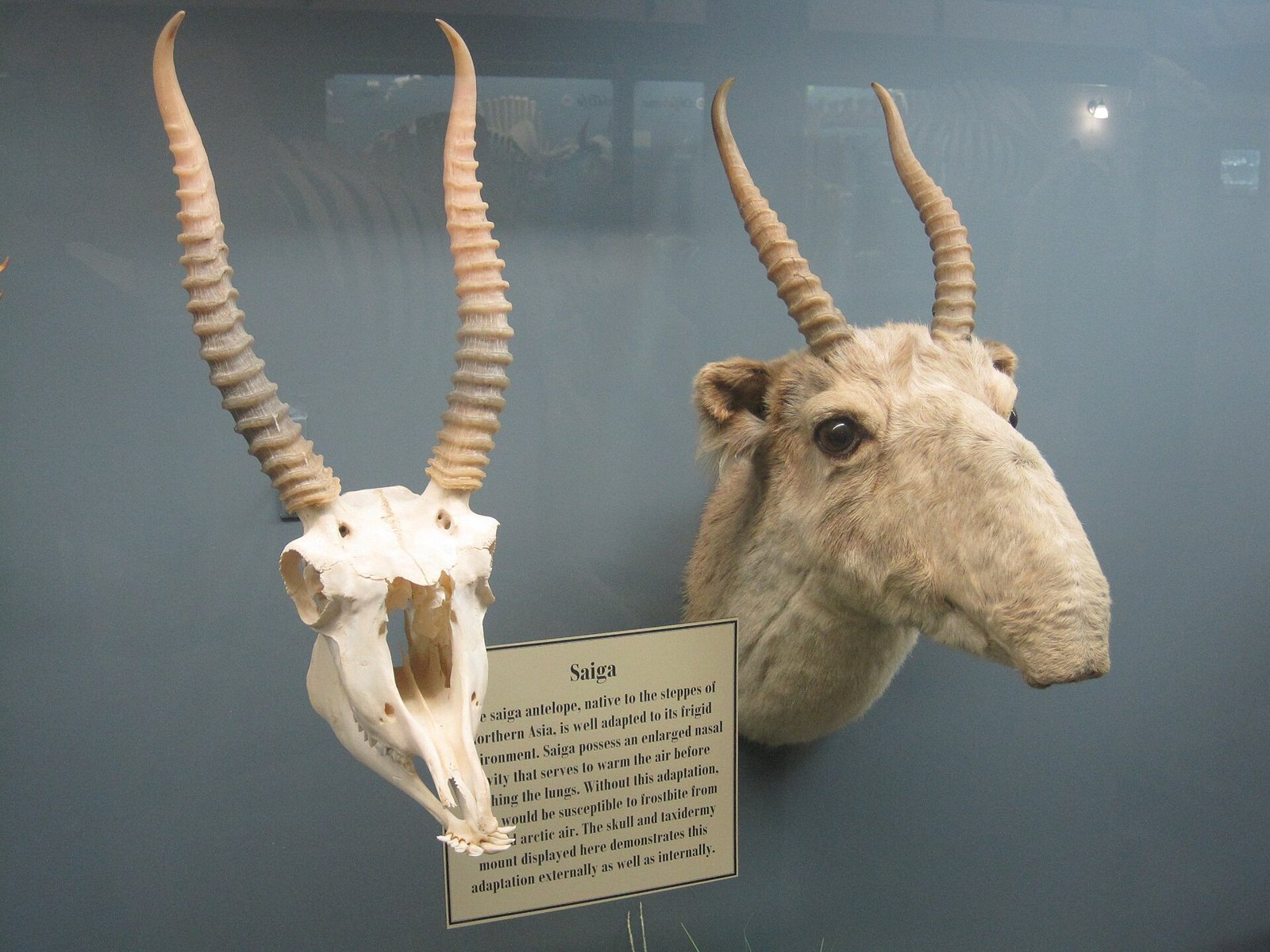
The American Museum of Natural History and the National Park Service describe the difference the same way. A true horn is built in two parts. The inner part is a core of bone fused to the skull. The outer part is a sheath made largely of keratin, the same broad family of material found in hair, feathers and fingernails. Horns generally grow throughout an animal's life and are not dropped.
Antlers work on a different plan. They are made entirely of bone, they grow from pedicles on the skull, and deer normally cast them and grow a new set each season. While an antler is growing it is wrapped in velvet; once the velvet is shed, there is no outer covering at all. If the skull on your wall has branching bone tines with no sheath, you are probably looking at a deer, and the deer skull identification story is the better place to start.
Antelope sheaths come in plenty of finishes. The San Diego Zoo and the museum guides describe them as smooth, ridged, curved or fluted, depending on the species. That variety is a big part of how identification works.
What about an antelope skull with no horns at all? Very often it still has them, in a sense. The bony cores belong to the skull and stay with it. The keratin sheaths are the part that can come away, so a skull that has lost its sheaths still shows the two bony cores where the horns used to be. It is still a horned skull; it has just lost its outer layer.
Tap or hover a row to highlight it.
| Feature | Horn | Antler | Pronghorn headgear |
|---|---|---|---|
| FeatureCore | HornBone | AntlerBone | Pronghorn headgearBone |
| FeatureOuter covering | HornKeratin sheath | AntlerNone after velvet is shed | Pronghorn headgearKeratin sheath |
| FeatureUsually found on | HornBovids, including antelope | AntlerDeer family | Pronghorn headgearAntilocapra americana |
| FeatureBranching | HornUsually not branched | AntlerCommonly branched | Pronghorn headgearMale sheath branches |
| FeatureShedding | HornUsually permanent | AntlerUsually annual | Pronghorn headgearSheath annual, bony core permanent |
Reading the skull as a whole
It is tempting to name an antelope from its horns alone, and the horns do carry a lot of information. Still, a single photograph or one loose horn is rarely enough to pin down the species. The clues that matter work together: the overall size and proportions of the skull, the tooth rows, the length of the rostrum (the snout part of the skull), the shape of the eye sockets, the position of the horn cores, and finally the form of the horns themselves.
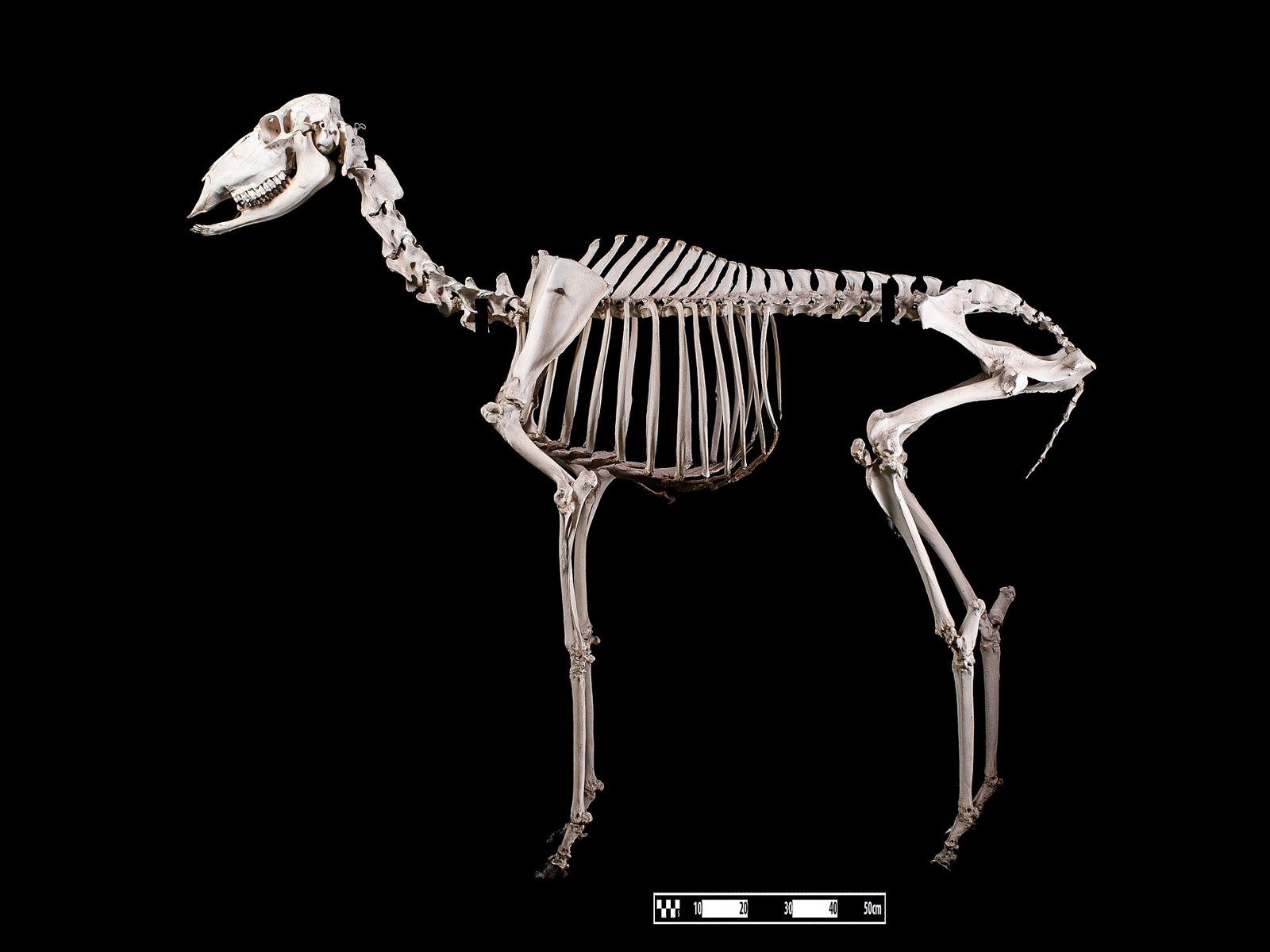
Professional keys are built the same way. The CITES-linked trophy identification guide splits identification into three keys: one by silhouette, one by horns and antlers, and one by skull. Its skull key is written specifically for specimens that have no horns or antlers left, which is a useful reminder that the bone alone holds plenty of evidence.
The University of Georgia mammal skull key shows how tooth characters and skull proportions are used to separate species. It is mainly a North American key, though, so it will not walk you through every African antelope. Treat it as a lesson in method rather than a full answer for a kudu or an oryx.
Whatever key you use, a species name stays provisional until you know where the skull came from, have something in the photo for scale, and can see the teeth and the skull clearly. For a firm answer, a regional natural history museum, a state wildlife skull key or a university comparative collection is the place to ask.
Six antelope skulls and their horns
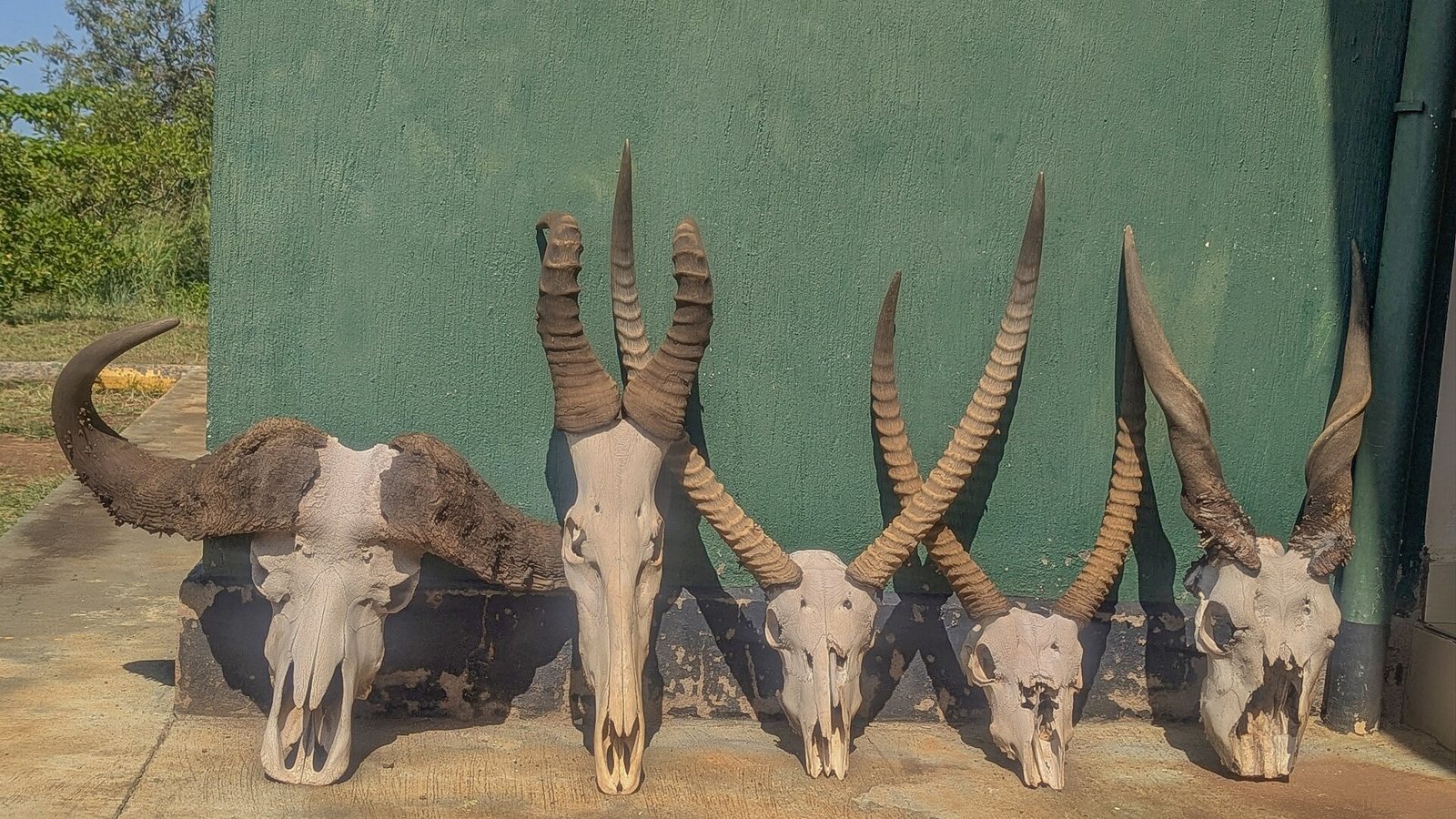
Six antelope turn up again and again on walls and in collections, and each has a horn shape that gives it away. Scientific names are worth keeping beside the common ones, because common names shift from place to place.
The greater kudu, *Tragelaphus strepsiceros*, has a large skull, and the males carry long spiraled horns, usually with two major twists. They are the corkscrews of the group. The California Academy of Sciences holds a complete greater kudu skeleton collected in Tanzania on 14 December 1931.
The impala, *Aepyceros melampus*, has a smaller, lighter skull. Male horns rise in an open lyre shape with ridged surfaces. The University of St Andrews keeps an impala skull and horns in its museum collections.
The oryx, the *Oryx* species, are known for long horns that run nearly straight or curve gently back. The gemsbok, *Oryx gazella*, is the southern African oryx, with especially long, straight, narrow horns that run close to parallel and a strong, elongated skull. According to Animal Diversity Web, the gemsbok is native to southern and eastern Africa and has also been introduced into Mexico and the southwestern United States, so a gemsbok skull in North America does not have to have crossed an ocean.
The springbok, *Antidorcas marsupialis*, has a medium-small skull. Its horns are ridged and curve backward, then hook inward toward the tips.
The wildebeest, the *Connochaetes* species, has a broad, heavy skull. Its horns sweep outward and downward before turning up again, and their thick base gives a distinctive boss-like look.
If your skull has horns that curl in a tight, ridged coil close to the head, it may belong to a different branch of the horned family altogether, and the ram skull and goat skull stories are worth a look. The sheep skull and bison skull stories cover two more horned relatives.
Tap or hover a row to highlight it.
| Common name | Scientific name | Visible clues |
|---|---|---|
| Common nameGreater kudu | Scientific nameTragelaphus strepsiceros | Visible cluesLarge skull; male horns long and spiraled, usually two major twists |
| Common nameImpala | Scientific nameAepyceros melampus | Visible cluesSmaller, lighter skull; male horns an open lyre with ridges |
| Common nameOryx | Scientific nameOryx species | Visible cluesLong horns, nearly straight or gently curved |
| Common nameSpringbok | Scientific nameAntidorcas marsupialis | Visible cluesMedium-small skull; ridged horns curve back, then inward at the tips |
| Common nameGemsbok | Scientific nameOryx gazella | Visible cluesSouthern African oryx; long, straight, narrow horns and a strong, elongated skull |
| Common nameWildebeest | Scientific nameConnochaetes species | Visible cluesBroad, heavy skull; horns curve out and down, then up, from a boss-like base |
The pronghorn, North America's odd one out
In North America, the skull many people call an antelope belongs to the pronghorn, *Antilocapra americana*. Its headgear sits halfway between the two systems above, which is exactly why it causes so much head-scratching.
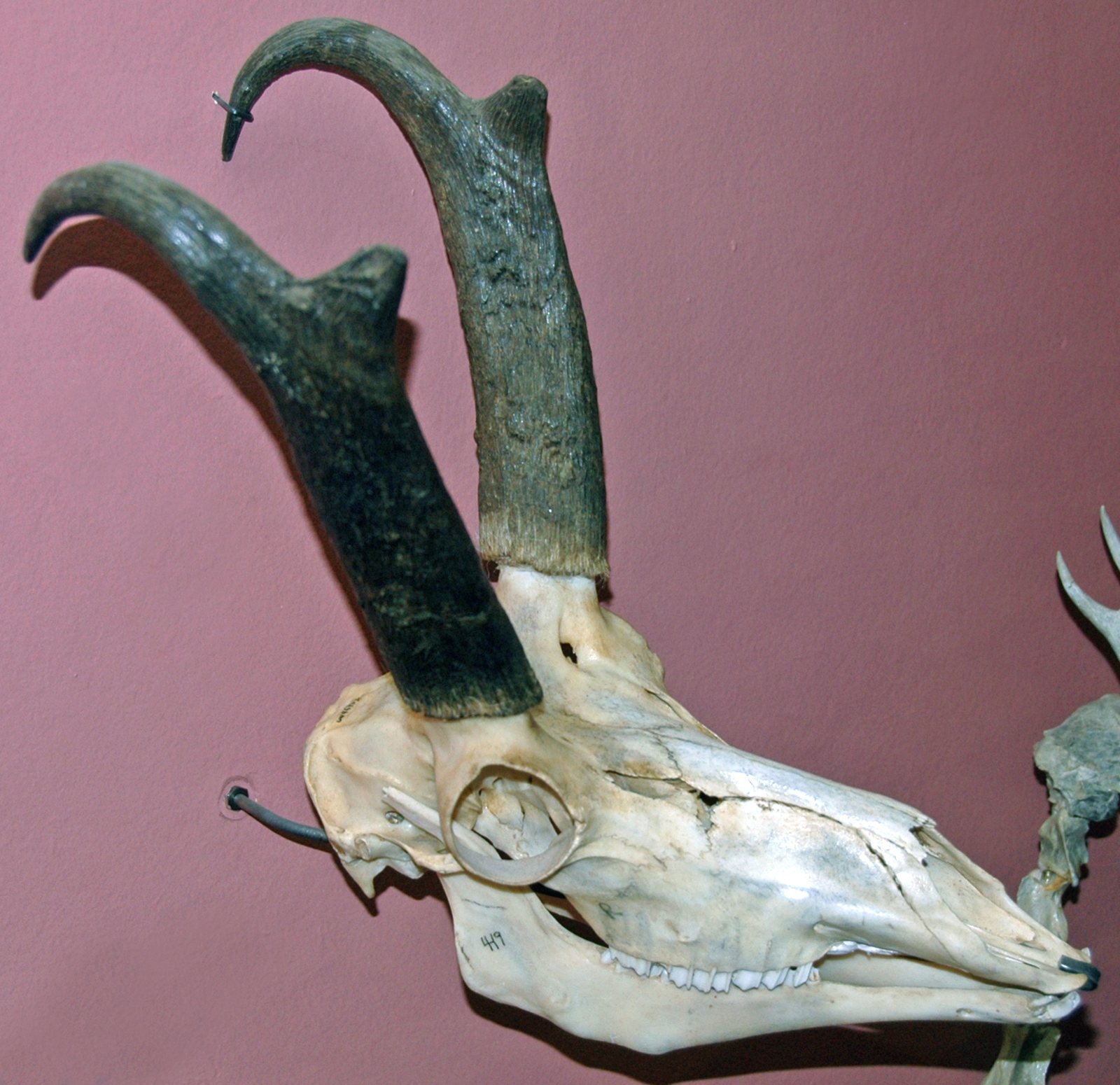
A pronghorn has a flattened, permanent bony core rising from the skull, covered by a keratin sheath, just like a true horn. The twist is that the sheath does not stay. Colorado Parks and Wildlife explains that pronghorns shed the sheath every year and grow a new one over the core, which stays in place for life. In males the sheath branches into a prong. Every year the pronghorn trades in its coat and keeps the hanger.
So, are pronghorn horns really horns? Yes: a bony core under a keratin sheath is the definition of a horn. What makes them unusual is the shedding and the branching sheath.
The National Park Service at Yellowstone gives the sizes. Adult males usually have horns about 10 to 16 inches long. About 70 percent of females also have horns, but theirs average only 1 to 2 inches and are not pronged.
The pronghorn is also not a true antelope. The Texas Parks and Wildlife Department notes that it is the only living species in its own family, Antilocapridae. "Pronghorn antelope" has stuck as a common name because the animal resembles the Old World antelope, and plenty of people still use it.
When a horn sheath comes loose
Finding a sheath lying beside its skull, or slipping off a mount, is common, and it is not the end of the specimen. The Canadian Conservation Institute is clear that horn sheaths are keratin, not bone, so they need different handling from bone and should not be treated as if they were antlers.
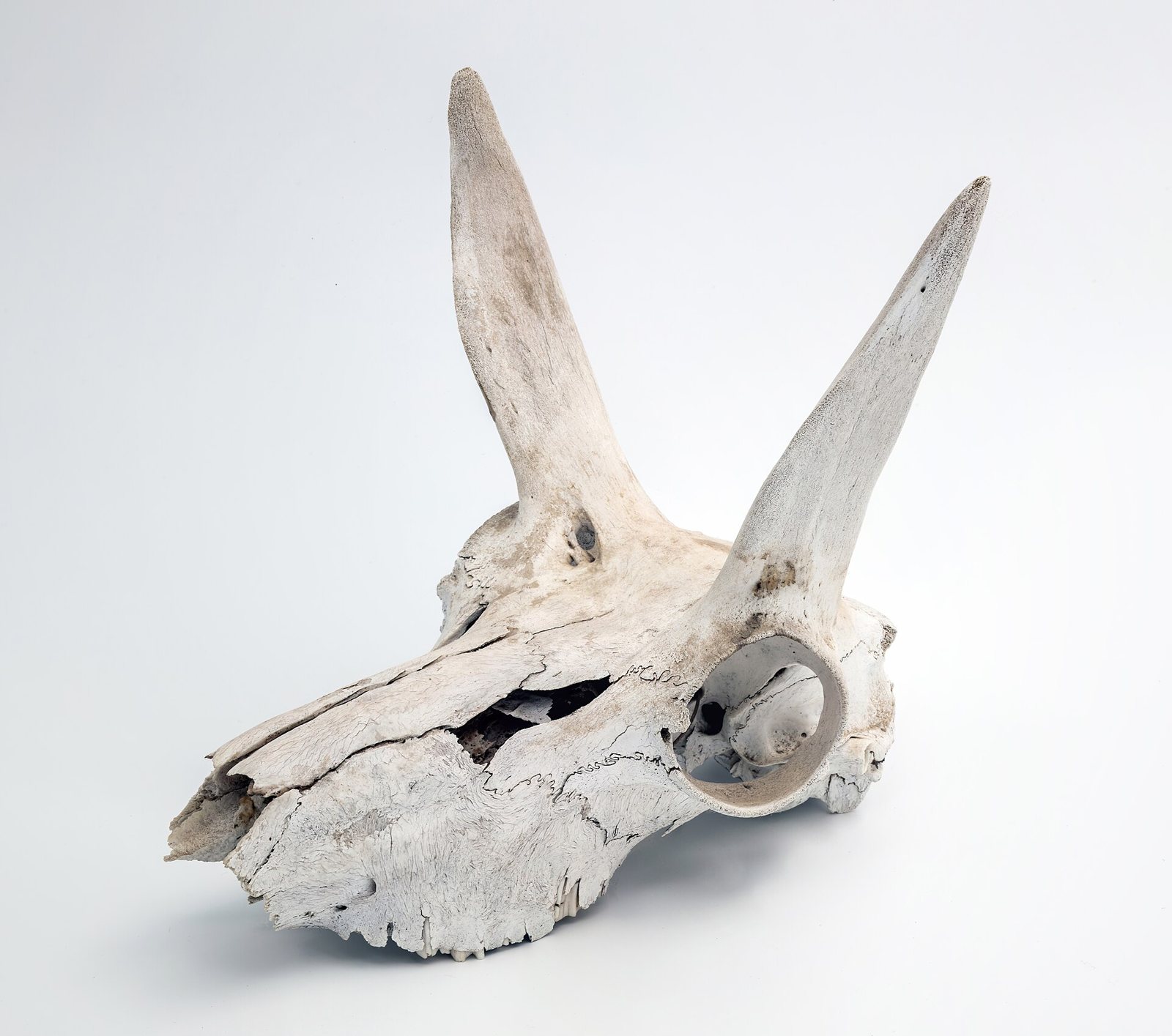
The practical steps are simple. Keep a detached sheath together with the skull it came from, and label it with what the specimen is, so the pair never gets separated or mixed up with another skull. If the sheaths on a mount are loose, cracked or smell bad, talk to a qualified conservator or an experienced taxidermist before reaching for oils, bleach, heat or glue. Each of those can do lasting harm to keratin.
Caring for an antelope mount
An antelope mount is mostly about steady, gentle conditions. The Canadian Conservation Institute's note on the care of mounted specimens recommends a relative humidity of roughly 45 to 55 percent. Mould can start to grow above about 65 percent, while very dry air can dry the material out until it cracks and turns brittle. Fast swings between damp and dry are hard on it too.
Light and heat matter as much as moisture. Keep the skull and its sheaths out of strong sunlight and ultraviolet light, choose low-light display, and avoid hanging a spotlight close enough to bake it. Damp rooms are a poor choice. Where you can, an enclosure such as a display case keeps dust off.
Older mounts deserve one extra precaution. The institute's guidance on natural history collections recommends HEPA-filtered vacuuming in the room around them and suitable protective gear when handling old taxidermy, because historic treatments may have left hazardous residues on the specimen.
If your skull is a raw find rather than a finished mount, cleaning comes first, and that is its own process; the how to clean an animal skull story walks through it. For displaying a cleaned skull on a plaque without the cape, the European mount story covers that style.
Antelope mount care checklist
Tap a card to bring it forward.
- Humidity: Aim for roughly 45 to 55 percent relative humidity for a mounted specimen.
- Mould risk: Mould can develop above about 65 percent relative humidity, so avoid damp rooms.
- Dry air: Very dry conditions can cause cracking and brittleness, and fast humidity swings add stress.
- Light and heat: Use low light, keep it out of sunlight and UV, and keep spotlights from heating it.
- Dust: Use an enclosure such as a display case where practical.
- Loose sheaths: Keep a detached sheath with its own skull and label it with the specimen identity.
- Repairs: Ask a conservator or experienced taxidermist before using oils, bleach, heat or adhesives.
Found one, or bringing one home
This part is general information only. It is not legal advice, and the rules change from one state and country to the next.
If you came across an antelope or pronghorn skull outdoors, whether you may keep it depends on where it was, what species it is and the rules that apply there. The found an animal skull story sets out the general points. Before you take a find home, ask your state wildlife agency or the US Fish and Wildlife Service.
A skull or trophy coming into the United States from abroad is a different matter, handled by federal agencies. The US Fish and Wildlife Service sets out wildlife permit requirements on its import and export permits page (dated September 21, 2026). For a sport-hunted trophy of a species protected under CITES or the Endangered Species Act, the agency uses permit application 3-200-20. Animal-health rules come from USDA APHIS: its animal product import page (dated June 18, 2026) covers animal-derived products and inspection by US Customs and Border Protection, and its approved establishments guidance (dated January 15, 2026) addresses cleaned and dried horns and bones and finished trophies. Travelers carrying wildlife or animal products need to declare them for inspection. Requirements shift, so confirm the current rules with USFWS, APHIS and CBP before any trip or shipment.
FAQ
A few more questions that come up about antelope skulls and their horns.
What does an antelope skull look like?
An antelope skull has a long snout, teeth built for cutting and grinding plants, and, in species with horns, two permanent bony horn cores on the front of the skull. In life those cores are covered by keratin sheaths. The overall shape varies a great deal: a greater kudu has spiral horns, an impala lyre-shaped horns and a gemsbok long, nearly straight ones.
Do antelope shed their horns?
Most antelope keep their horns for life, and the sheaths keep growing. The pronghorn is the exception, and even it sheds only the keratin sheath each year while the bony core stays on the skull.
Do female antelope have horns?
It depends on the species. About 70 percent of female pronghorns carry short horns averaging 1 to 2 inches, with no prong. The long spiral kudu horns and the lyre-shaped impala horns described in identification keys are the males', so check a key for the species you have in mind.
Can you tell an antelope species from the skull?
Often you can, by comparing the whole skull, the teeth and the horn shape with a museum or wildlife key. The answer stays provisional without knowing where the skull came from and without a clear sense of its size. A natural history museum or university collection can confirm a difficult one.
Why is a pronghorn called an antelope?
It resembles the Old World antelope, so "pronghorn antelope" became a common name in North America. Biologically it stands alone as the only living member of the family Antilocapridae.
Horns that tell you who they belong to
An antelope skull is easier to read once you know that its horns are two things at once: bone that belongs to the skull and keratin that covers it. Look at the whole skull, then the horn shape, and the kudu's spiral, the impala's lyre and the gemsbok's long spears start to sort themselves out. If your skull shares a wall with other African trophies, the warthog skull story explains those curved tusks, and human vs animal skull is a good next read for anyone sorting a mixed collection.
Antelope skull quiz
Answer every question to check.
Terms in this story
Tap a term to see what it means.
Horn core. The permanent bone at the center of a horn, attached to the skull. It stays with the skull even when the sheath comes off.
---