

No. 344
Tarsier Skull: Why the Eye Sockets Are So Big and How the Tarsier Turns Its Head
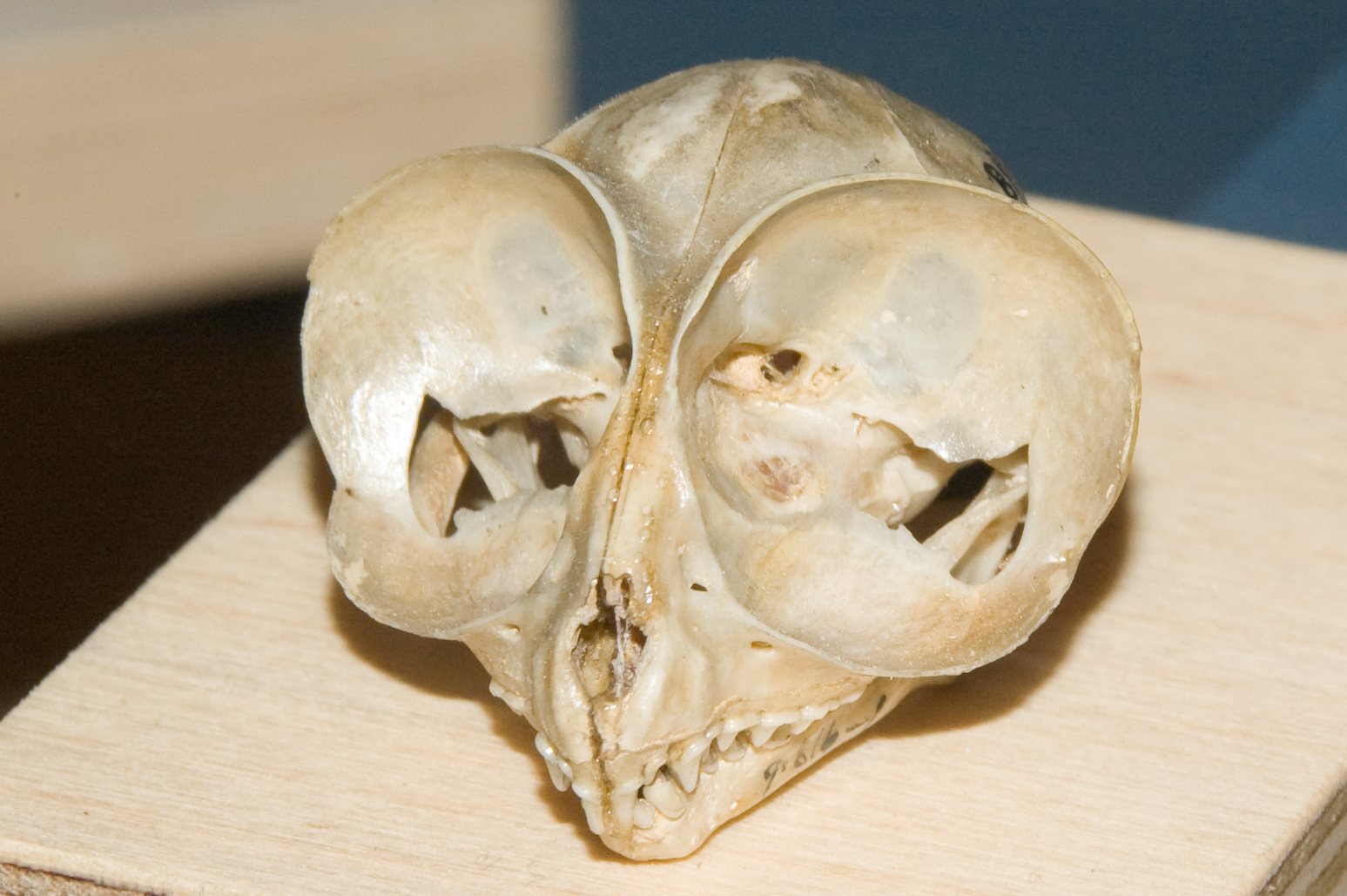
A tarsier skull is built around its eyes. Tarsiers are primates that hunt at night, and their eyes are so large that in measured specimens a single eye was about 80 to 120 percent of the volume of the brain, according to Alfred L. Rosenberger's 2010 study of the tarsier skull. Those huge eyes gather light in the dark forest, and that is why the eye sockets swallow most of the face.
The eyes come at a price: they are effectively fixed in the skull and cannot roll around the way ours do. To look somewhere new, a tarsier turns its head instead, and it can turn it a very long way, nearly 360 degrees, or almost 180 degrees in each direction, according to Michigan State University's Comparative Mammalian Brain Collections.
A skull built around two eyes
Seen from the front, a tarsier skull looks almost like a pair of eye sockets with a braincase attached at the back. The orbital fossae, the bony hollows that hold the eyes, are enormous, face forward and take up much of the face. Rosenberger's study, *The Skull of Tarsius*, describes the orbits as recessed and the eyeballs as unusually positioned.
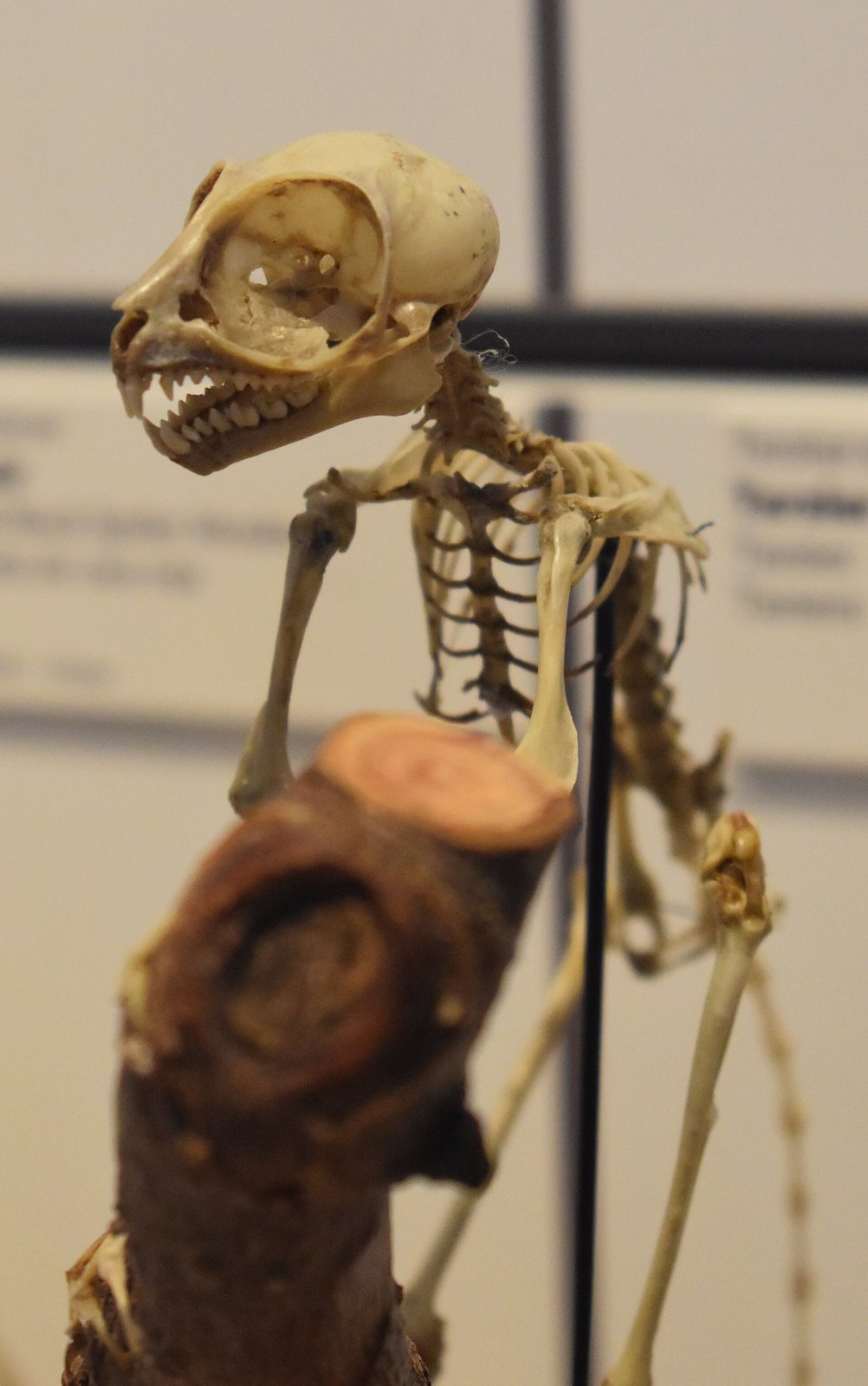
The rest of the skull has made room for them. Rosenberger describes the brain as tilted upward and the braincase as rounded, and he notes a shifted foramen magnum, the opening at the base of the skull where the spinal cord passes through. In a skull this dominated by its eyes, everything else seems to have shuffled along to fit.
There is protection, too. A university-level primate overview published on LibreTexts Español describes a partially closed postorbital plate, a sheet of bone behind each socket that helps shield the eye.
If you want to see one for yourself, a tarsier skull photographed at the Cleveland Museum of Natural History is shared under an open licence, and the University of Michigan Museum of Zoology has photographed a Philippine tarsier cranium from below.
Reading a tarsier skull
Tap a card to bring it forward.
- Orbits: Enormous, forward-facing eye sockets take up much of the face.
- Set-back sockets: The orbits are recessed and the eyeballs sit in an unusual position.
- Brain: The brain is tilted upward inside a rounded braincase.
- Foramen magnum: The opening for the spinal cord at the base of the skull is shifted.
- Postorbital plate: A partially closed plate of bone behind each socket helps protect the eye.
Is each eye really as big as the brain?
Often, yes, though the exact number depends on the tarsier and on how you measure. In the wet specimens Rosenberger worked with, a single eye measured roughly 80 to 120 percent of the volume of the brain. At the low end, one eye is a little smaller than the brain; at the high end, it is a little bigger.
Put both eyes together and the comparison gets even more lopsided. Rosenberger's model estimated the combined mass of the two eyes at roughly twice the mass of the brain. So, the honest headline is that each eye can be about as large as, or larger than, the brain, and that the pair together outweigh it. The ratio shifts with the specimen, the species and the measuring method, so no single figure fits every tarsier.
It is a rare animal that could fairly say its eyes are its biggest asset.
Why tarsier eyes are so big
Tarsiers are nocturnal hunters. They go after insects and other prey in dark forest, and in that setting every bit of light counts. Bigger eyes collect more of it.
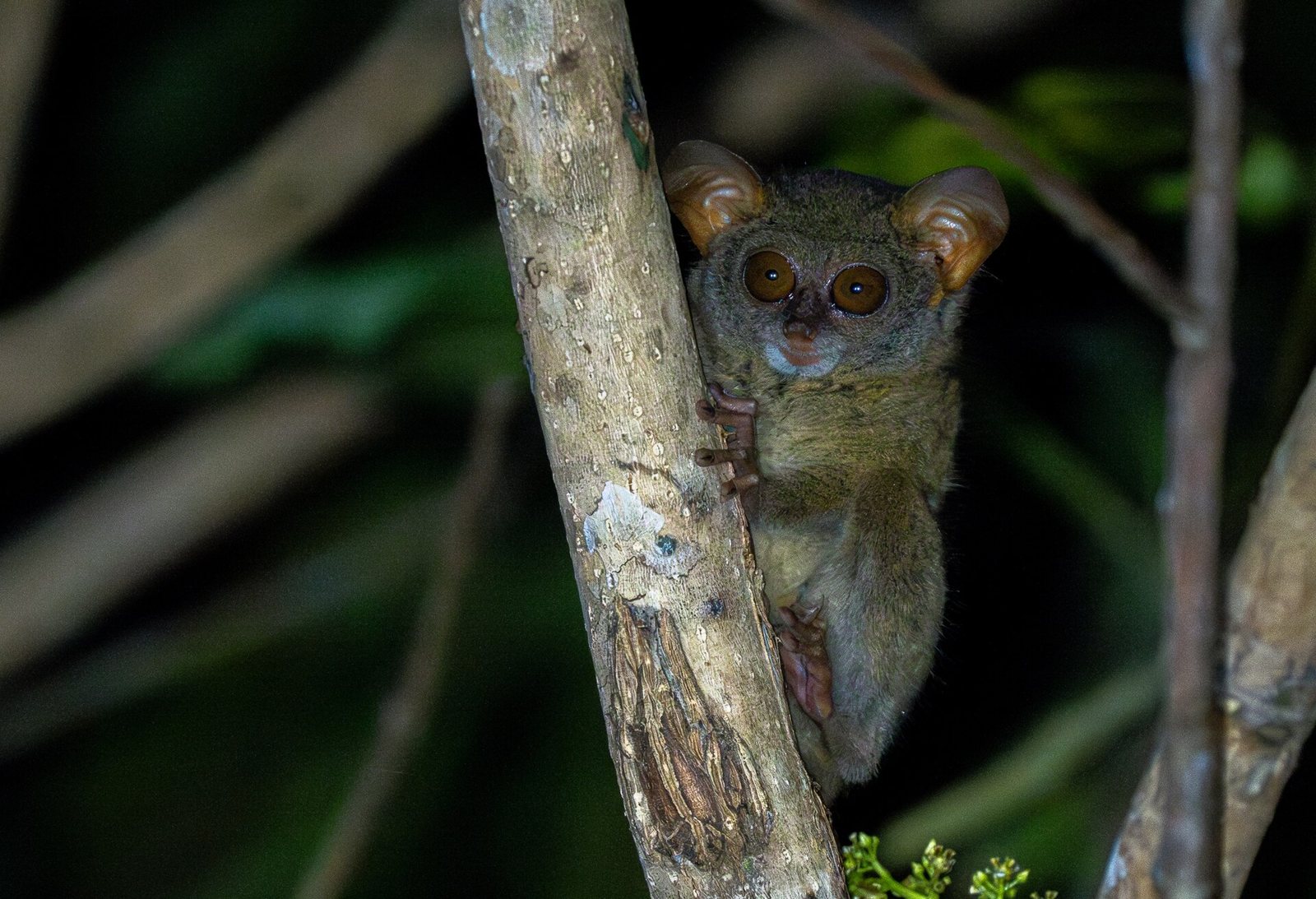
Many nocturnal mammals have a helper for this: the tapetum lucidum, a reflective layer in the eye that helps recycle light. Tarsiers do not have one, as both Rosenberger and the LibreTexts primate overview note. Without that reflective layer, sheer size has to do the work, and the result is eyes so large they shape the whole skull around them.
What those eyes are hunting for is animal prey, mainly insects. The University of Wisconsin-Madison's Primate Info Net lists grasshoppers, moths, beetles, ants and termites in the Philippine tarsier's diet, and Michigan State University's brain collection notes that tarsiers in captivity also eat small lizards and crustaceans.
Fixed eyes, turning head
Eyes that big do not move much. Tarsier eyes are effectively fixed in their sockets and cannot rotate the way human eyes can. A person can glance sideways without moving their head; a tarsier cannot.
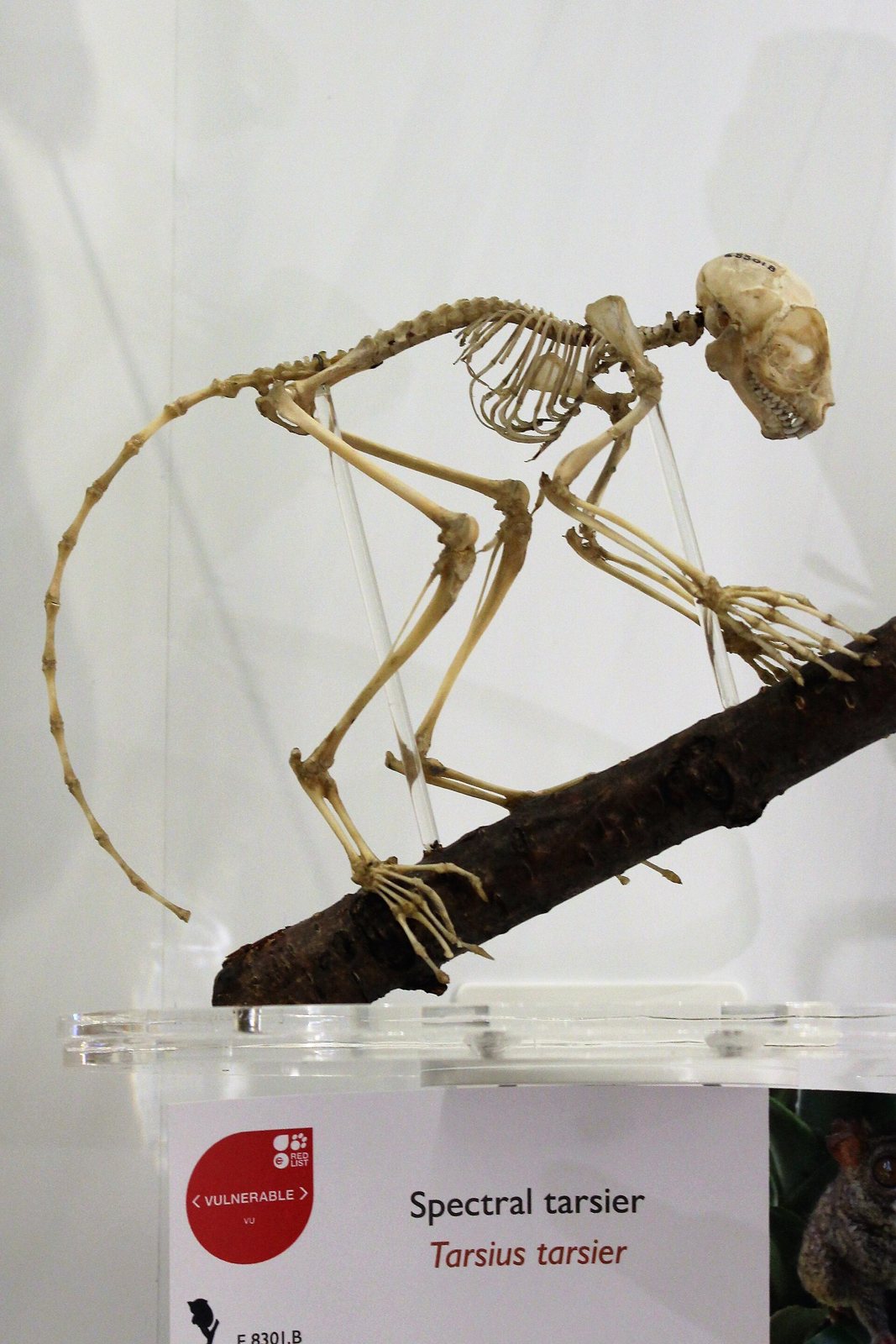
So, the tarsier moves the head instead. To aim its gaze, it turns its head and neck, and the range is striking. Michigan State University's Comparative Mammalian Brain Collections describes rotation of nearly 360 degrees, which is often put as almost 180 degrees in either direction. The University of Michigan's Animal Diversity Web also notes this head rotation. That is not the same as spinning the head all the way round like a dial; it is a very wide swing to the left and to the right, enough to look almost directly behind.
Owls are famous for turning their heads to look around too, and the owl skull story covers how that works in a bird.
Tap or hover a row to highlight it.
| Feature | Detail |
|---|---|
| FeatureEye size | DetailOne eye measured about 80 to 120 percent of brain volume in examined specimens |
| FeatureNight vision | DetailNocturnal, with no tapetum lucidum |
| FeatureEye movement | DetailEyes effectively fixed in the skull |
| FeatureHead movement | DetailNearly 360 degrees, or almost 180 degrees in either direction |
| FeaturePrimate group | DetailHaplorhini, alongside monkeys, apes and humans |
Where tarsiers sit among primates
Tarsiers are haplorhine primates, which puts them on the same branch as monkeys, apes and humans. They are neither lemurs nor monkeys; they are a group of their own within that branch.
Animal Diversity Web summarizes Christopher Ross's primate classification, which places tarsiers closer to the anthropoids, the group that holds monkeys, apes and humans, than to lemurs and lorises. Their exact position on the family tree has been debated over the years, but molecular and anatomical evidence supports their place among the haplorhines.
That makes the tarsier a useful comparison with its look-alikes. A tarsier and a lemur both have big forward-facing eyes, yet they sit on different branches. For the strepsirrhine side, the lemur skull story looks at a very different primate face built around a comb of front teeth. For more haplorhines, the chimpanzee skull and baboon skull stories cover two of the tarsier's haplorhine relatives.
Philippine and other tarsiers
Living tarsiers are found in island Southeast Asia. One of them is the Philippine tarsier, *Carlito syrichta*, which was long treated as *Tarsius syrichta* and is endemic to the southeastern Philippines.
A 2017 paper by Myron Shekelle, Colin Groves, Ibnu Maryanto and Russell Mittermeier, describing two new tarsier species, recognizes three living genera: *Tarsius* on Sulawesi and the islands around it, *Cephalopachus* in Sundaland, and *Carlito* in the Philippines. The same paper named *Tarsius spectrumgurskyae* and *Tarsius supriatnai*, both from northern Sulawesi.
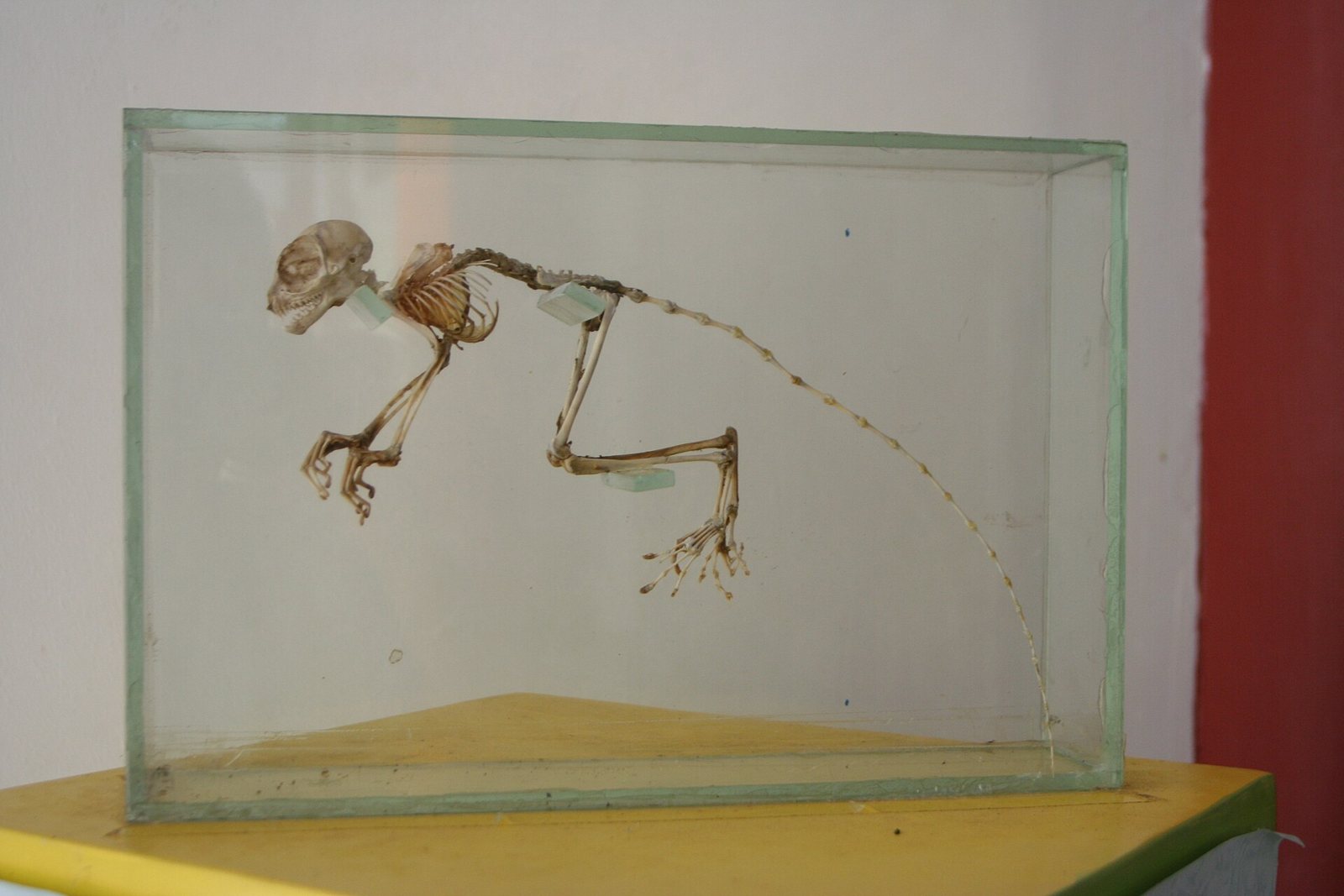
Tarsier skeletons also appear in displays. A photograph taken on April 25, 2005 shows a Philippine tarsier skeleton on display at the Philippine Tarsier Sanctuary in Corella, Bohol.
A tarsier skull and the law
Read this as general information, not legal advice; the rules are set country by country and, in the United States, state by state as well.
Tarsiers are listed in Appendix II of CITES, the international agreement on trade in wild animals and plants. A CITES Animals Committee document records the tarsier family under the primate listing in Appendix II, which means international trade in tarsiers, and in their parts, is regulated.
Before you move or keep any skull of a protected animal, contact your state wildlife agency or the US Fish and Wildlife Service and ask what applies to your situation. The found an animal skull story gives the general background. For study and display, a museum cast or a photograph from an open collection, such as the Cleveland and Michigan images above, lets you look closely at those enormous orbits without any of the questions a real specimen raises.
FAQ
A few more short answers about tarsiers and their skulls.
Can tarsiers move their eyes at all?
For practical purposes, no: tarsier eyes are effectively fixed in the skull. The head and neck do the looking, turning nearly 360 degrees in total to point those eyes where they are needed.
Is a tarsier a lemur or a monkey?
A tarsier is neither; it is a haplorhine primate in a group of its own. Its classification places it closer to monkeys, apes and humans than to lemurs and lorises.
Where do tarsiers live?
Tarsiers live in island Southeast Asia. The 2017 classification places *Tarsius* on Sulawesi and nearby islands, *Cephalopachus* in Sundaland and *Carlito*, the Philippine tarsier, in the southeastern Philippines.
Are tarsiers protected?
Yes, tarsiers are listed in CITES Appendix II, so international trade in them and their parts is regulated. Rules for owning or moving a specimen also depend on where you live, so check with your wildlife authority first.
Do tarsiers make good pets?
No, tarsiers do not make good pets, and in the Philippines keeping one is prohibited. Proclamation No. 1030 of June 23, 1997 declared the Philippine tarsier (listed under its older scientific name, *Tarsius syrichta*) a specially protected species and bars private possession except for certified educational, scientific or conservation research, as the Philippine Supreme Court E-Library records. Republic Act No. 9147 also prohibits collecting, possessing, trading or transporting wildlife without authorization.
Can you touch a tarsier or photograph it with a flash?
Please do neither: touching frightens and stresses tarsiers, and a camera flash frightens these nocturnal animals. On May 16, 2020, the Philippine Department of Environment and Natural Resources office in Davao (DENR-Davao) asked the public not to possess, trade, harm or touch tarsiers and not to use flash photography around them. The Philippine government also counts human intervention among the threats to tarsiers.
How long do tarsiers live?
Tarsiers have lived more than 17 years in captivity, the longest recorded for the genus according to Animal Diversity Web, while the oldest tarsier recorded in the wild was estimated at 10 years. Lifespan figures for individual species, including the Philippine tarsier, are still sparse.
All eyes, by design
A tarsier skull looks almost impossible at first: two vast eye sockets, a tilted brain tucked in behind them and very little else. It makes sense once you know the animal hunts at night without a reflective layer in its eyes, and that it has to swing its whole head to look around. For another skull built around unusual eyes and a turning head, the owl skull story is a natural next stop, and human vs animal skull shows how our own eye sockets compare.
Tarsier skull quiz
Answer every question to check.
Terms in this story
Tap a term to see what it means.
Orbital fossa. The bony hollow in the skull that holds the eye. In tarsiers the two orbital fossae take up much of the face.
---