

No. 302
Seal Skull or Sea Lion Skull? What You Found on the Beach
A skull on a sea beach that looks like a dog's or a bear's is very often a seal or a sea lion. Both are pinnipeds, and both are carnivorans with long snouts and real canine teeth, so the resemblance is honest. The quickest way to tell them apart from a dog or bear is the row of cheek teeth behind the canines: a seal or sea lion has a fairly even row of simple teeth, while a dog or bear has big slicing carnassials. The ear region and the bone around the eye sockets settle the rest.
Before you pick it up, one practical point. In the United States, every seal and sea lion is protected under federal law, so the first step is to leave the skull where it is and contact the NOAA Fisheries stranding network or regional office.
Seal or sea lion: earless seals and eared seals
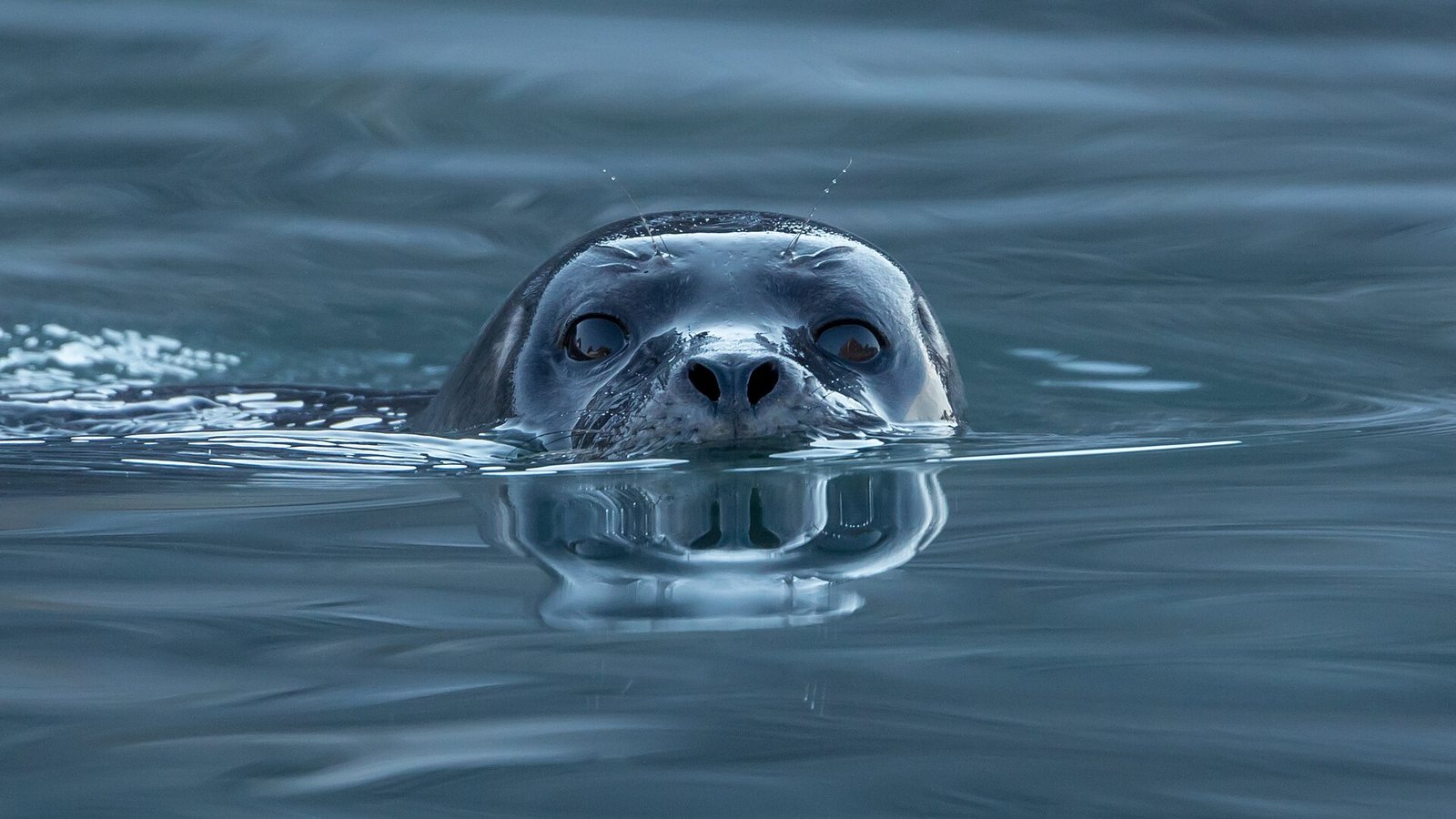
Pinnipeds split into two families that matter on a beach. True seals are phocids, also called earless seals. Sea lions and fur seals are otariids, the eared seals, which in life carry a small visible ear flap. NOAA Fisheries uses exactly that split, earless versus eared, in its guide to telling the two apart.
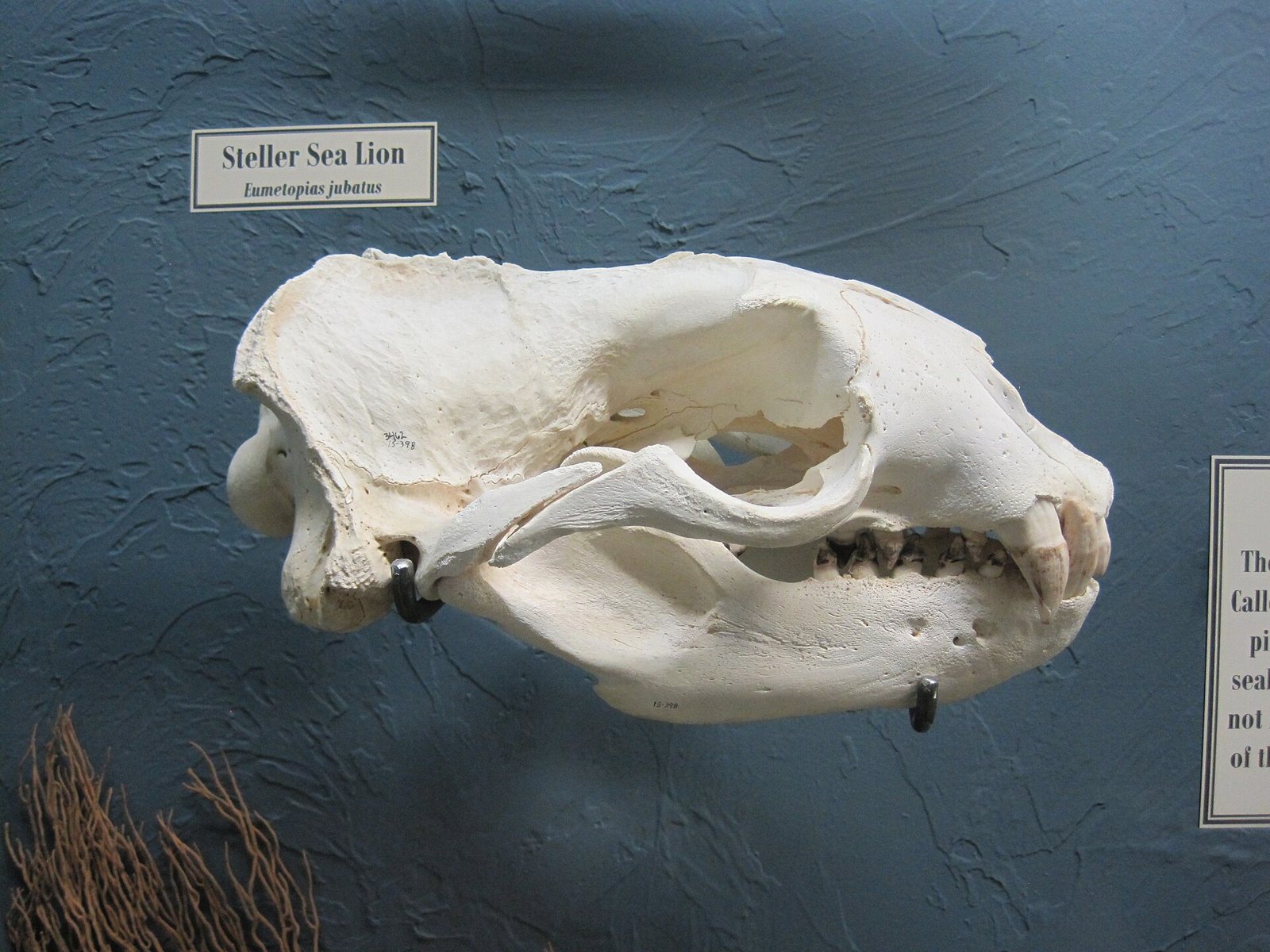
The skulls differ in ways you can see once you know where to look. The California Academy of Sciences published a pinniped skull identification guide for the Greater Farallones in 2021, and it gives clear, bone-level clues for the two most common West Coast species.
A California sea lion (*Zalophus californianus*) skull has large auditory bullae, the rounded bony capsules that hold the middle ear on the underside of the skull. The space between its eye sockets is narrow, and it has no postorbital processes, the little points of bone that stick out behind the eye. Its cheek teeth, the postcanines, are reduced and peg-like.
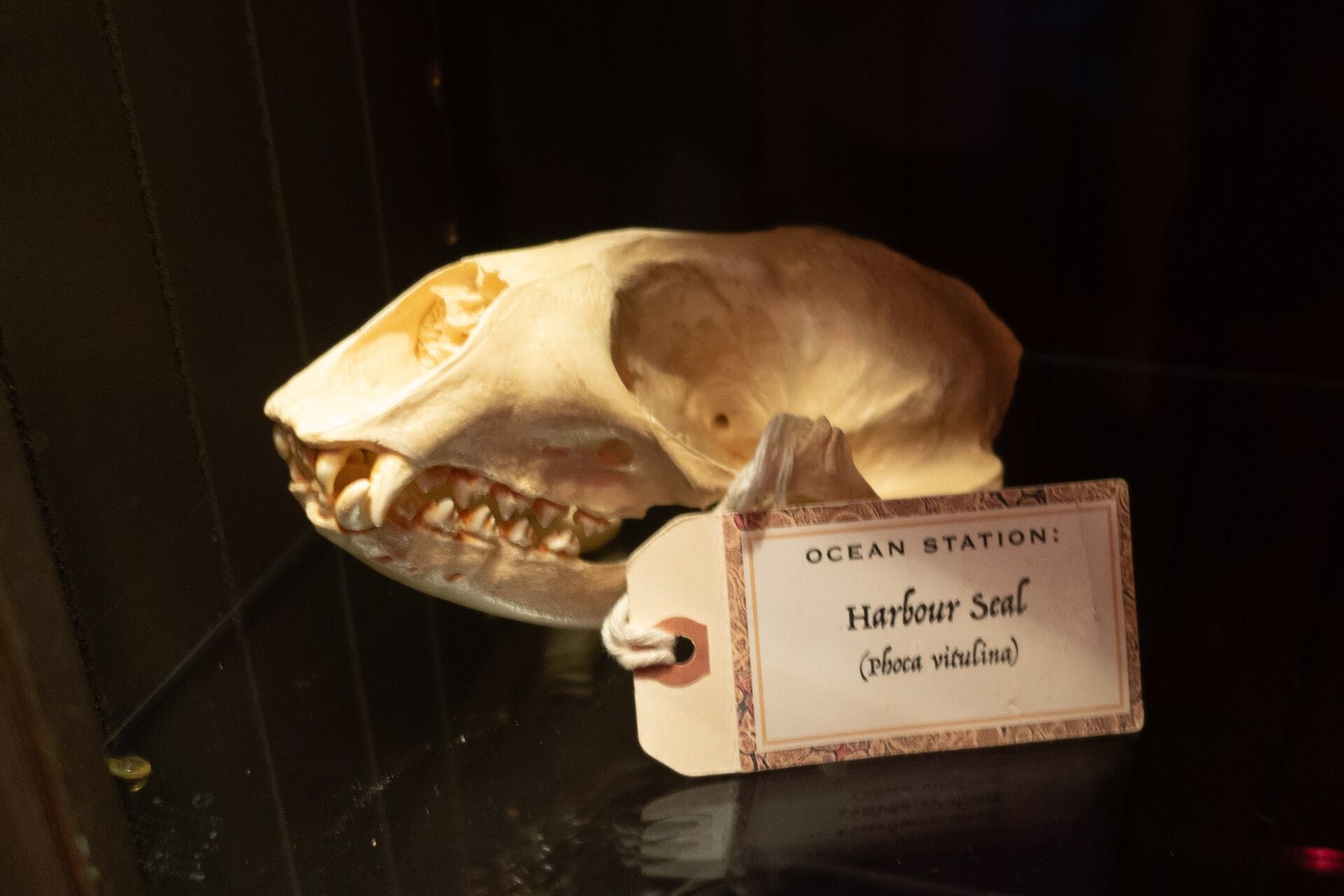
A harbor seal (*Phoca vitulina*) skull turns those clues around. It has triangular postorbital processes, a wider region between the eye sockets, and, in adult males, a pronounced sagittal crest, a ridge of bone running along the top of the braincase where jaw muscles attach. Its postcanine teeth usually have at least three cusps, so each one looks like a tiny crown rather than a simple peg.
Skull shape, tooth pattern, eye sockets and the ear region are the main clues for any mammal skull, as the Smithsonian National Museum of Natural History explains in its guide to reading one. A beach skull is often broken, sanded down or missing its lower jaw, though. If yours is damaged, compare several views and measurements against a museum or university skull key, or ask the regional stranding coordinator for help with the species.
Seal skull vs dog skull vs bear skull
A pinniped skull looks dog-like for a good reason: seals, sea lions, dogs and bears are all carnivorans, with long snouts and prominent canines. The differences show up in the teeth behind the canines, the tooth rows and the overall proportions.
The University of Georgia Mammal Skull Key separates a black bear (*Ursus americanus*) from the dog family by a short, broad rostrum, the snout section of the skull, and upper tooth rows that run parallel. A black bear skull is also generally longer than 310 millimeters. Canids, including the domestic dog (*Canis lupus familiaris*), have a longer, narrower rostrum and upper tooth rows that are not parallel. From there, the key uses the shape of the postorbital process and the length of the skull to separate wolf, red wolf, coyote and foxes.
The National Park Service comparison sheet points to the prominent carnassial teeth of dog and bear skulls, the big blade-like cheek teeth that shear meat. Virginia Tech describes a domestic dog's cheek teeth as a mix of piercing, slicing, grinding and crushing surfaces. A seal or sea lion has none of that variety. Its postcanine row is more uniform, and the skull carries pinniped ear and postorbital features that a dog or bear does not.
So, if the teeth behind the canines all look roughly alike, think seal or sea lion. If one big tooth on each side looks like a pair of shears, think dog or bear. Our dog skull identification guide and bear skull guide cover those two in detail, and the otter skull guide helps with another coastal look-alike that turns up on the same beaches.
Tap or hover a row to highlight it.
| Feature | Harbor seal (*Phoca vitulina*) | California sea lion (*Zalophus californianus*) | Dog or bear |
|---|---|---|---|
| FeatureGroup | Harbor seal (*Phoca vitulina*)True seal, Phocidae | California sea lion (*Zalophus californianus*)Eared seal, Otariidae | Dog or bearLand carnivorans |
| FeatureSkull clue | Harbor seal (*Phoca vitulina*)Triangular postorbital processes; wide space between the eye sockets | California sea lion (*Zalophus californianus*)Large auditory bullae; narrow space between the eye sockets; no postorbital processes | Dog or bearDog: long, narrow rostrum. Black bear: short, broad rostrum |
| FeatureCheek teeth | Harbor seal (*Phoca vitulina*)Postcanines usually with at least three cusps | California sea lion (*Zalophus californianus*)Reduced, peg-like postcanines; very large canines | Dog or bearProminent carnassial teeth |
| FeaturePermanent teeth | Harbor seal (*Phoca vitulina*)34 | California sea lion (*Zalophus californianus*)34 | Dog or bearVaries by species |
| FeatureTypical US beach region | Harbor seal (*Phoca vitulina*)Atlantic and Pacific coasts, Alaska to Baja California | California sea lion (*Zalophus californianus*)West Coast, southeast Alaska to central Mexico | Dog or bearDepends on local land animals |
Which seals wash up on which coast
Where you found the skull narrows the list quickly. On the Pacific coast of North America, the usual candidates are the harbor seal and the California sea lion, with the Steller sea lion (*Eumetopias jubatus*) and the northern fur seal (*Callorhinus ursinus*) joining them farther north.
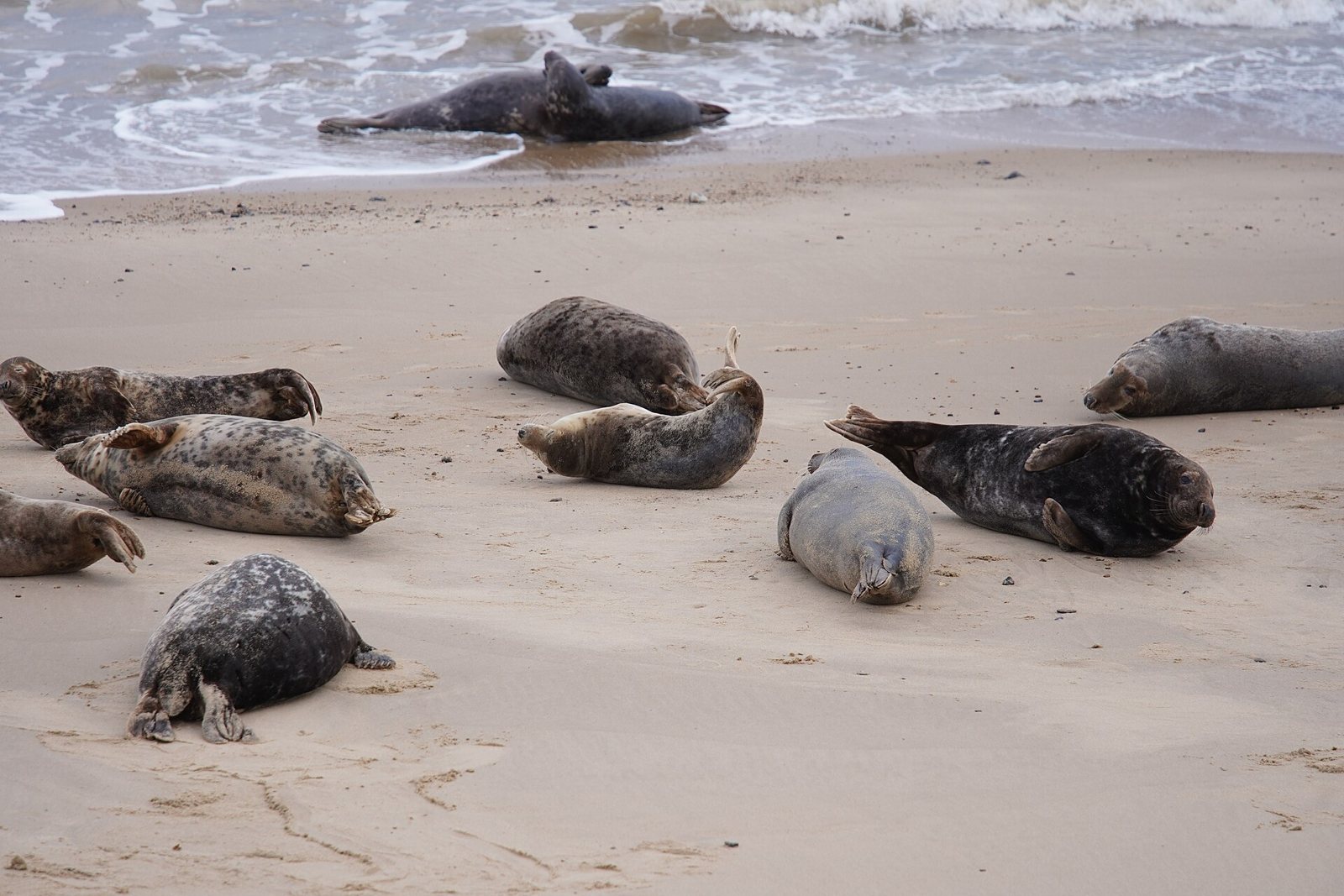
NOAA Fisheries places harbor seals on the West Coast from Baja California, Mexico, north to the Bering Sea, and in the East from the Canadian Arctic through the Mid-Atlantic. It counts 18 US harbor seal stocks, from Alaska and California to Washington's inland waters and the eastern USA and Canada stock.
California sea lions range from southeast Alaska to the Pacific coast of central Mexico. Their main US breeding range is around the Channel Islands and southern California, and they haul out on beaches, docks, buoys and jetties.
On the northeastern Atlantic coast, the big possibility is the gray seal (*Halichoerus grypus*). NOAA places the western North Atlantic gray seal stock in eastern Canada and the northeastern United States, with New England colonies including Muskeget, Monomoy and islands off Maine. NOAA's Share the Shore guidance for New England notes that gray seals use islands, sandbars and rocky coasts, while harbor seals are smaller and have a more dog-like face. A big seal skull on a New England beach may well be a gray seal.
Why seal teeth look the way they do
Seal teeth follow the way each species feeds underwater. In a 2016 study in the Journal of Anatomy, Brooke E. Kienle and Annalisa Berta compared skull and tooth form across phocid seals and linked them to four feeding styles: filter feeding, grip-and-tear feeding, pierce feeding and suction feeding.
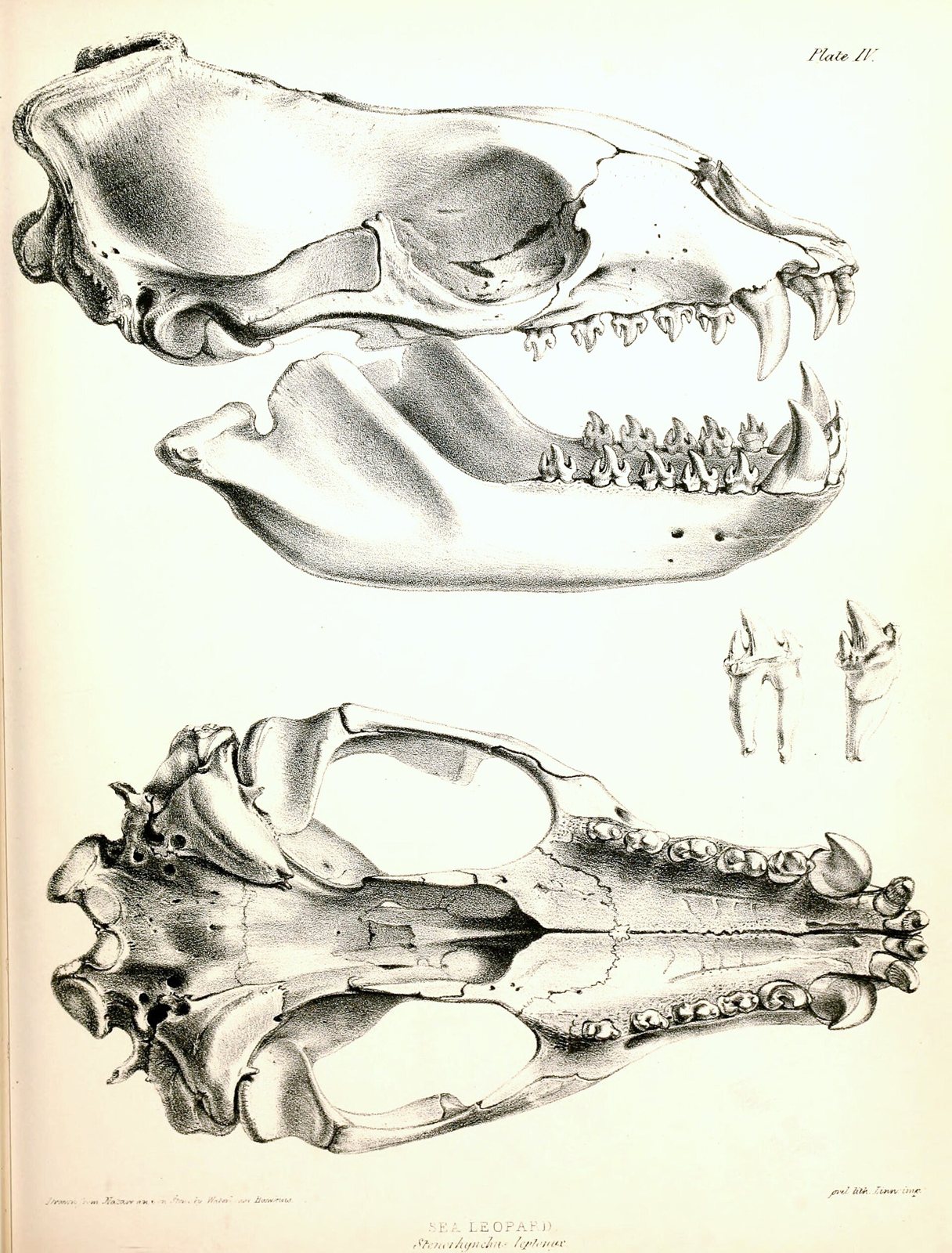
Most true seals are pierce feeders. Their pointed postcanine teeth catch and hold fairly small prey, which is often swallowed whole. The leopard seal (*Hydrurga leptonyx*) has sharper teeth suited to gripping and tearing larger prey. The crabeater seal (*Lobodon carcinophaga*) has elaborate, many-cusped teeth that work like a sieve for straining krill out of the water. The northern and southern elephant seals (*Mirounga angustirostris* and *Mirounga leonina*) feed by suction, and their postcanines are reduced, often to rounded nubs.
A harbor seal has 34 permanent teeth, with the dental formula I3/2, C1/1, P4/4, M1/1, according to a study of dental anomalies in harbor seals. Read across, that means three incisors on top and two below, one canine, four premolars and one molar on each side. Those teeth are built for gripping slippery fish rather than chewing the way a dog or bear chews. The California sea lion also has 34 permanent teeth, per the Bioexplora osteological atlas, with large canines and a fairly uniform row behind them. That uniform row is exactly the clue that separates a seal skull from a dog's.
What US law says about a seal skull on the beach
This part is general information, not legal advice, and rules differ by state, country, park and tribal land.
NOAA Fisheries says that all marine mammals, including seals, sea lions, dolphins and whales, are protected under the Marine Mammal Protection Act of 1972. A dead seal or sea lion that still has soft tissue counts as a stranded animal. Do not touch it, take parts from it or move it; report it to the NOAA Fisheries Stranding Network instead, as NOAA's guidance on how experts handle dead marine mammals asks.
NOAA's page on protected species parts also describes a narrow case. Fully clean bones, teeth or ivory from a marine mammal that is not listed under the Endangered Species Act, found on a beach or on land within a quarter mile of an ocean, bay or estuary, may in some cases be collected and kept. Even then, the item has to be identified and registered with the nearest NOAA Fisheries Regional Office, it cannot come from a carcass or from remains with soft tissue attached, and it can never be bought or sold. State, local, park and tribal rules can add their own limits on top.
That means the safe order of things on the beach is simple. Leave the skull where it is, do not handle it, and contact the regional stranding coordinator before doing anything else. For a particular beach, confirm the rule with the land manager and the NOAA regional office too. Our page on finding an animal skull covers the general questions that come up with any find.
A seal or sea lion skull on the beach: what to do
Tap a card to bring it forward.
- Leave it in place: Do not pick it up or take it home before you know what applies.
- Soft tissue still attached: It counts as a stranded animal. Do not touch it, remove parts or move it; report it to the NOAA Fisheries Stranding Network.
- A clean, bare skull: Contact the NOAA Fisheries Regional Office or the stranding coordinator before collecting anything.
- Never for sale: Marine mammal parts may not be bought or sold.
- Local rules: Check with the land manager for state, park and tribal rules on that beach.
Seal skulls in museum collections
If you would rather see a lot of seal skulls without breaking any rules, museums have you covered. The California Academy of Sciences has a display called "Sea of Skulls" holding 400 California sea lion skulls, about one-sixth of the Academy's sea lion research collection. It is a lot of sea lion in one place.
Some seal skulls carry their own history. The Horniman Museum in London holds a Weddell seal (*Leptonychotes weddellii*) skull collected near Little America on the Ross Ice Shelf during Richard E. Byrd's second Antarctic Expedition, which was stationed there from January 1934 to February 1935.
For comparing views at home, Alaska Sea Grant's Marine Mammal Skulls in 3-D offers university-based 3-D skulls of the harbor seal, northern fur seal, ribbon seal and spotted seal, along with the polar bear and sea otter. Turning a model around on a screen is a good way to match the eye sockets, ear region and teeth of your own find.
Seal skulls in time
Tap or hover a step to follow the order.
January 1934 to February 1935
Richard E. Byrd's second Antarctic Expedition is stationed at Little America, where the Horniman Museum's Weddell seal skull was collected.
1972
The Marine Mammal Protection Act brings federal protection to seals, sea lions and other marine mammals in the United States.
2016
Brooke E. Kienle and Annalisa Berta link true seal skull and tooth form to four feeding styles.
2021
The California Academy of Sciences publishes its Greater Farallones pinniped skull identification guide.
Quick answers about seal skulls
Four short answers for anyone still crouched over a find on the sand.
How do you identify a seal skull?
Look for a skull with a fairly short, dog-like face, large eye sockets, pinniped ear bullae and a row of cheek teeth that is more uniform than a dog's or bear's. Harbor seals have cheek teeth with several cusps, and California sea lions have peg-like ones with large bullae, per the California Academy of Sciences guide. A damaged skull may need a side-by-side comparison with a museum key.
Can I keep a seal skull I found on the beach?
In the United States, do not assume that you can keep it. NOAA says not to collect any part of a carcass or anything with soft tissue attached, and a fully clean bone from a species not listed under the Endangered Species Act falls only under a limited exception that requires identification and registration and forbids sale. Contact the NOAA Fisheries Regional Office or the stranding coordinator first.
What does a seal skull look like?
A seal skull looks a lot like a dog's at first glance, but it belongs to a pinniped. True seals had no outer ear flaps in life, and their skulls usually show large eye sockets, specialized ear structures and fairly even cheek teeth, with the harbor seal's cheek teeth carrying several cusps each.
What is the difference between a seal and a sea lion?
Seals are earless seals and sea lions are eared seals, so a living sea lion shows small ear flaps that a seal lacks. NOAA also lists broad front flippers and a long, narrow snout as living-animal clues for the California sea lion, whose adult males can grow a pronounced forehead crest.
Seal skull quiz
Answer every question to check.
Next steps for your beach skull
A seal skull is a good find to understand even if it stays on the sand: the even row of cheek teeth, the ear bullae and the bone behind the eyes tell you which family it came from and a little about how the animal fed. If it still looks more like a dog to you, the dog skull guide and bear skull guide are the next comparison. Other marine mammal skulls on the beach fall under the same federal law, and our stories on the dolphin skull and the whale skull cover them, while the shark skull story explains why a shark leaves teeth and jaws rather than a bony head. For a wider look at how bones differ across species, see human vs animal skulls.
Terms in this story
Tap a term to see what it means.
Pinniped. The group of marine carnivorans that includes true seals, sea lions and fur seals.
---