


No. 303
The Dolphin Skull: The Beak, the Blowhole and the Teeth
A dolphin skull is easy to know once you have seen one. It has a long bony beak, called the rostrum, lined with many small, generally cone-shaped teeth. Behind the beak sits a rounded braincase, and the facial bones climb up and over it. The nasal openings sit on top of the skull, right where the blowhole was in life, and the bones around them are lopsided on purpose: the left and right sides of the face are shaped differently, a normal feature in the bottlenose dolphin (*Tursiops truncatus*) and other toothed whales, according to the Smithsonian's dolphin educator guide and the Digimorph bottlenose dolphin scans.
If you are looking at one on a beach in the United States, there is one more thing to know right away. Dolphins are protected under the Marine Mammal Protection Act, and a dead dolphin that still has soft tissue is reported to the NOAA Fisheries Stranding Network rather than collected.
The beak, the blowhole and the teeth
The beak that gives a dolphin its famous smile is bone. In *Anatomy of Dolphins*, Cozzi and Oelschläger describe the rostrum as formed mainly by the elongated upper jaw and its associated facial bones. It is not a separate bill stuck onto the face.
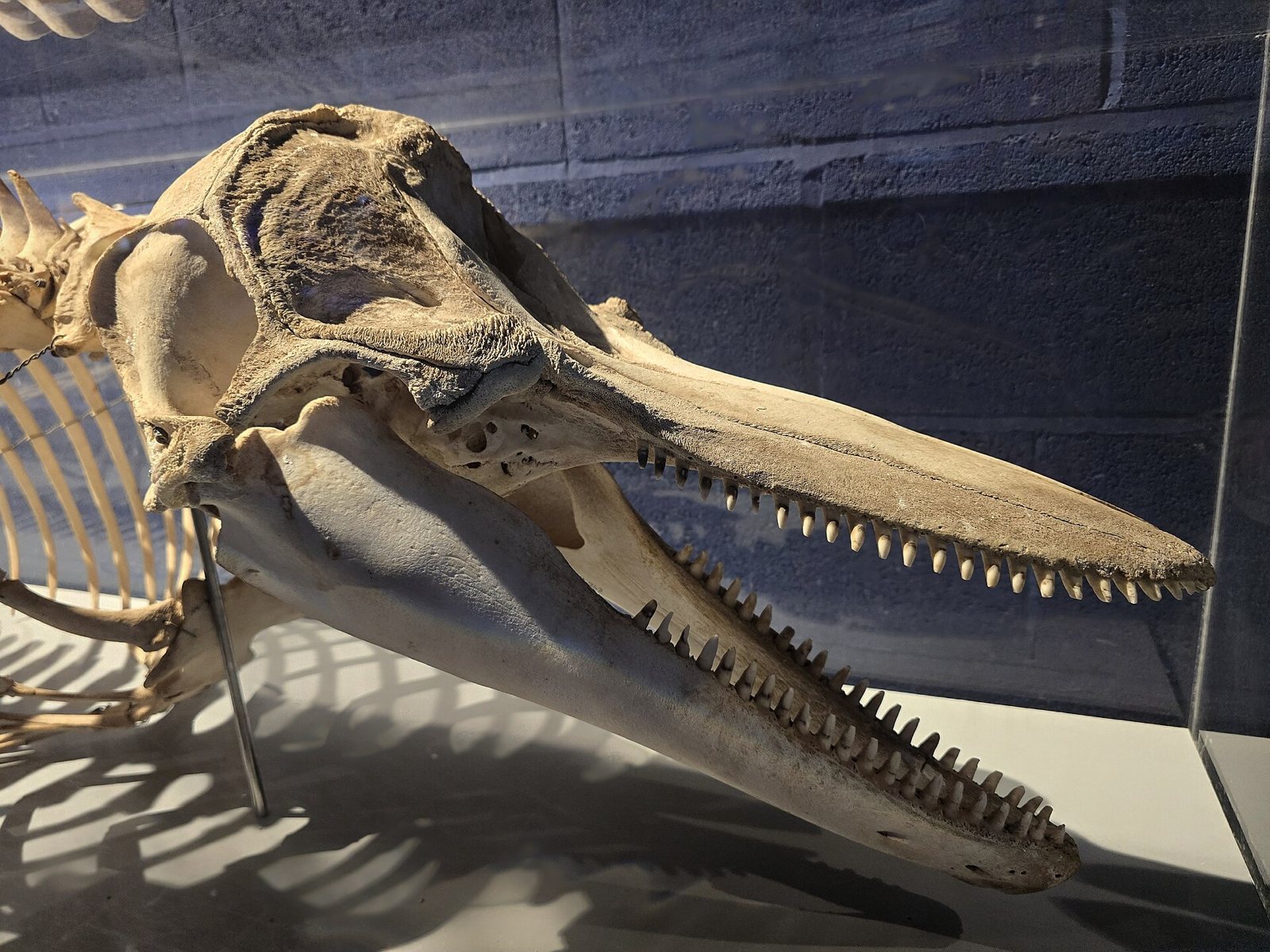
The blowhole tells the other half of the story. In toothed whales the outer nasal openings have shifted up to the top of the skull, so a dolphin breathes through a single hole on top of its head while the nasal passages inside the skull still connect to it. The Western North Atlantic cetacean identification guide by Leatherwood and colleagues gives the quick rule: toothed whales have one blowhole and baleen whales have two. Dolphins, porpoises, sperm whales and pilot whales are all toothed whales.
The teeth are the third clue. A dolphin skull usually carries long rows of small, pointed, cone-shaped teeth set along the beak, and the number varies from species to species.
What you will not see on a cleaned skull is the soft machinery that made it work. The melon, the nasal air sacs and the phonic lips were living tissues wrapped around and against these bones. They are gone, but the bones still show where they sat.
Telescoping: a skull that slid together
Look at a dolphin skull from the side and it seems squashed, as if the face slid backward over the head. Scientists call this telescoping, after the way the sections of a collapsible telescope slide into one another.
The term goes back to Miller's 1923 Smithsonian publication, *The Telescoping of the Cetacean Skull*. As the nostrils moved backward and upward over the course of cetacean evolution, the premaxillae and maxillae, the bones of the upper jaw, spread back over bones that used to sit behind them. That shortened the skull behind the rostrum and put the breathing opening near the top of the head.
Why it happened has more than one proposed answer. According to David W. Roston and colleagues, scientists have pointed to easier breathing at the surface, reinforcement of the skull around the blowhole, support for the long rostrum, and structural changes tied to echolocation. Roston's team also separates telescoping itself from the features that travel with it, such as the moved nostrils and the lopsided face. Toothed whales and baleen whales did not telescope in the same way, and a 2018 study by Geisler and colleagues traced how the pattern developed in the echolocating whales.
Why is a dolphin skull asymmetrical?
A dolphin skull is not the same on its left and right sides, and that is normal. Toothed whale skulls show directional asymmetry in the nasal and facial region, and in bottlenose dolphins it is especially clear around the nasal bones, premaxillae and maxillae.
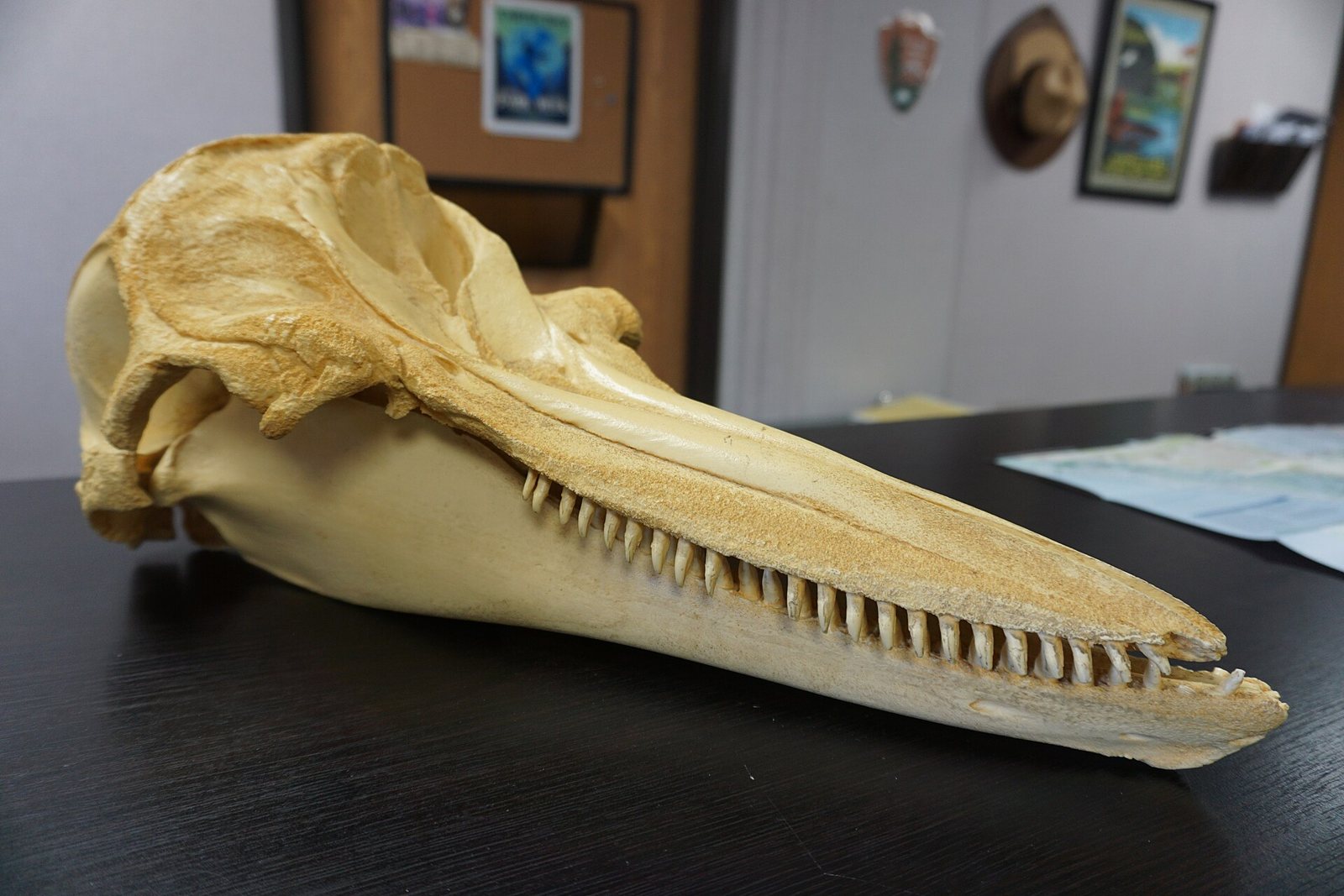
Scientists connect this lopsided face with the soft tissues dolphins use to make sound and echolocate. The exact story of how it evolved, and precisely what each difference does, is still being studied. What is well documented is how widespread it is. In a 2020 study nicknamed "Wonky whales", McLeod and colleagues reconstructed skull asymmetry across 162 living and extinct cetaceans spanning roughly 50 million years, showing strong asymmetry in the nasal and facial region of modern toothed whales.
So, if the skull in front of you looks a little crooked around the top of the face, that is not damage. It is the dolphin.
The melon and how a dolphin hears with its jaw
The lopsided bones make more sense once you know what sat on top of them. According to Smithsonian Ocean, dolphins produce high-frequency clicks in tissues called phonic lips, in the nasal passage just beneath the blowhole. The clicks pass through the melon, a fatty organ in the forehead that focuses them into a beam of sound.
The returning echoes come back in a surprising way: mainly through the lower jaw. Specialized fatty tissues in the jaw carry the sound toward the middle and inner ear. A cetacean field guide from Peru's Ministerio del Ambiente labels this fat pathway along the mandible on a three-dimensional dolphin skull.
Because the melon is soft tissue, it disappears when a skull is cleaned. The rounded forehead you know from the living animal is simply not there on the bone. What stays behind is the bony rostrum, the nasal passages, the jaw and the ear region that once held the whole sound system in place.
Dolphin, porpoise or small whale?
Dolphins, porpoises and the smaller whales are all toothed cetaceans, so their skulls share a single blowhole, telescoping and teeth that are present after birth. Telling them apart takes a closer look.
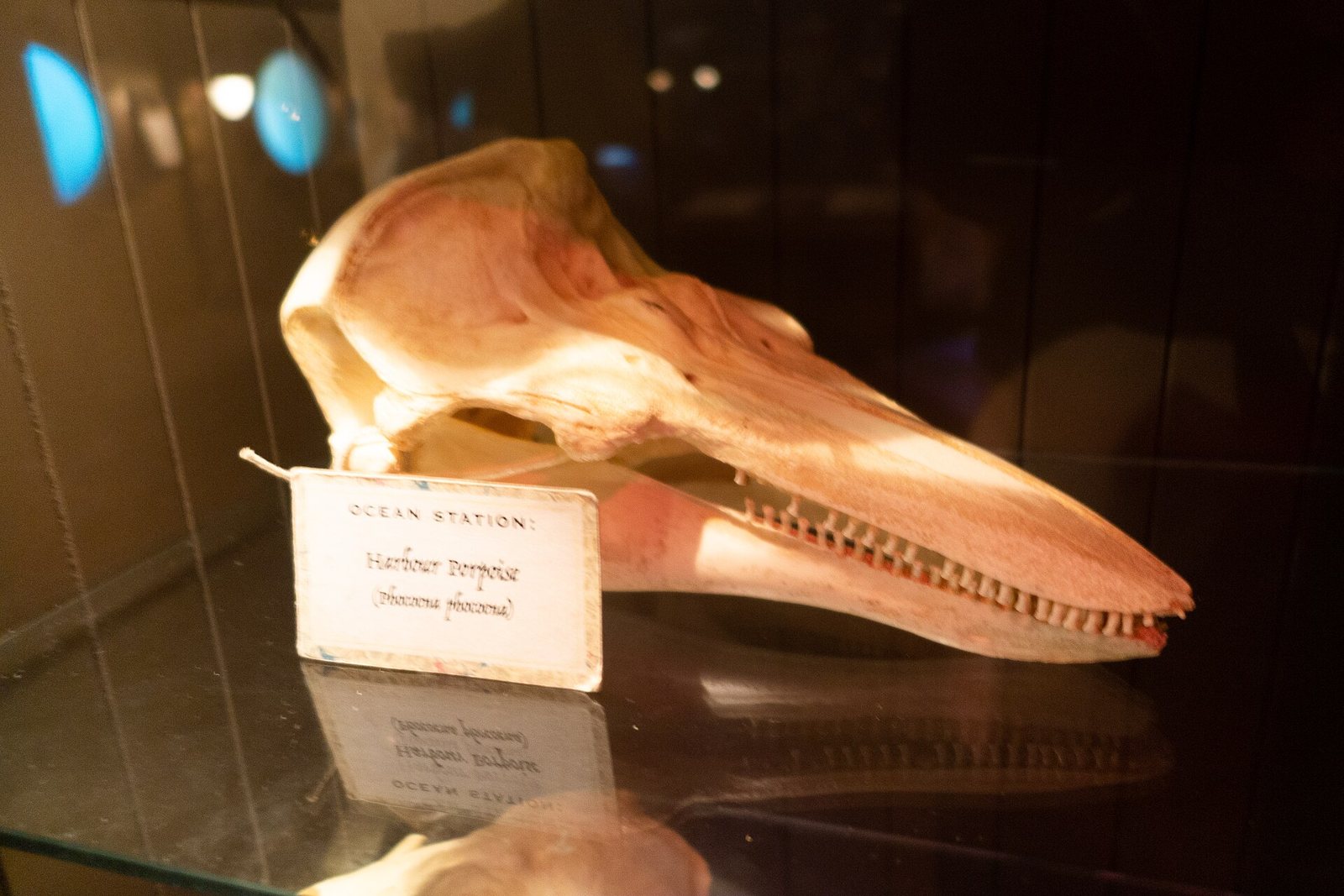
NOAA Fisheries notes that dolphins generally have a longer, narrower rostrum and many slender, pointed teeth. The harbor porpoise (*Phocoena phocoena*) usually has a shorter, blunter rostrum and spade-shaped teeth, as the University College Cork harbour porpoise collection describes.
A long beak alone will not separate a dolphin from a small whale, though. Pilot whales, false killer whales and some other species are dolphins by family, even with "whale" in their common names. Identification keys use several features together: skull length, rostrum shape, tooth count, tooth shape, braincase width, the position of the nasal bones and the shape of the lower jaw. A species-level answer usually needs measurements and a comparison with a reference collection. For that, use the regional cetacean identification key, or ask a museum mammal collection or the NOAA stranding coordinator. For the bigger relatives, including the baleen whales with their two blowholes, see our whale skull story.
Tap or hover a row to highlight it.
| Feature | Dolphin | Porpoise | Toothed whale with "whale" in its name |
|---|---|---|---|
| FeatureBlowhole | DolphinOne | PorpoiseOne | Toothed whale with "whale" in its nameOne |
| FeatureTeeth | DolphinPresent after birth, usually many and pointed | PorpoisePresent after birth, often spade-shaped | Toothed whale with "whale" in its namePresent after birth, highly variable |
| FeatureRostrum | DolphinOften long and narrow, depending on species | PorpoiseOften shorter and blunter | Toothed whale with "whale" in its nameVariable, from long to very short |
| FeatureSkull structure | DolphinTelescoped and asymmetrical | PorpoiseTelescoped and asymmetrical | Toothed whale with "whale" in its nameTelescoped and often strongly asymmetrical |
| FeatureBest way to identify | DolphinCompare rostrum, tooth count, skull proportions and where it was found | PorpoiseCompare tooth shape, rostrum and skull proportions | Toothed whale with "whale" in its nameUse a regional identification key and reference specimens |
A dolphin skull from 22 million years ago
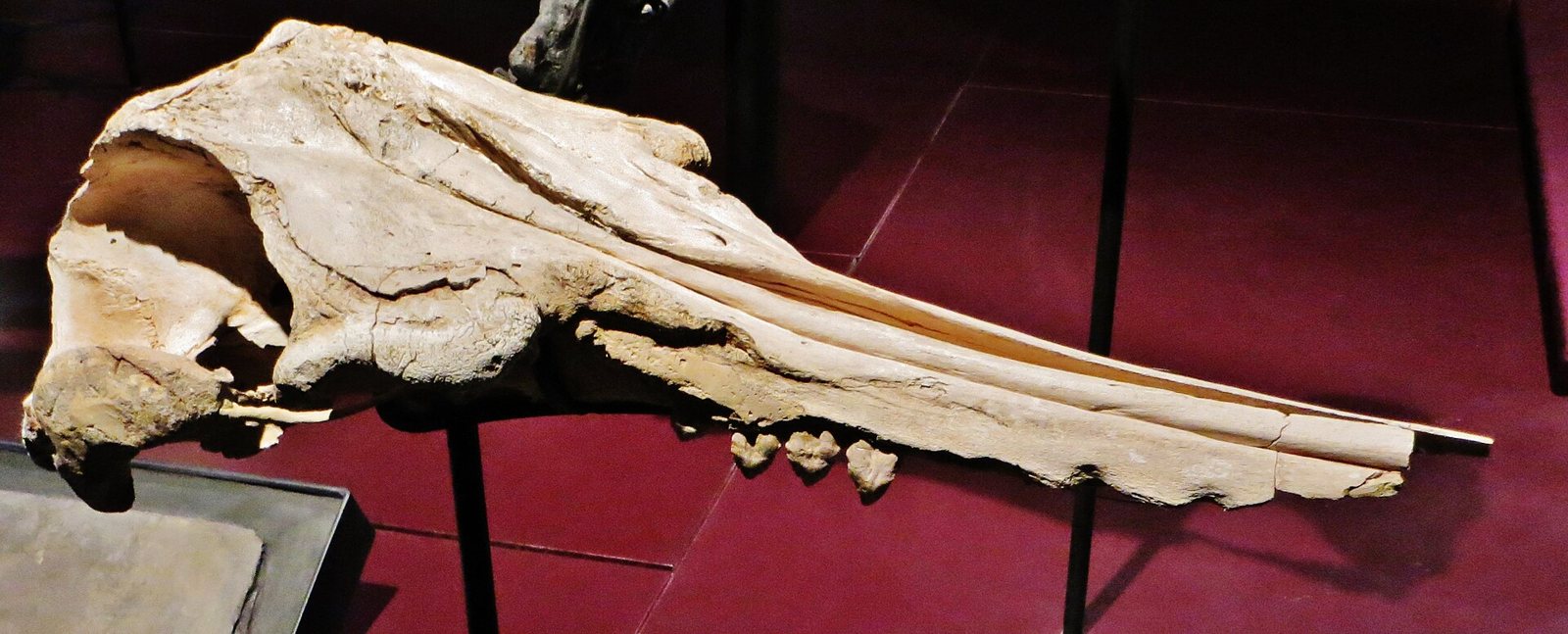
The basic dolphin design is old. In 2025 the Bavarian State Collection announced *Romaleodelphis pollerspoecki*, a prehistoric dolphin from rocks about 22 million years old in Austria. Its skull already had a long, toothed rostrum and nasal openings shifted far back on the skull, the same two features that make a modern beach find recognizable. Another ancient sea skull with a very different plan is the mosasaur skull, from a marine reptile rather than a mammal.
Dolphin skulls in science
Tap or hover a step to follow the order.
1923
Miller publishes *The Telescoping of the Cetacean Skull* through the Smithsonian.
December 21, 1972
The Marine Mammal Protection Act takes effect in the United States.
2018
Geisler and colleagues publish on the evolution of skull telescoping in echolocating whales.
2020
McLeod and colleagues map skull asymmetry across 162 living and extinct cetaceans.
2025
The Bavarian State Collection announces the prehistoric dolphin *Romaleodelphis pollerspoecki* from Austria.
Dolphin bones and US law
Treat this as general information rather than legal advice; state, country and land-manager rules can differ.
The Marine Mammal Protection Act took effect on December 21, 1972. It protects dolphins, porpoises, whales, seals and sea lions in United States waters, and it regulates taking, possessing, importing, exporting, buying, selling and transferring their parts.
NOAA Fisheries' guidance on protected species parts draws a clear line around dead animals. A dolphin with soft tissue still on it is a stranded animal: nothing is collected from it, and it is reported to the NOAA Fisheries Stranding Network. NOAA also allows a narrow case. Bones, teeth or ivory from a marine mammal not listed under the Endangered Species Act, found on a beach or on land within a quarter mile of an ocean, bay or estuary, with no soft tissue and not part of a carcass, may be collected and kept once they are identified and registered with the nearest NOAA Fisheries Regional Office. They may never be bought or sold, and parts of an ESA-listed species may not be collected without authorization.
Whether a given skull fits that case depends on the species, its condition, where it lay and its paperwork, so follow NOAA's current guidance and confirm identification and registration with the NOAA office before you move it. Our page on finding an animal skull covers the general questions, and the seal skull story explains how the same act applies to seals and sea lions.
More dolphin skull questions
Three questions that come up after the first look.
Is it illegal to keep a dolphin skull?
In the United States, it depends on the skull's origin, species, condition, location and documentation. NOAA Fisheries treats a fully clean skull from a non-ESA-listed species, picked up within the coastal zone it defines, differently from a skull taken from a carcass, one with soft tissue, or one from an ESA-listed species, which may not be collected without authorization.
Is it legal to keep dolphin bones?
NOAA allows some beach-found bones from marine mammals that are not ESA-listed, but only once they are identified and registered, and they can never be sold. Bones from a carcass or from remains with soft tissue are off limits, so contact the NOAA Fisheries Regional Office or the stranding coordinator first.
What are dolphin teeth like?
Dolphins usually have many slender, pointed, cone-shaped teeth, and the count varies by species. Dolphins, porpoises and the other toothed cetaceans all have teeth after birth, and a row of tiny teeth along a long beak points so strongly toward a dolphin rather than a porpoise with its spade-shaped teeth.
Dolphin skull quiz
Answer every question to check.
Where to go from here
A dolphin skull is a nose that moved to the roof of the head, a face built a little off-center for sound, and a long beak lined with small teeth. If your beach find turns out to have a dog-like face and even cheek teeth instead, the seal skull story is the next stop, and if it turns out to be mostly teeth and jaw with no bony head at all, the shark skull story explains why. For a wider look at how bones compare across species, see human vs animal skulls.
Terms in this story
Tap a term to see what it means.
Rostrum. The long bony beak of a dolphin skull, formed mainly by the upper jaw and its facial bones.
---