

No. 271
Male vs Female Skull: How Experts Tell Them Apart
Forensic anthropologists estimate sex from an adult skull by scoring five areas, a method set out by Phillip L. Walker in 2008: the brow ridge and the smooth area between the brows, the upper rim of the eye socket, the mastoid process behind the ear, the nuchal crest at the back of the skull, and the chin. Larger, more pronounced features raise the probability that a skull is male; smaller, smoother ones raise the probability that it is female. The features overlap a great deal, so the answer is always a probability. The Royal Society's forensic anthropology primer gives the skull an accuracy of about 85% to 92%, and the pelvis does better, at about 95%.
That is the short version. The longer one is more interesting, because it shows how much a skull can say, where its limits are, and why an artist and a forensic scientist use the same features in very different ways.
The five features experts score
Walker's 2008 study scores each trait on a five-point scale, from smallest and smoothest to largest and most pronounced. If you hold a skull, or a good drawing of one, you can find all five.
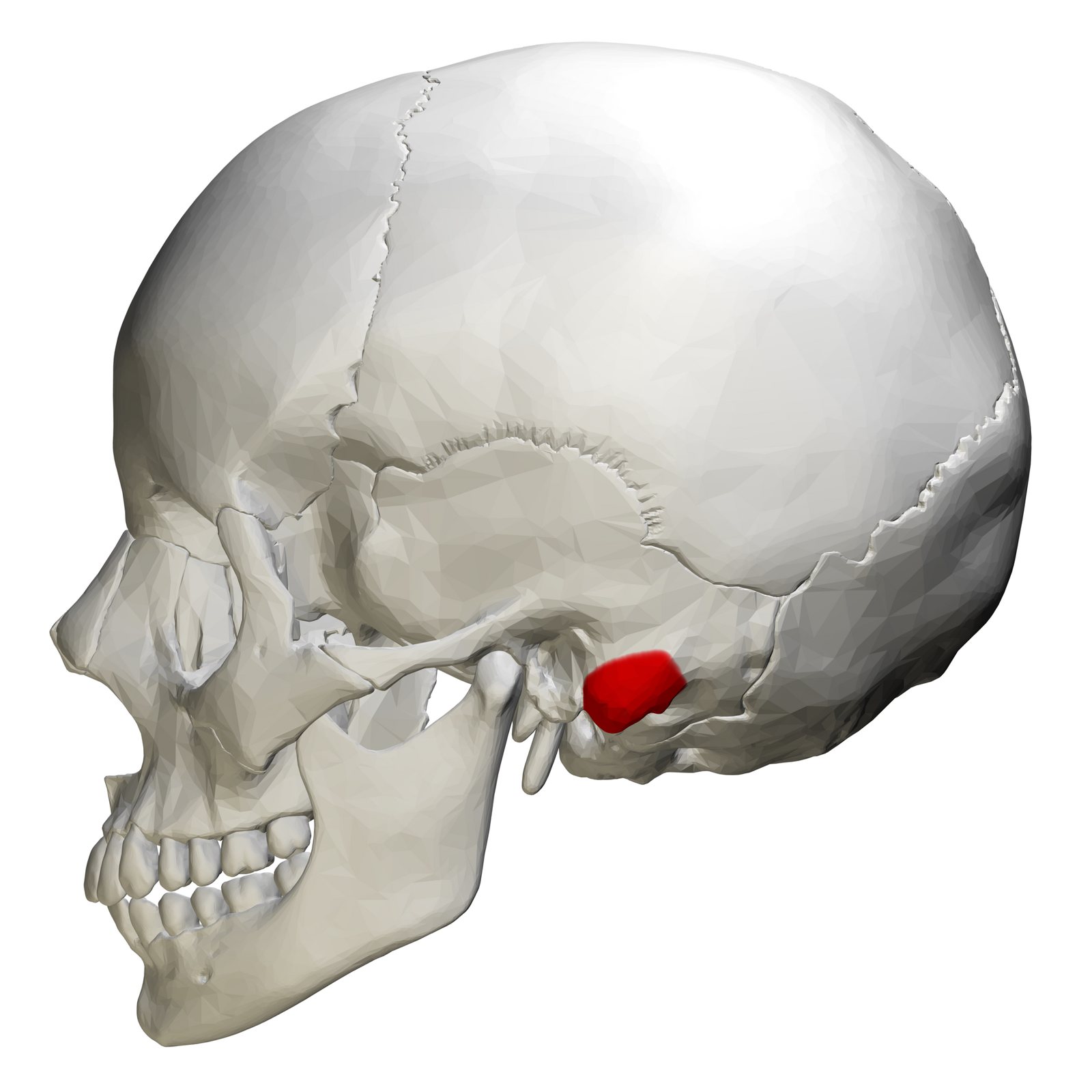
The glabella is the smooth patch of bone just above the nose, between the eyebrows, and the brow ridge runs out from it over the eyes. The orbital margin is the upper rim of each eye socket. The mastoid process is the rounded bump of bone just behind and below the ear opening. The nuchal crest, or nuchal area, sits at the back of the skull, where the neck muscles attach. The mental eminence is the chin, the raised part at the front of the lower jaw.
Not all five carry the same weight. Walker reported that the glabella and the mastoid were stronger single indicators than the nuchal area or the orbital margin. A later study, published in 2017, built a decision tree for sex assessment from the skull using six traits: the glabella, mastoid process, mental eminence, supraorbital margin and nuchal crest, plus the zygomatic extension, a ridge on the cheekbone arch.
Walker's five skull traits
Tap a card to bring it forward.
- Glabella and brow ridge: The area above the nose and over the eyes. A more pronounced brow raises the probability of a male classification.
- Orbital margin: The upper rim of the eye socket. Scored along with the other four, never alone.
- Mastoid process: The bump behind and below the ear. A larger mastoid raises the probability of a male classification.
- Nuchal crest: The muscle-attachment area at the back of the skull. A stronger crest raises the probability of a male classification.
- Mental eminence: The chin. A broader or more projecting chin raises the probability of a male classification.
What the differences look like, on average
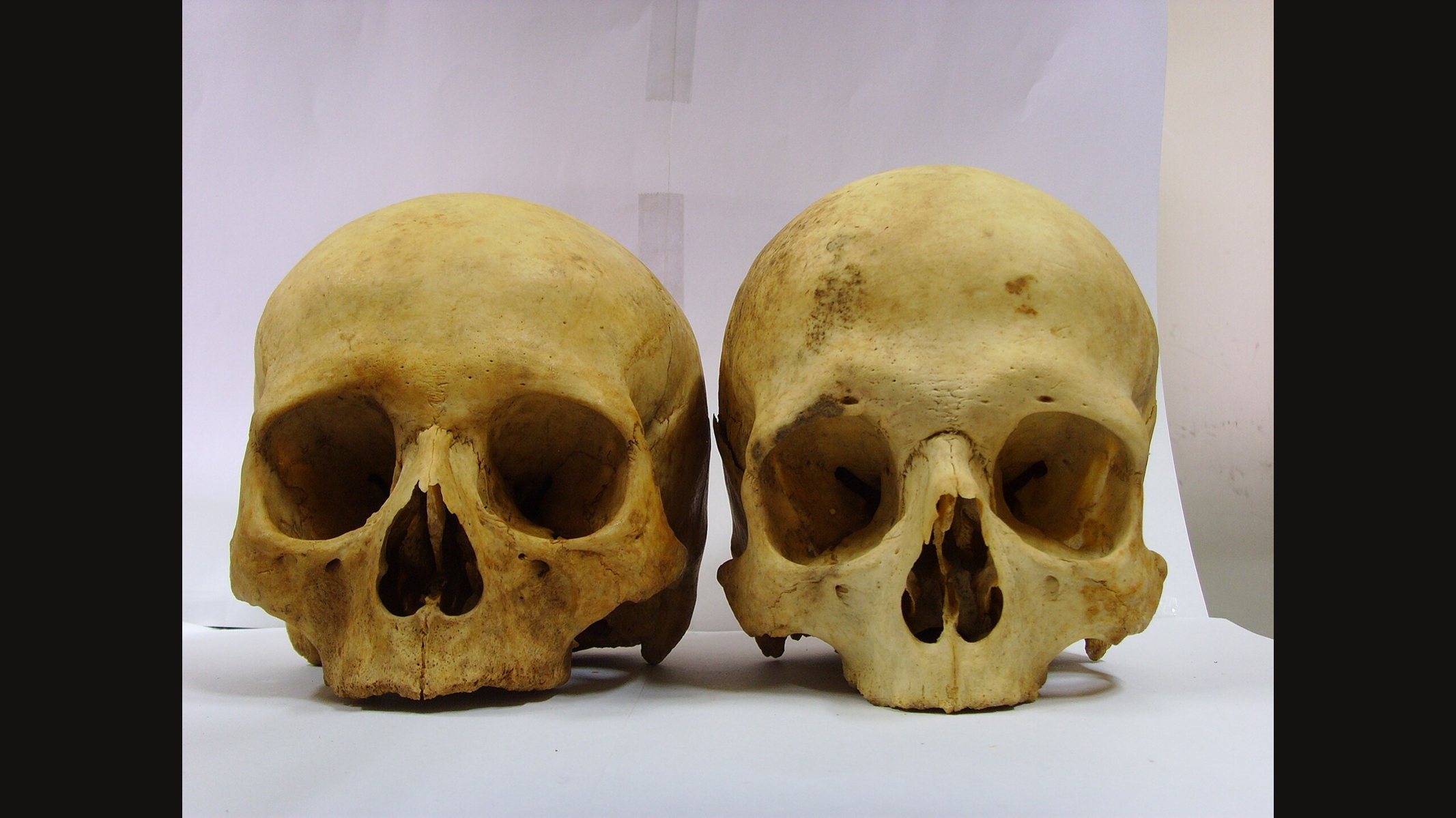
Put a male-classified and a female-classified adult skull side by side from a reference collection and the averages show. The male-classified skull tends to be larger and more heavily built, with stronger muscle markings, a more pronounced brow, a larger mastoid process, a stronger nuchal crest and a broader or more projecting chin.
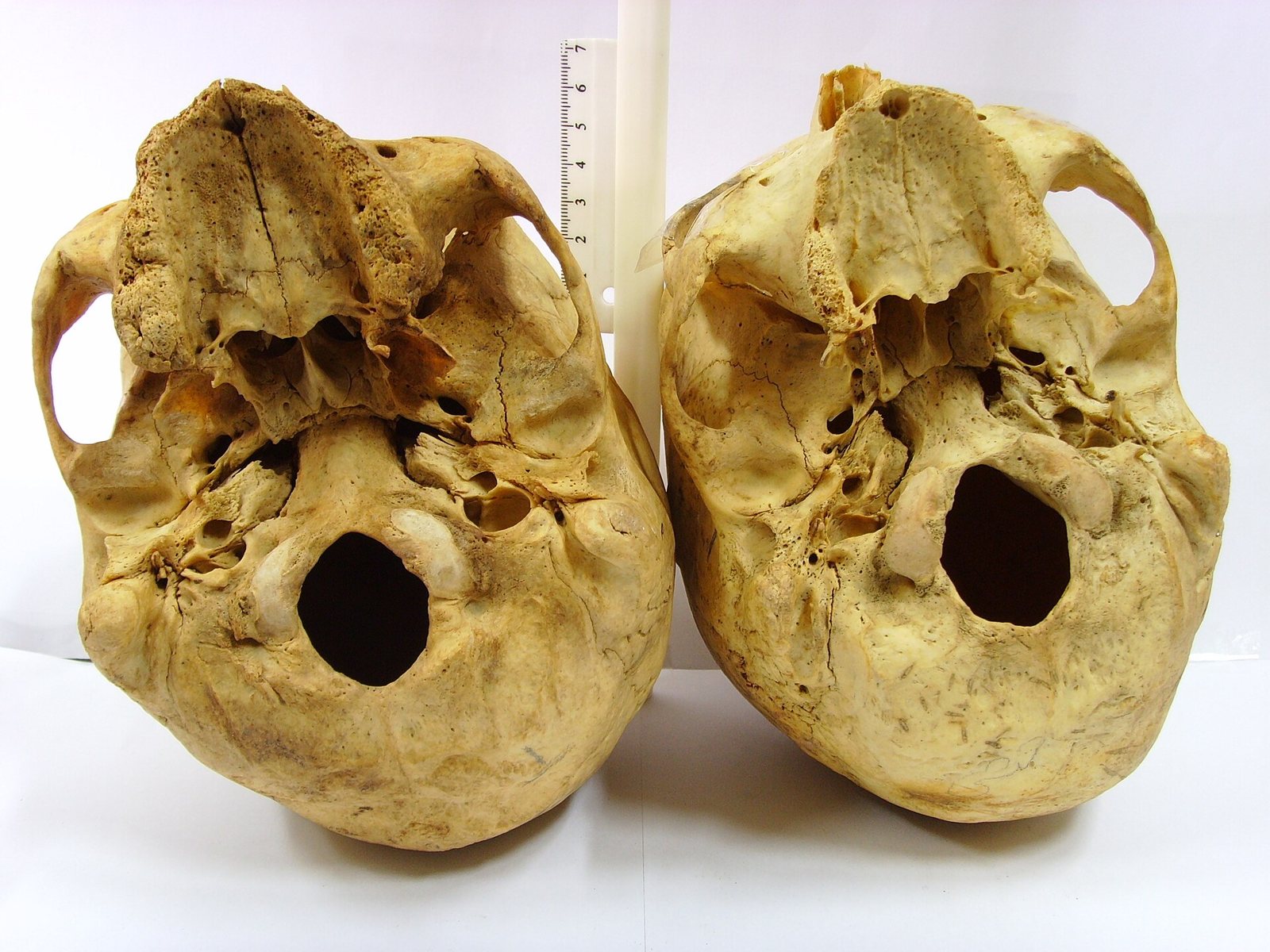
The word that matters is average. There is no single female skull appearance. A skull earns a more typically female probability when several traits are relatively smooth or small, and individual traits on the same skull can point in different directions. One skull can have a small chin and a heavy brow.
Size works the same way. Male skulls are often larger on average in the reference samples forensic anthropologists use, but the ranges overlap, and size also depends on population, age, nutrition and individual variation, as the American Dental Association's overview of forensic anthropology notes. Size alone cannot classify a skull.
How accurate skull sex estimation is
Published accuracy depends on the sample, the traits scored, how well the skull is preserved, who does the scoring and which statistics are used, so every figure needs its method and sample beside it.
Walker's model using all five traits classified 88% of the modern American and English skulls in his study correctly, and about 89% in leave-one-out tests, where each skull is classified by a model built without it. The 2017 six-trait decision tree reported 93.5% accuracy in its training sample, 94% in cross-validation and 96% in a separate holdout sample.
Then a National Institute of Justice database study tested Walker's method on other groups and turned up a lopsided result: an average of 94.1% for males but only 58.5% for females. When the researchers recalibrated the method, overall accuracy came to 83.0%. One headline number, in other words, can hide a large gap between the sexes. These are all figures for adult reference samples. None is a guarantee about the skull in front of you.
Tap or hover a row to highlight it.
| Method and sample | Reported accuracy |
|---|---|
| Method and sampleWalker, five skull traits, modern American and English skulls | Reported accuracy88% |
| Method and sampleWalker, five traits, leave-one-out models | Reported accuracyAbout 89% |
| Method and sample2017 six-trait decision tree | Reported accuracy93.5% training, 94% cross-validation, 96% holdout |
| Method and sampleWalker's method in the NIJ database study, males | Reported accuracy94.1% |
| Method and sampleWalker's method in the NIJ database study, females | Reported accuracy58.5% |
| Method and sampleSkull, morphological estimate (Royal Society primer) | Reported accuracy85% to 92% |
| Method and samplePelvis, morphological estimate (Royal Society primer) | Reported accuracyAbout 95% |
Why the pelvis tells you more
If the whole skeleton is available, experts turn to the hips first. The adult pelvis usually differs more between the sexes than the skull does, because its shape is strongly influenced by reproductive anatomy, especially the pubic region, the pelvic inlet and the greater sciatic notch. The Royal Society primer gives about 95% accuracy for sex estimation from the shape of the pelvis, against 85% to 92% for the skull.
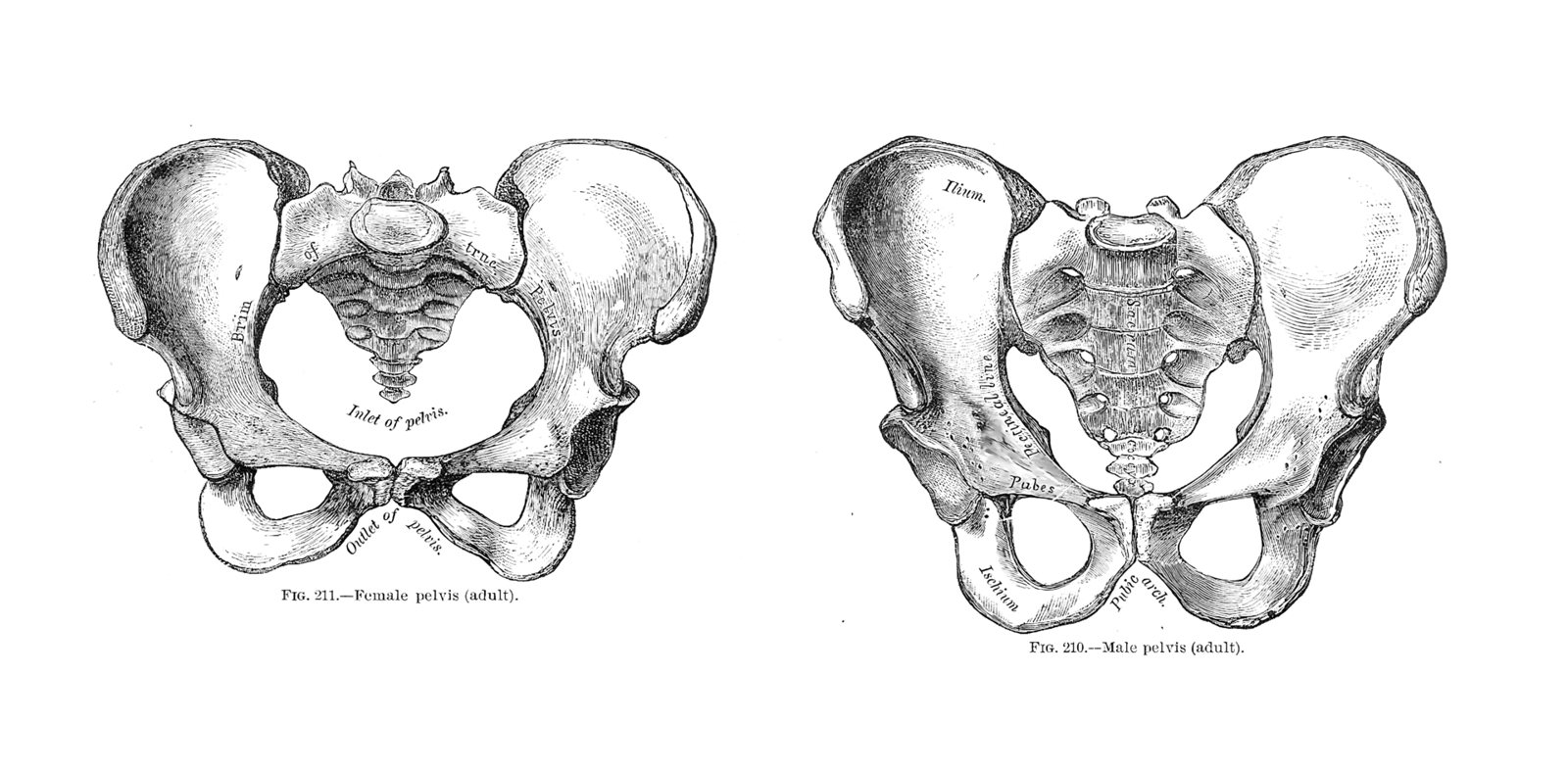
The pelvis is not infallible either. Its results also depend on preservation, reference data and method. And when the pelvis is missing, as it often is, the skull remains an important alternative, a comparison Spradley examined in her study of sex estimation from the skull and from the rest of the skeleton.
Why one formula does not fit everyone
Skull traits vary between populations and over time, so a formula built on one group may perform poorly on another. Walker knew this and tested it. His study used 304 modern skulls of people of known age and sex, from African American, European American and English samples, plus 156 ancient Native American crania whose sex had been estimated from the pelvis.
The ancient Native American sample had heavier average scores and less separation between the sexes. In that group the nuchal area predicted sex correctly in only 57% of cases, and the glabella and mastoid scores reached about 70%. Walker advised caution when applying his equations to populations outside the ones used to build them. A later study of a contemporary Italian sample tested Walker's equations again and stressed the same need for population-specific validation.
These differences say nothing about any population being better or worse. They are a reason to check a method against the right reference group before trusting it. The people in these collections, including the ancestors of living Native American communities, were real individuals whose remains deserve care.
Only adults show these differences
Everything above applies to adults. The differences forensic anthropologists score develop as a person matures, which is also why the popular "skull theory," guessing a baby's sex from the shape of the skull on an ultrasound, is not a clinical method. Live Science reported that the theory is not scientifically valid. Harvard Health says ultrasound can sometimes show a baby's sex, and the Danish Fetal Medicine Society guideline bases that call on directly seeing the external genitals, not the skull, with stated limits before 14 weeks. Questions about a pregnancy are for the care team doing the scan. For how a baby's skull is built, see our story on the soft spots in a baby's skull.
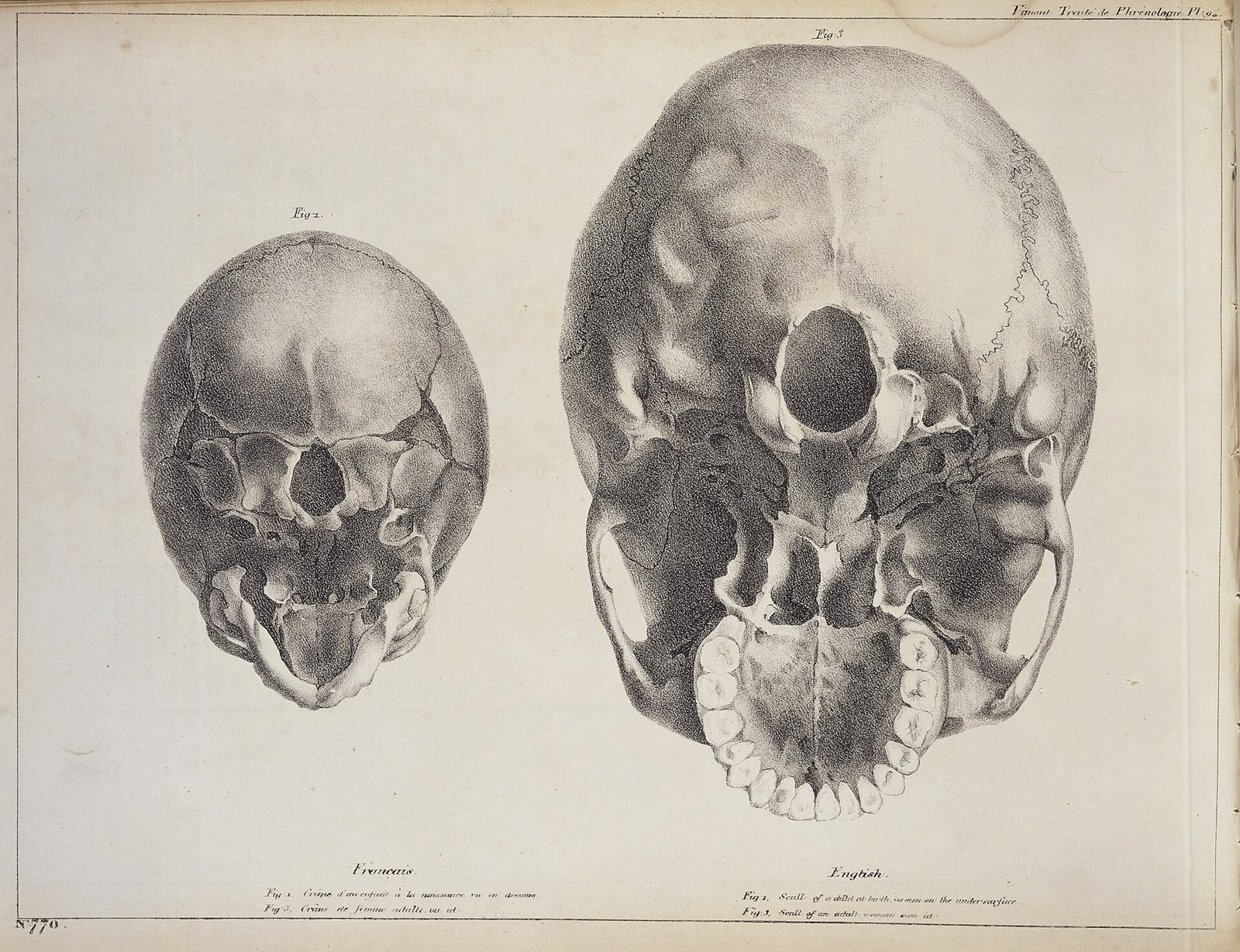
Drawing male and female skulls
Artists can borrow these features freely, as long as they treat them as design cues rather than rules. Push the brow ridge, the mastoid, the chin or the nuchal crest up or down, and a skull reads as heavier or lighter, gentler or more rugged. Real skulls, remember, sit along a continuous range, so there is no wrong answer in a drawing.
For building the skull itself, Proko's lesson on drawing the skull recommends studying its large forms and major features from reference. Our own guide on how to draw a skull walks through the center line, eye sockets, nasal opening, cheekbones, jaw and lighting, and the five traits above are the details you adjust once that structure is in place. A sculptor working on a facial reconstruction faces the same features from the other side, building a face over them.
If you have a skull in front of you
A real estimate needs a trained analyst, a well-preserved skull and, ideally, more of the skeleton. If you have come across what may be human bones, leave them where they are, do not handle or collect them, and call the police. Our page on finding human bones covers the steps. If you are not sure whether a skull is human at all, start with our guide to human vs animal skulls.
Sex is half of what a lab reads from a skeleton. The other half, age, is told in our companion story on how to tell age from a skull.
More questions about male and female skulls
These answers pick up where the sections above leave off.
What does a female skull look like?
There is no single female skull look; a skull earns a more typically female probability when several traits, such as the brow, mastoid, nuchal area and chin, are relatively smooth or small. Because traits on one skull can disagree, experts score them together instead of judging by one feature.
Are male skulls bigger?
Often, on average, in the adult reference samples used in forensic anthropology. The sizes overlap and shift with population, age and nutrition, so size alone cannot tell you whether a given skull is male or female.
Can you tell whether a particular skull is male or female from a photo?
Only as a probability, and only when a trained analyst can score the traits properly, ideally with the pelvis available too. If the skull may be human and was found outdoors, it is a matter for the police rather than a photo.
Can bones show whether someone was male or female?
Yes, as a probability. The Royal Society primer gives about 95% accuracy for the pelvis and 85% to 92% for the skull, and results always depend on the method and the reference population.
Male vs female skull quiz
Answer every question to check.
Every skull in these studies belonged to a person with a name and a family. The numbers are careful because those people deserve care. For more about the human skull itself, our human skull facts and how much a human skull weighs are good next reads.
Terms in this story
Tap a term to see what it means.
Glabella. The smooth area of bone above the nose, between the eyebrows, one of the five traits in Walker's method.