

No. 186
The Head of St Catherine of Siena: How It Reached Siena and Where the Rest of Her Is
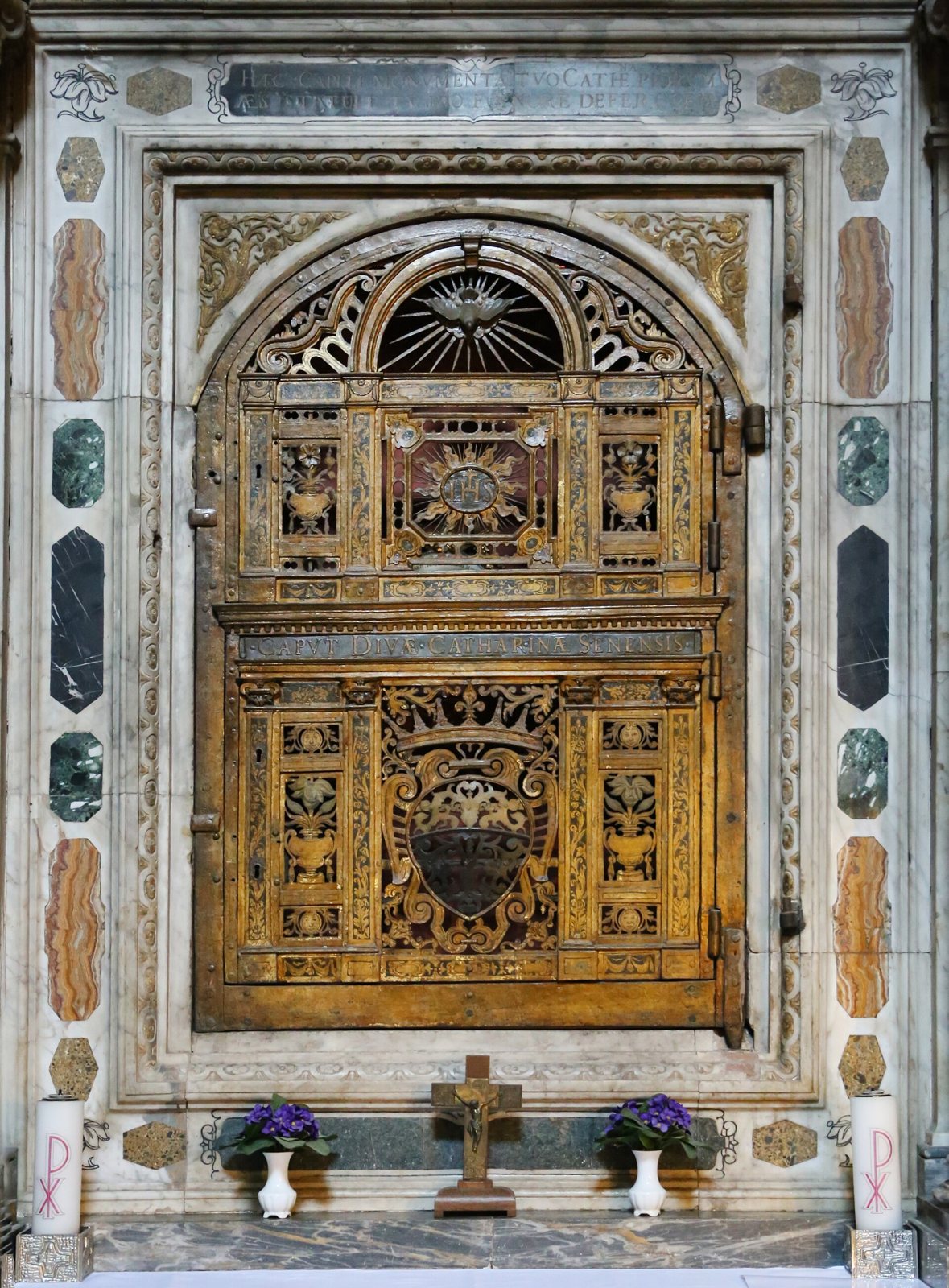
The head of St Catherine of Siena rests in the Chapel of Saint Catherine in Siena's Basilica of San Domenico. Catherine died in Rome in 1380. Raymond of Capua, head of the Dominican order, obtained Pope Urban VI's permission to separate her head, and it was carried secretly to her hometown in a silk bag in 1384 (Basilica of San Domenico).
The rest of her is mostly in Rome, in a sarcophagus beneath the high altar of Santa Maria sopra Minerva. Her right thumb is in San Domenico with the head, and her left foot is venerated in Venice.
Is the head incorrupt? The basilica says the relic has stayed intact through fires, riots and an earthquake, and Visit Siena describes it as *la testa mummificata*, the mummified head. It is venerated as a relic, a preserved, mummified head.
Who Catherine of Siena was
Before she was a relic, Catherine was a woman with a great deal to say. She was born in Siena in 1347 and died in Rome on 29 April 1380, at the age of 33. She was a Dominican tertiary, a religious writer, a mystic and a strong voice for Church reform and for peace (Vatican, General Audience of 2010; Archdiocese of Siena).
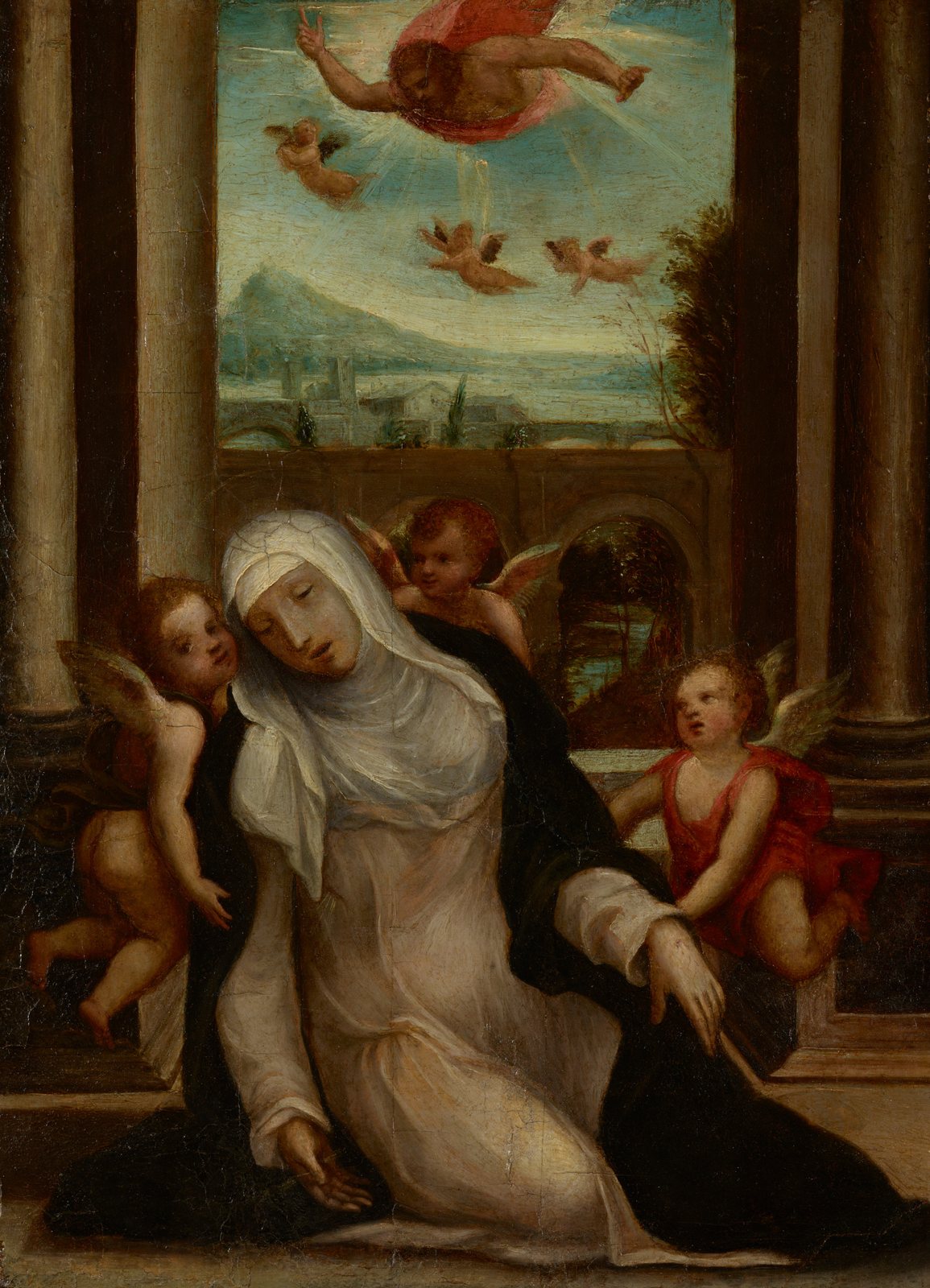
The honors came over the following centuries. Pope Pius II canonized her in 1461. In 1939, Pope Pius XII proclaimed her a primary patron of Italy (Vatican, 1939). In 1970, Pope Paul VI declared her a Doctor of the Church. And in 1999, John Paul II named her a co-patroness of Europe (Vatican, 1999).
So, the small head behind the gold grille belongs to a writer, mystic and peacemaker whom popes named a patron of Italy and of Europe.
From Rome to Siena in a silk bag
Catherine died far from home. The Basilica of San Domenico's own account says she was first buried near Santa Maria sopra Minerva in Rome and later moved inside the church, because the ground was damp.
Siena wanted her back. Raymond of Capua, who led the Dominicans at the time, obtained Pope Urban VI's permission to detach her head; the official account of the Sanctuary House of Saint Catherine dates that permission to 1381. The head then traveled secretly to Siena in a silk bag, in 1384. That bag still survives and is kept today at the Sanctuary House of Saint Catherine in Siena (Sanctuary House of Saint Catherine).
The secrecy ended with a celebration. In 1385, Raymond informed Siena's Consistory, and a solemn procession carried the head from the church of San Lazzaro to San Domenico. Visit Siena dates that procession to 5 May 1385 (Visit Siena).
Catherine of Siena and her head, 1347 to 1999
Tap or hover a step to follow the order.
1347
Catherine is born in Siena.
29 April 1380
She dies in Rome, aged 33.
1381
Pope Urban VI permits the separation of her head, according to the Sanctuary House account.
1384
The head is carried secretly to Siena in a silk bag.
1385
A solemn procession carries the head from San Lazzaro to San Domenico.
1461
Pope Pius II canonizes Catherine.
1931
The present reliquary is made, and the relic is examined.
1939
Pope Pius XII proclaims her a primary patron of Italy.
1970
Pope Paul VI declares her a Doctor of the Church.
1999
John Paul II names her a co-patroness of Europe.
The rose petals in the bag
Siena tells a lovelier version of the trip. In the devotional tradition, as EWTN retells it, guards stopped the men carrying the bag and opened it, and instead of a head they saw rose petals (EWTN, Saint Catherine of Siena).
It is a tradition, cherished and retold, and it helps to know which part comes from where. The basilica's own account records the silk bag and the secret transfer from Rome, and it tells the story without the rose petals. The petals belong to Siena's devotion, a way of remembering her return home as a small miracle.
Incorrupt, preserved or mummified?
People often ask whether the head is incorrupt. The answer depends on whose words you read.
The Basilica of San Domenico describes the relic as having remained "intact" through fires, riots and an earthquake. That is the language of devotion: a church describing a relic it has guarded for centuries. Visit Siena, describing what a visitor actually sees, calls it *la testa mummificata*, the mummified head (Visit Siena, in Italian). The two descriptions sit side by side; one speaks of preservation, the other of the remains' physical state.
The relic has been examined. In 1931, Professors Giulio Gori, Mazzi, Raimondi, Lunghetti and Londini carried out an examination at the request of Siena's chief magistrate, Fabio Bargagli Petrucci (Visit Tuscany). So, the most accurate way to describe it is as a preserved, mummified head, venerated by the Church as the relic of Saint Catherine, without a scientific finding that it is naturally incorrupt.
Where the rest of Catherine is
Catherine's relics are in three cities, and each has its own church and its own story.
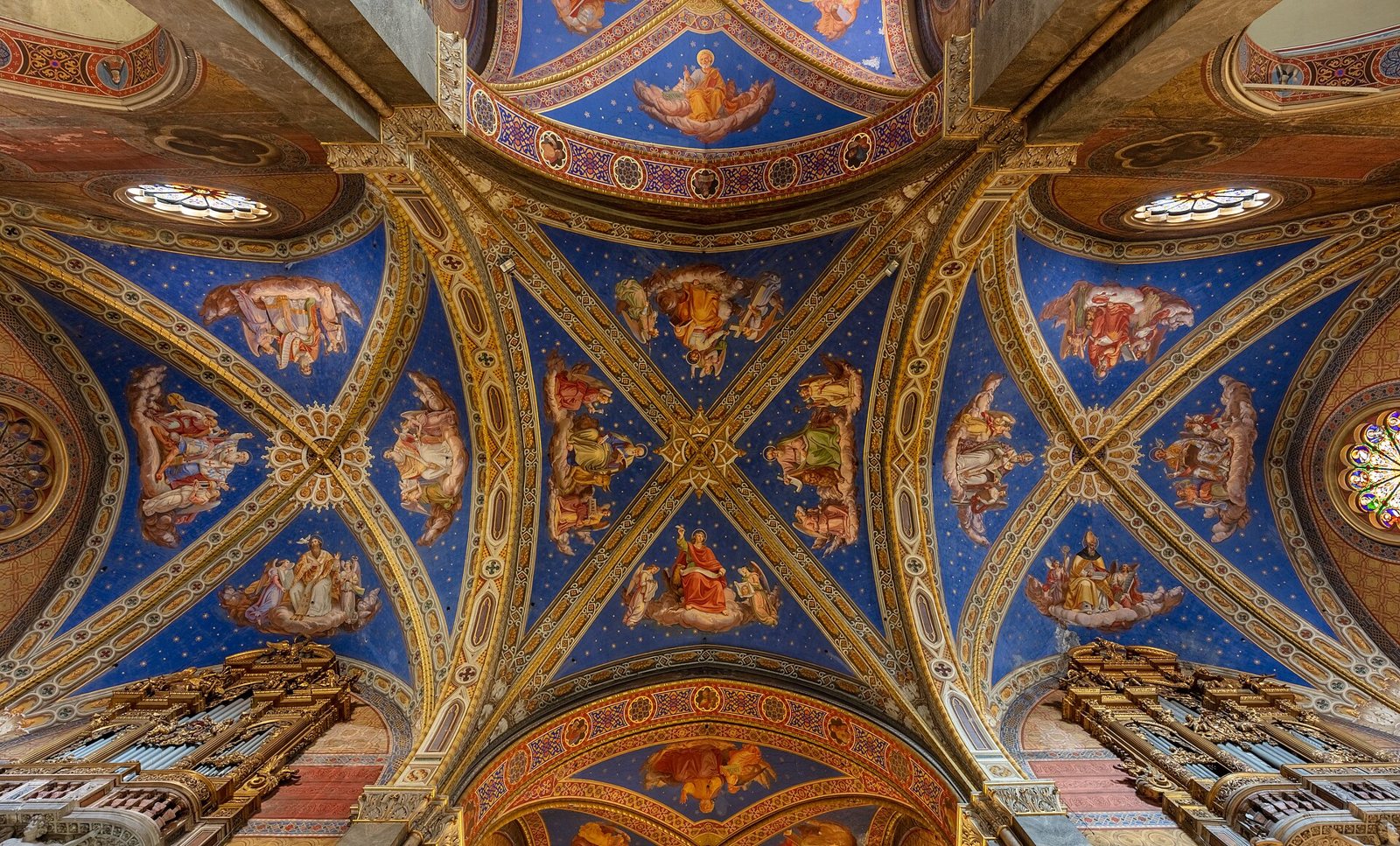
Her body lies in Rome, in a sarcophagus beneath the high altar of Santa Maria sopra Minerva, the church near which she was first buried (Rome Superintendency; Archdiocese of Siena).
Siena keeps two relics in San Domenico: her head and the thumb of her right hand. The thumb rests in a crystal-and-silver reliquary, and during the annual celebrations it is carried to Piazza del Campo for a blessing associated with Italy and Europe, the two places she protects as patron.
Venice keeps her left foot, venerated at the Basilica of Santi Giovanni e Paolo. The historian Jennifer McFarland, in a scholarly article on relics in Renaissance Venice, identifies the foot as a relic donated to the Dominican convent there between 1487 and 1500, and connects it with Dominican reform efforts in the city in the late fifteenth century (Jennifer McFarland, "Relics, reinvention, and reform in Renaissance Venice").
Tap or hover a row to highlight it.
| Relic | Where it is | Who says so |
|---|---|---|
| RelicHead | Where it isChapel of Saint Catherine, Basilica of San Domenico, Siena | Who says soBasilica of San Domenico |
| RelicRight thumb | Where it isBasilica of San Domenico, Siena | Who says soBasilica of San Domenico |
| RelicBody | Where it isBeneath the high altar of Santa Maria sopra Minerva, Rome | Who says soArchdiocese of Siena |
| RelicLeft foot | Where it isBasilica of Santi Giovanni e Paolo, Venice | Who says soVisit Siena; Jennifer McFarland |
The chapel and the reliquary in San Domenico
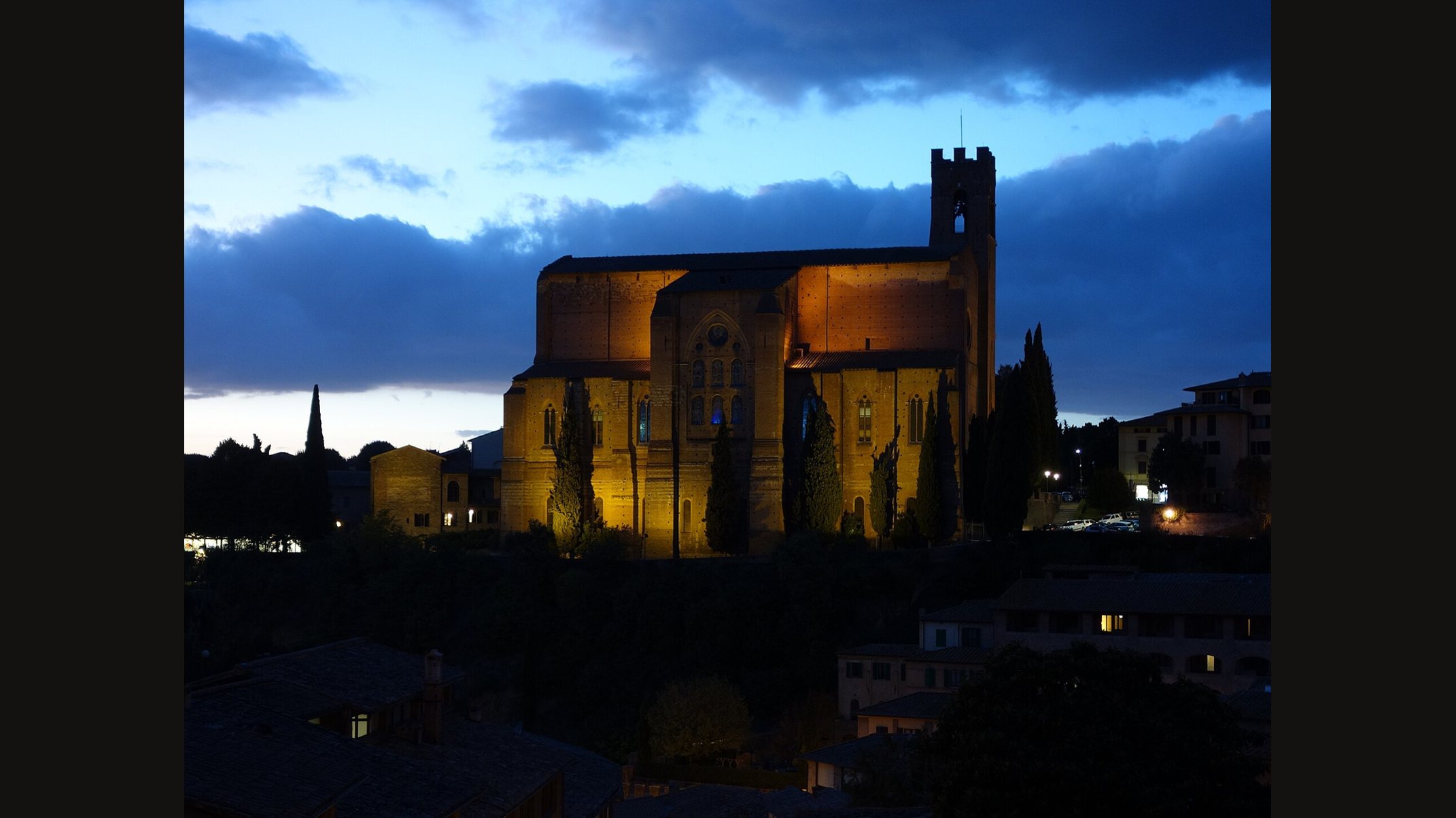
The head is shown in the Chapel of Saint Catherine inside the Basilica of San Domenico, behind a gold grille. It sits in a silver-and-enamel reliquary in the Gothic style, made in 1931 by the Florentine goldsmith David Manetti to a design by Angelo Giorgi, the same year as the professors' examination. The basilica stands at Via Camporegio, 2, in Siena.
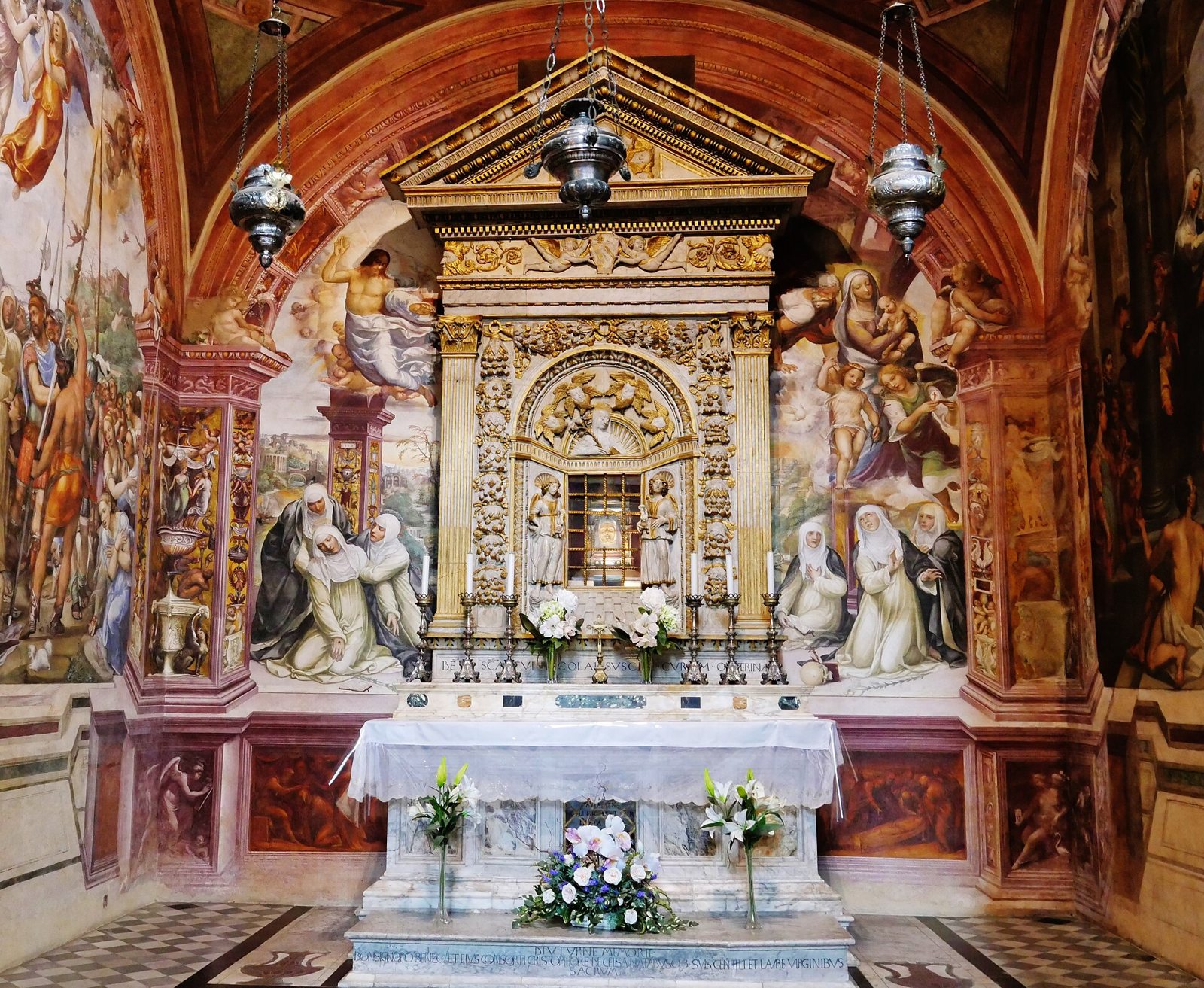
The reliquary is much younger than the relic. The head has been in Siena since the fourteenth century, while the case around it dates from 1931, and the setting is a chapel in a working church, with the saint's head at its heart.
Visiting the head in Siena
San Domenico is a working church, so the first thing to know is that people come here to pray. The Archdiocese of Siena's 2025 issue of *La Patrona d'Italia e d'Europa*, which carries the schedule for 2026, lists Masses and confession times, including weekday confession from 9:00 to 12:00 and from 17:00 to 18:00 (Archdiocese of Siena, La Patrona d'Italia e d'Europa). Those are times for worship, not visiting hours.
Confirm current access, any fees and the photography rules with the Basilica of San Domenico before you travel, and while you are inside, behave as you would in any church where a service may be going on.
Before you visit Saint Catherine's head
Tap a card to bring it forward.
- Where: The Chapel of Saint Catherine, Basilica of San Domenico, Via Camporegio, 2, Siena.
- A working church: Masses and confession take place here; worship times are not visiting hours.
- Confirm first: Check current access, any fees and photography rules with the basilica before you travel.
- Inside: Behave as you would in any church, quietly and with respect for people at prayer.
Other saints' heads kept in their own churches
Catherine is far from the only saint whose head or skull is kept apart from the rest of her remains. Our roundup of saint skull relics follows Saint Agatha in Catania, Thomas Aquinas in Toulouse and Rose of Lima in Lima, and explains what a first-class relic is.
Several churches claim the head of John the Baptist, and the skull venerated as Mary Magdalene's rests in Provence. Rome has Saint Valentine's skull, and German-speaking churches display the jeweled catacomb saints. For the wider place of skulls in Christian art and practice, see skulls in Christianity.
Saint Catherine's head: a short quiz
Answer every question to check.
Questions about the head of St Catherine of Siena
These are the questions that come up most once people have seen the relic.
Why was St Catherine's head separated from her body?
According to the basilica, Raymond of Capua wanted Catherine's relics in her hometown, so with Pope Urban VI's permission he had her head detached and carried to Siena. Catholics venerate a saint's relics as part of honoring the saint, and our roundup of saint skull relics explains why. Siena welcomed the head with a public procession in 1385.
Where is the head of St Catherine of Siena?
It is in the Chapel of Saint Catherine in the Basilica of San Domenico in Siena, Italy. It sits behind a gold grille in a silver-and-enamel reliquary made in 1931, and the basilica also keeps her right thumb.
What is kept at the Sanctuary House of Saint Catherine?
The Sanctuary House of Saint Catherine in Siena keeps the silk bag in which, according to the official account, her head was carried secretly from Rome. Its account also dates Pope Urban VI's permission to separate the head to 1381.
A head that came home
Catherine spent her short life writing, praying and arguing for peace, and she died in Rome. Within a few years Siena had her back, at least in part, carried home in a silk bag and welcomed with a procession. The small head behind the gold grille in San Domenico is how her city has kept her close ever since.
Terms in this story
Tap a term to see what it means.
Relic. Part of a saint's body, or an object connected with a saint, kept and venerated by the Church.
---