

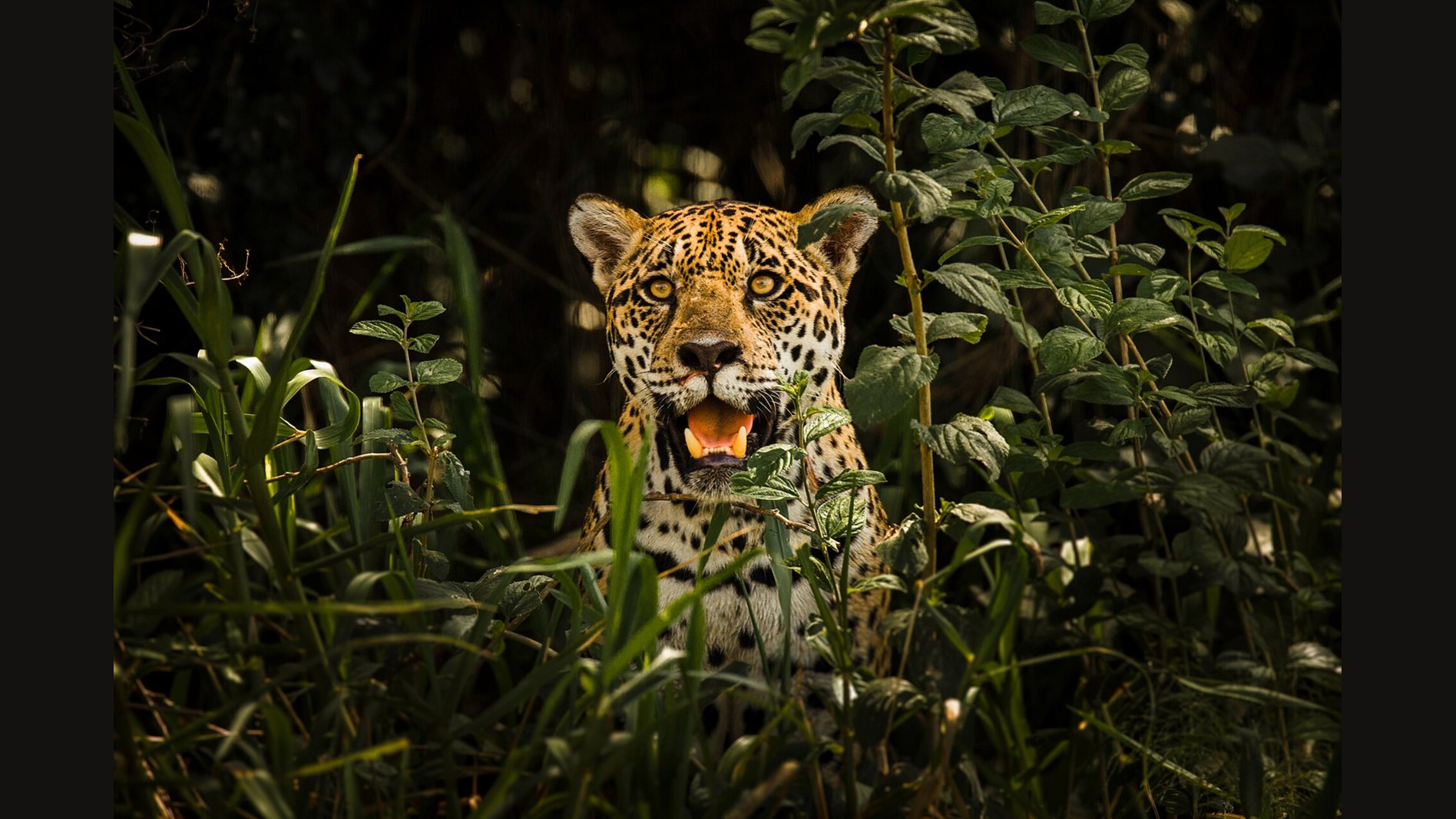
No. 339
The Jaguar Skull: A Big Cat Built for a Skull-Piercing Bite
A jaguar skull stands out for its short, broad, heavily built shape. The jaguar, *Panthera onca*, has a wide snout, broad cheekbones, a tall ridge of bone along the top of the head called the sagittal crest, and thick canines about 5 to 9 centimetres long.
All of that frames big jaw muscles. They give the jaguar an exceptionally strong bite for an animal of its size, strong enough that jaguars are known to kill some prey with a single bite through the skull.
That bite is why the skull draws so much attention, in natural history museums and in the art of the Maya and the Mexica, who linked the jaguar with night, war and rulers. The bones also explain how a jaguar skull differs from a leopard's or a tiger's, and what the famous bite numbers really mean.
What a jaguar skull looks like
Set a jaguar skull on a table and the first impression is width. The Florida Museum of Natural History points to a wide rostrum (the snout), broad zygomatic arches (the cheekbones that sweep out to the sides) and a prominent sagittal crest running along the top of the braincase.
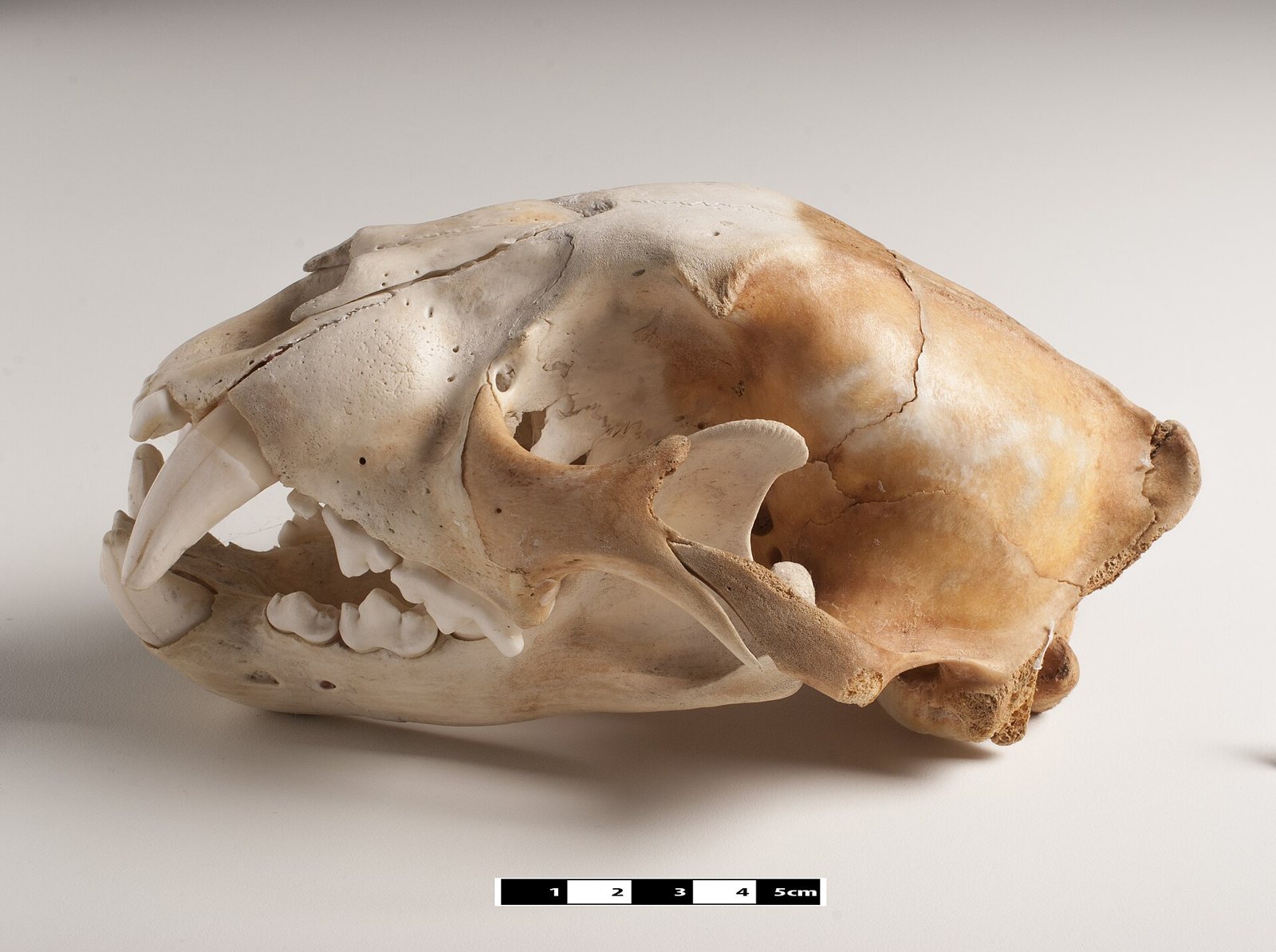
The teeth tell the same story. An adult jaguar has 30 teeth, with a dental formula of 3/3 incisors, 1/1 canines, 3/2 premolars and 1/1 molars on each side. Compared with other big cats in its genus, the jaguar's lower canines are relatively large, its lower third premolar is smaller and its lower first molar is shorter. The Museu de Ciències Naturals de Barcelona also records 30 teeth and names the carnassials, the shearing cheek teeth, as the upper third premolar and the lower first molar.
Then come the canines. Panthera's Mesoamerican field guide gives them as roughly 5 to 9 centimetres long, the longest and sturdiest canines of any native cat in Mesoamerica. Put those together, a wide muzzle, a deep cheek region, a strong crest and thick, conical fangs, and you have the look that makes a jaguar skull easy to remember.
Jaguar skull features at a glance
Tap a card to bring it forward.
- Wide rostrum: A broad snout that gives the front of the skull its blunt, heavy look.
- Broad zygomatic arches: Cheekbones that flare out to the sides, leaving room for big chewing muscles.
- Sagittal crest: A ridge along the top of the braincase that gives the jaw muscles more surface to grip.
- Canines: About 5 to 9 cm long, the longest and sturdiest of the native Mesoamerican cats.
- Teeth: 30 in an adult, with the formula 3/3, 1/1, 3/2, 1/1.
The muscles behind the bite
A skull is a scaffold, and the jaguar's is built to anchor muscle. Its broad surfaces give generous attachment space to the temporalis, the masseter and the medial pterygoid, the three muscle groups that close the jaw.
In 2012, Adam Hartstone-Rose, Jonathan Perry and Christopher Morrow dissected the jaw muscles of several cats to model their bite force. Their jaguar specimen carried 809.28 grams of jaw-closing muscle, with a total physiological cross-sectional area of 388.40 square centimetres. That second figure is a measure of how much muscle fibre pulls at once.
The tiger in the same study had bigger muscles in absolute terms, as you would expect from a bigger cat. The jaguar's stood out for a different reason: it plotted above the expected line for its size, a cat with unusually high modelled force for how large it is. The authors were careful to say their sample was small and that the result did not set an exact ranking among all cats.
How strong is a jaguar's bite?
A jaguar's bite is exceptionally strong for its body size, and the numbers that describe it come from models rather than from a gauge in a living cat's mouth. Scientists estimate bite force from skull measurements, muscle anatomy and the mechanics of the jaw as a lever.
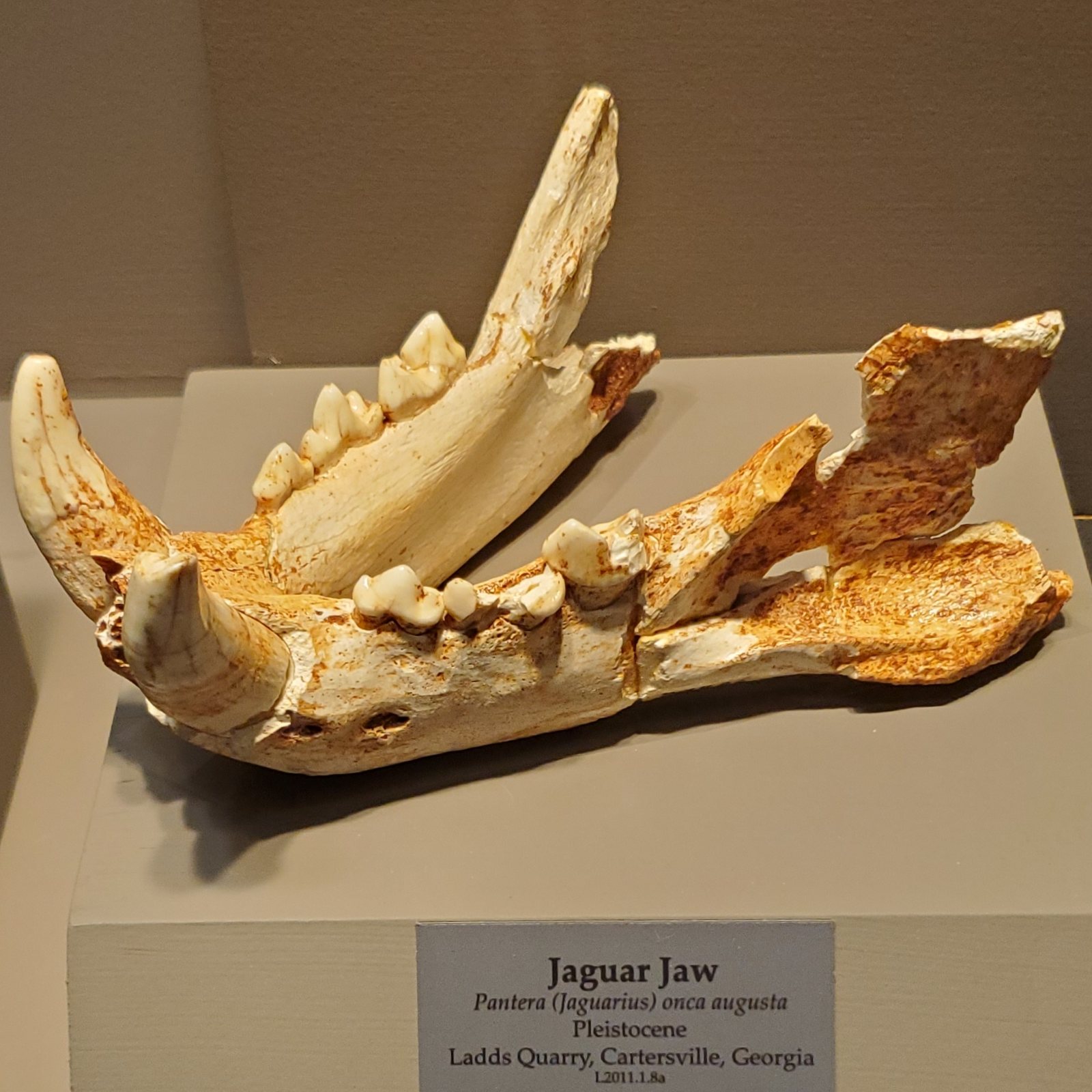
The broadest of these studies came from Per Christiansen and Stephen Wroe in 2007. They modelled bite forces for 151 carnivore species from skull measurements and linked a high bite force, relative to body size, with feeding on large or difficult prey.
A Mexican team looked at the jaguar specifically. In 2011, J. Fernando Del Moral Sachetti, Fátima I. Lameda Camacaro, Jorge Santiago Vázquez and Ramiro Zenteno Cárdenas modelled jaguar bites against peccary skulls. Their model estimated a maximum canine bite of 681.56 newtons, with the force at the carnassial teeth about three times greater. Their verdict was that forces like these could fracture the rigid braincase of a peccary.
A tiger bites harder in absolute terms, while a jaguar bites harder for its size. In a 2005 comparison, Stephen Wroe, Colin McHenry and Jeffrey Thomason estimated a bite force of 1,525 newtons for the tiger, *Panthera tigris*, and 1,014 newtons for the jaguar. Their bite force quotient, which adjusts for body mass, gave the jaguar 137 and the tiger 127. Both figures are biomechanical estimates, not readings taken from every living cat.
Big round figures in pounds per square inch circulate widely online. Treat any single number as an estimate tied to one study and one method, and look for which tooth, which model and which animal it describes.
A bite through the skull
Jaguars do not kill in only one way. The Jaguar Conservation Assessment for Arizona, New Mexico and northern Mexico, written in 2011 by Christopher Johnson, David Van Pelt and James Stuart, describes jaguars killing capybaras either with a throat bite or by puncturing the back of the skull. Caimans are attacked through the back of the neck, where the bite can sever the neck vertebrae.
The same assessment cites a 2000 account by Rosa and Nocke that jaguars are the only American cats that routinely kill prey with a single piercing bite to the skull. So, the skull-piercing bite is real and documented, but the method changes with the prey in front of the cat. It is one of the jaguar's tools, not a rule every jaguar follows every time.
A jaguar can also inflict severe skull injuries on a person, though attacks on people are rare. In 2011, Neto and colleagues described three jaguar attacks in central Brazil in *Wilderness & Environmental Medicine*. One was fatal, and in one case the injuries included fractures of the skull and loss of skull bone. The authors judged one attack predatory and another provoked after dogs chased the jaguar. A 2022 Brazilian case series described five more attacks, none fatal and none predatory. Reports like these record single events rather than a full count, and for a particular region, local wildlife authorities are the people to ask.
Jaguar, leopard or tiger?
These three big cats can be surprisingly hard to tell apart from bone alone. In general the jaguar skull is broader and heavier than the skull of a leopard, *Panthera pardus*, which tends to be longer and more variable in shape.
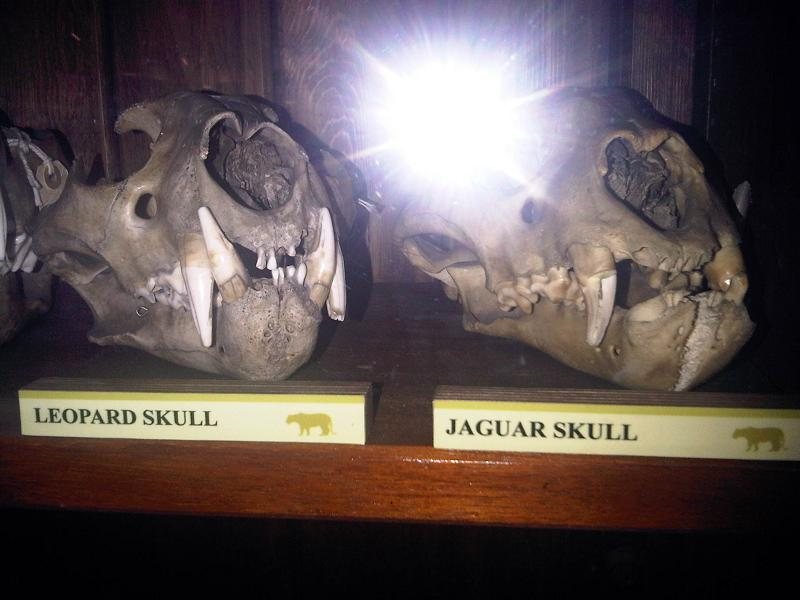
The most detailed help comes from a 2025 identification key by Dominika Formanová and Anna Zelena Kubátová, published in Zoologica Scripta. They worked from skulls in the Czech National Museum, the Natural History Museum in London, the US Fish and Wildlife Service National Fish and Wildlife Forensics Laboratory and other collections: 18 jaguars, 42 leopards and 62 tigers. One of their first points is that jaguar and tiger (*Panthera tigris*) skulls can look very alike in overall shape.
Their answer is to turn the skull over and look at the back edge of the bony palate:
- Jaguars usually have a deep, narrow notch in the middle.
- Leopards commonly have two main notches with a small spine of bone between them; 66.7 percent of the leopard skulls showed this pattern, which the key calls Type 6.
- Tigers most often have a narrow, shallow central notch, called Type 3.
The proportions of the greater palatine foramina, small openings in the palate, add more evidence, and so does skull length. Jaguar skulls often fall in the 25 to 30 centimetre range for greatest length, while the largest tiger skulls reach 30 to 40 centimetres. The ranges overlap, so size alone settles nothing. The authors recommend using all the characters together, with genetic testing for skulls that sit between species. Age, sex, where the animal lived and any damage to the bone can all blur the result, so for a real specimen, a museum skull key or a natural history collection specialist is the best next step.
Tap or hover a row to highlight it.
| Feature | Jaguar (*Panthera onca*) | Leopard (*Panthera pardus*) | Tiger (*Panthera tigris*) |
|---|---|---|---|
| FeatureOverall impression | Jaguar (*Panthera onca*)Broad and heavy, wide rostrum, broad zygomatic arches | Leopard (*Panthera pardus*)More variable, generally more elongated | Tiger (*Panthera tigris*)Large, often longer overall |
| FeatureDental formula | Jaguar (*Panthera onca*)3/3, 1/1, 3/2, 1/1, for 30 teeth | Leopard (*Panthera pardus*)Broadly similar big cat formula | Tiger (*Panthera tigris*)Broadly similar big cat formula |
| FeatureBack of the palate (2025 key) | Jaguar (*Panthera onca*)Deep central notch common, usually Type 4 or Type 5 | Leopard (*Panthera pardus*)Type 6 common: two notches and a central spine | Tiger (*Panthera tigris*)Type 3 most common: narrow, shallow central notch |
| FeatureGreatest skull length groups | Jaguar (*Panthera onca*)Commonly 25 to 30 cm, with overlap | Leopard (*Panthera pardus*)14 to 30 cm groups, with overlap | Tiger (*Panthera tigris*)25 to 40 cm groups |
| FeatureCaution | Jaguar (*Panthera onca*)Never identify from size alone | Leopard (*Panthera pardus*)Skull shape varies a lot | Tiger (*Panthera tigris*)Can look very like a jaguar |
Other cats have their own giveaways. For another big cat of the Americas, see the mountain lion skull; for the lion, and how it compares with the tiger, the lion skull; for an extinct cat, the Smilodon skull; and for general pointers on cat skulls, cat skull identification.
The jaguar in Maya and Mexica art
The jaguar mattered long before anyone measured its bite, and museum collections show that its meaning depended on who was carving it, where and when. Three traditions are worth keeping apart.
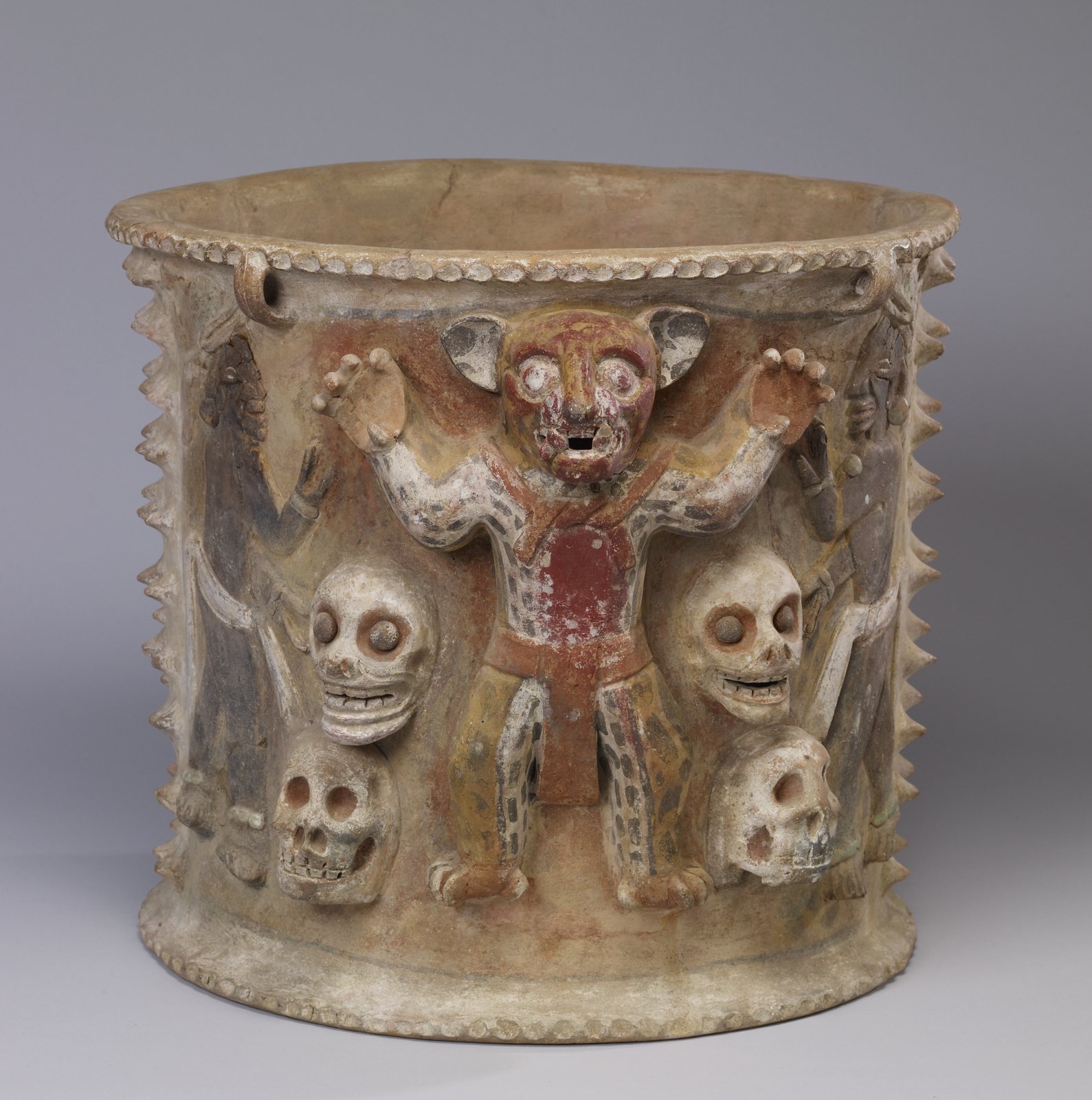
For the Classic Maya, roughly the third to ninth centuries, The Metropolitan Museum of Art explains that jaguars were active at night and were among the most powerful carnivores of the region. Maya artists gave jaguar features to deities and night gods with fierce, warlike qualities, and rulers appeared in the guise of the Jaguar God of the Underworld. In Maya art the jaguar was tied to night, war, fire, the underworld and royal power.
A jaguar head in Maya art could also stand for royal protection and for the Sun on its night journey, and in writing it could spell the Maya word for jaguar, *balam*, also written *b'alam* or *bahlam*. The Library of Congress describes the jaguar as a patron and protector of kings and a deity tied to the Sun in its nocturnal aspect, and notes that Maya rulers took "Balam" into their royal names. The British Museum explains that a jaguar-head glyph could write the whole word, which could also be spelled out with syllable signs. Meanings shifted with period, place and context, so a jaguar head in a carving does not carry one fixed meaning.
The Mexica of central Mexico, in the Late Postclassic period, built the jaguar into their military ranks. The Museo del Templo Mayor and INAH, Mexico's national institute of anthropology and history, describe the eagle and jaguar warriors as elite orders. The Nahuatl phrase *in cuauhtli in ocelotl*, "the eagle, the jaguar," named those elite fighters. An INAH label for a Mexica eagle warrior sculpture from the Templo Mayor, dated 1481 to 1486, explains that the jaguar stood for the night side of the Sun's movement and the eagle for its daytime side. The Met's Altar to the Sun Warrior, made by a Nahua artist or artists, pairs the two animals as a metaphor for a military order of noble-born men with both martial and religious weight.
Classic Veracruz art offers a third version. The Met's Hacha head, dated 600 to 900 CE, shows a figure connected with the ballgame wearing jaguar-warrior headgear. The museum reads it as a person claiming the jaguar's fierceness and power for himself.
The jaguar in art and science
Tap or hover a step to follow the order.
Third to ninth centuries
Classic Maya artists show jaguar deities and night gods tied to war, fire and the underworld.
600 to 900 CE
A Classic Veracruz hacha head shows a ballgame figure in jaguar-warrior headgear.
1481 to 1486
A Mexica eagle warrior sculpture is made for the Templo Mayor, part of the eagle and jaguar warrior tradition.
2005
Wroe, McHenry and Thomason compare estimated bite forces, giving the jaguar a higher bite force quotient than the tiger.
2007
Christiansen and Wroe model bite forces for 151 carnivore species.
2011
Del Moral Sachetti and colleagues model a jaguar bite that could fracture a peccary skull.
2012
Hartstone-Rose, Perry and Morrow measure felid jaw muscles and model bite force.
2025
Formanová and Kubátová publish a big cat skull key based on the palate.
If you come across a jaguar skull
A note first: this is general information rather than legal advice, and the rules change from one country or state to the next. The jaguar sits in Appendix I of CITES, the treaty that controls international trade in threatened wildlife, in the version of the Appendices valid from 25 May 2024.
In the United States, the US Fish and Wildlife Service lists the jaguar as endangered under the Endangered Species Act, in a rule published on 22 July 1997. The Service explains that the Act prohibits unauthorized take, possession, sale or interstate commerce involving unlawfully taken endangered wildlife. A real jaguar skull cannot be traded without permits.
If one turns up in a relative's attic, at an estate sale or anywhere else, leave the buying and selling alone and contact your state wildlife agency or the US Fish and Wildlife Service before doing anything with it. For more general background on bones and skulls people come across, read found an animal skull.
FAQ
Quick answers on size, bite rankings, bite numbers and the leopard question.
How big is a jaguar skull?
Many adult jaguar skulls measure 25 to 30 centimetres in greatest length, according to the 2025 key by Formanová and Kubátová. Size varies with sex, age and population, and it overlaps with leopards and smaller tigers. A measurement means little without knowing how it was taken and from which animal.
Does the jaguar have the strongest bite of any big cat?
The jaguar has one of the strongest bites for its size, but not the biggest bite in absolute terms. In the 2012 jaw-muscle study, the tiger's muscles were larger overall, while the jaguar scored above what its size would predict. No study sets an exact ranking for all cats.
What is the true bite force of a jaguar?
There is no single measured figure; published numbers are model estimates. The 2011 peccary study estimated 681.56 newtons at the canine, with carnassial force about three times higher in the same model. Large pound-per-square-inch figures repeated online are not direct readings from living jaguars.
What is the difference between a leopard and a jaguar skull?
A jaguar skull is usually broader and heavier, while a leopard skull tends to be longer and more variable. On the underside, leopards often show two notches at the back of the palate with a small spine between them, and jaguars a single deep notch. For a real specimen, ask a natural history museum or collection specialist.
A skull shaped by its bite
Every feature of a jaguar skull points back to the bite: the wide cheekbones and tall crest for muscle, the thick canines for piercing, the shearing carnassials for the rest. The Maya, the Mexica and the artists of Classic Veracruz each saw something different in the animal, and museums still keep those meanings apart. For another skull built around enormous jaw muscles, though for a very different diet, read about the panda skull.
Jaguar skull quiz
Answer every question to check.
Terms in this story
Tap a term to see what it means.
Panthera onca. The scientific name of the jaguar. It shares the genus Panthera with the leopard and the tiger.
---