

No. 280
Toumaï Skull (Sahelanthropus): The Fossil from Chad and Why Scientists Debate It
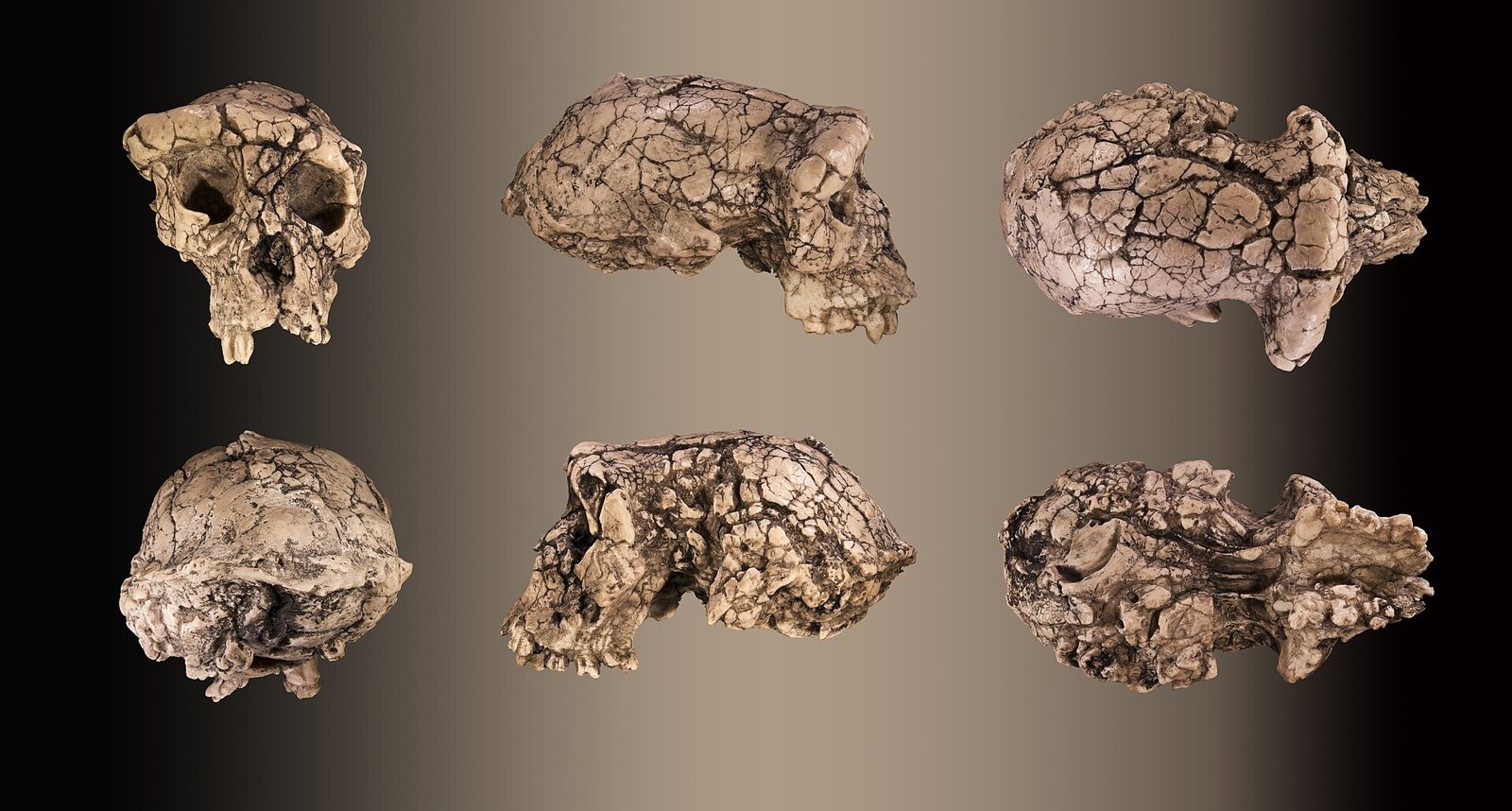
Toumaï is the nickname of a fossil cranium found in 2001 at Toros-Menalla, in the Djurab Desert of Chad. It is the type specimen of *Sahelanthropus tchadensis*, a species named in 2002, and it is about 7 million years old: 6 to 7 million years judging by the animal fossils found with it, and about 6.8 to 7.2 million years from later dating of the surrounding sediments (Smithsonian Human Origins Program; Brunet and colleagues, 2002).
Scientists still debate two big questions about it. Did Toumaï belong to the human lineage, and did it walk upright? The skull mixes ape-like and human-like features, and the limb bones from the same site have been read in very different ways (CNRS). That mix is exactly why the fossil keeps turning up in conversations about where our own family tree begins.
The find at Toros-Menalla
On 19 July 2001, the Franco-Chadian Mission Paléoanthropologique was working at a locality called TM 266, at Toros-Menalla in the Djurab Desert of northern Chad. The team, led by the French palaeontologist Michel Brunet and including researchers from Chad, France and other institutions, recovered a nearly complete cranium along with jaw fragments and teeth (Smithsonian Human Origins Program; Australian Museum).
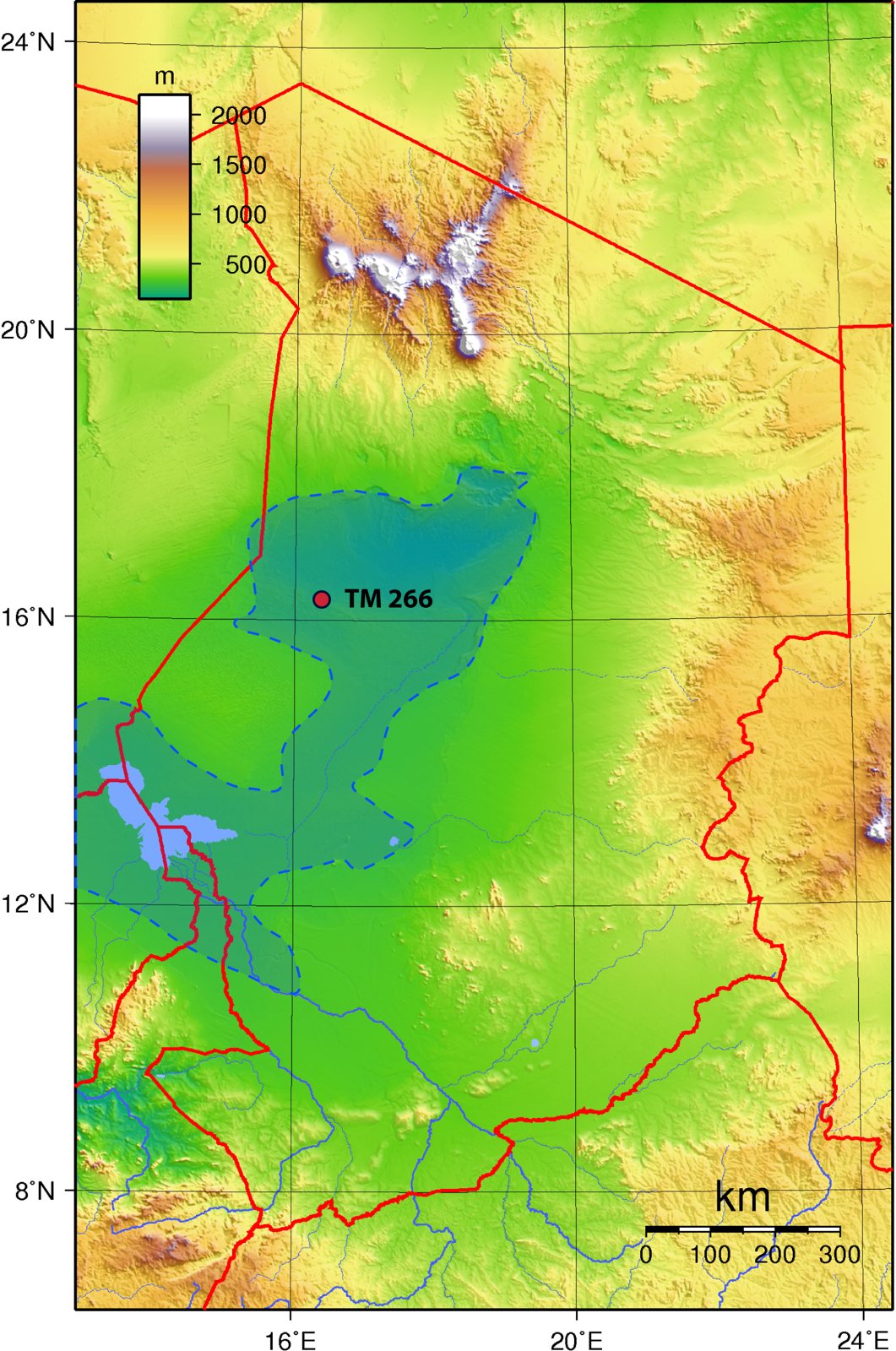
The place stands out on a map. Toros-Menalla lies about 2,500 kilometers west of the East African Rift, deep in the desert of north-central Africa.
The skull did not come out of the ground looking the way it does in photographs. It was crushed and distorted, and it has been reconstructed from its surviving bones. In 2002 the team formally described the species in *Nature*, with a companion paper by Vignaud and colleagues setting out the geology and the animal fossils of the site (Brunet and colleagues, 2002; Vignaud and colleagues, 2002). The cranium became the holotype, the specimen that defines the species, under the catalogue number TM 266-01-060-1.
What the name Toumaï means
Toumaï is the cranium's nickname, and it comes from Chad. The Smithsonian Human Origins Program gives it as a word meaning "hope of life" in the local Dazaga language (Smithsonian specimen record). The Muséum national d'Histoire naturelle in Paris gives the related form "espoir de vie," hope of life, in the Gorane language (Muséum national d'Histoire naturelle). The two institutions name the language differently, and both tie the word to the people of the region where the skull was found.
The scientific name is just as local. *Sahelanthropus tchadensis* means "Sahel man from Chad": *Sahelanthropus* for the Sahel, the region along the southern edge of the Sahara, and *tchadensis* for Chad itself (Australian Museum).
How old is Toumaï, and how was it dated?
The short answer is about 7 million years, and two different methods stand behind that figure.

The first came with the 2002 papers. Toros-Menalla had no layers of volcanic ash suitable for ordinary radiometric dating. So, the team used biostratigraphy, which dates a layer by the animals buried in it: they compared the animal fossils found with Toumaï to faunas that had already been dated at other sites. That gave an age of 6 to 7 million years (Brunet and colleagues, 2002; Vignaud and colleagues, 2002).
The second came later. In 2008, Lebatard and colleagues applied cosmogenic beryllium dating to sediments from the fossil-bearing layer, known as the anthracotheriid unit. That method measures a rare form of beryllium that builds up in sediments, which lets scientists estimate how long ago a layer was laid down. It produced a range of about 6.8 to 7.2 million years (Lebatard and colleagues; Australian Museum).
So, when you read "7 million years," that is a rounded figure resting on two ranges that overlap. It is precise for a fossil this old, but it is still a range rather than a single date.
What the skull shows
The Toumaï skull is a mix, and that is what makes it so interesting. Its brain was small, estimated at about 320 to 390 cubic centimeters, similar in size to a chimpanzee's. It has a heavy brow ridge across the forehead. Yet its face is relatively short and does not jut forward much, its canine teeth are small, and its foramen magnum, the opening where the spinal cord leaves the skull, is positioned forward (Smithsonian Human Origins Program; Australian Museum).
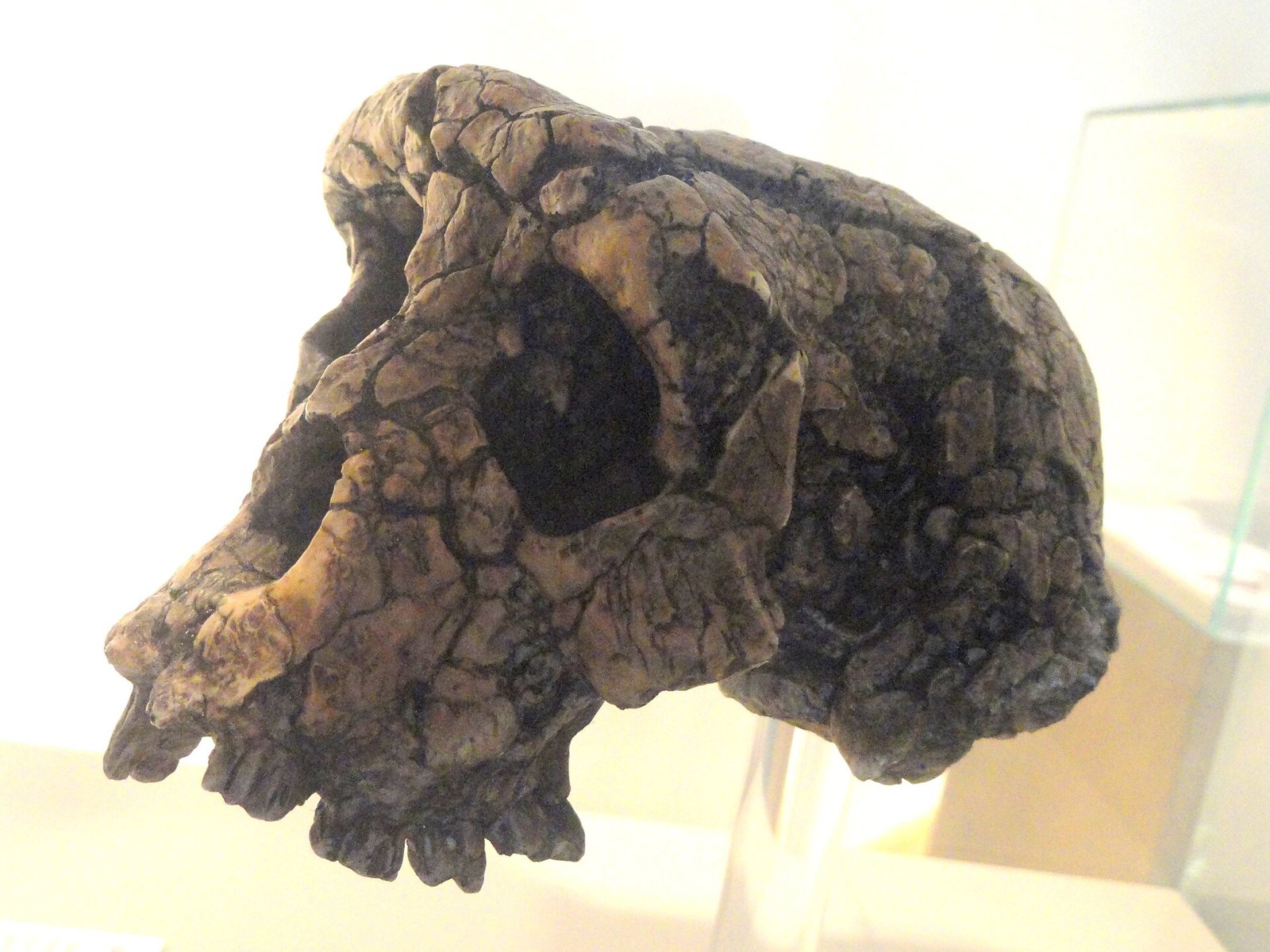
That last feature carries a lot of weight. A forward-placed foramen magnum suggests a head balanced on top of an upright spine, rather than hanging forward from a horizontal one. Brunet and colleagues read the skull's anatomy as evidence that the head was held on an upright body, and they placed *Sahelanthropus* within the human lineage.
Ape-like and human-like features in one skull
Tap a card to bring it forward.
- Small brain: About 320 to 390 cubic centimeters, similar to a chimpanzee's.
- Heavy brow ridge: A thick bar of bone above the eyes.
- Short face: A relatively short face that projects less than you might expect.
- Small canines: Smaller canine teeth, read by the describing team as a human-lineage trait.
- Forward foramen magnum: The opening for the spinal cord sits forward, which Brunet and colleagues read as a sign of an upright body.
Tap or hover a row to highlight it.
| Field | Data |
|---|---|
| FieldScientific name | DataSahelanthropus tchadensis |
| FieldNickname | DataToumaï |
| FieldYear found | Data2001 |
| FieldSite | DataToros-Menalla, locality TM 266 |
| FieldRegion | DataDjurab Desert, northern Chad |
| FieldAge | Data6 to 7 million years by biostratigraphy; about 6.8 to 7.2 million years by cosmogenic beryllium dating |
| FieldHolotype | DataCranium TM 266-01-060-1 |
| FieldSkull features | DataSmall brain, heavy brow ridge, small canine teeth, forward-positioned foramen magnum |
| FieldMain scientific dispute | DataWhether the species belonged to the human lineage and whether it was habitually bipedal |
The femur, the forearm bones and why scientists disagree
The skull was not the only bone from Toros-Menalla. A partial femur, or thigh bone, from the same locality was recognized as a possible hominid bone in 2004, three years after the skull came to light. Two ulnae, bones of the forearm, joined the discussion later (Australian Museum; CNRS). Because legs and arms say more about how an animal moved than a skull can, these bones became the center of the argument.
The readings point in different directions. In 2020, Roberto Macchiarelli, Aude Bergeret-Medina, Damiano Marchi and Bernard Wood reported that the femur showed no clear evidence of habitual bipedalism, meaning regular walking on two legs (Macchiarelli and colleagues, 2020). In 2022, Guillaume Daver, Franck Guy and colleagues argued the opposite case: that the femur and the two ulnae showed adaptations for walking upright on the ground, combined with climbing or other movement in the trees (CNRS technical summary). In 2023, Marc Meyer and colleagues read the ulnae as more consistent with ape-like knuckle-walking.
There is one more wrinkle. The femur and ulnae were assigned to *Sahelanthropus* because no other large primate has been identified at the site, but nobody can prove they belonged to the same individual as the cranium. So, the question "Was Toumaï a biped?" depends partly on which bones you count as Toumaï's, and the scientists who have studied them most closely still disagree.
Toumaï from the desert to the debate
Tap or hover a step to follow the order.
2001
The cranium and associated fossils come out of the ground at Toros-Menalla, Chad.
2002
Sahelanthropus tchadensis is formally described in Nature.
2004
The partial femur is recognized as a possible hominid bone.
2008
Cosmogenic beryllium dating places the sediments at about 6.8 to 7.2 million years.
2020
Macchiarelli and colleagues argue the femur does not show habitual bipedalism.
2022
Daver, Guy and colleagues argue for bipedal adaptations in the femur and ulnae.
2023
Meyer and colleagues argue the ulnae show ape-like knuckle-walking.
Was Toumaï a human ancestor?
It may have been part of the human lineage, but that is not settled. The skull has several features that its describers read as hominin traits, meaning traits of the human branch, while the competing studies of the femur and ulnae support different readings of how it moved and where it sits in evolution (Smithsonian Human Origins Program).
The fairest way to describe Toumaï is as one of the oldest possible members of the human lineage, not as a confirmed direct ancestor of modern humans. That still puts it near the very start of a long line of fossils. For how Toumaï fits among the other contenders for the oldest skulls in our family's story, read our guide to the oldest human skull, and for a much later and far better known human relative, the story of Lucy picks up the thread millions of years on.
Where to see Toumaï
The skull itself comes from Chad, and most people meet it through casts. A reconstructed cast of the holotype is kept at the Centre d'anthropobiologie et de génomique in Toulouse, France (CNRS). The Muséum national d'Histoire naturelle in Paris also presents Toumaï through a cast of the skull (Muséum national d'Histoire naturelle).
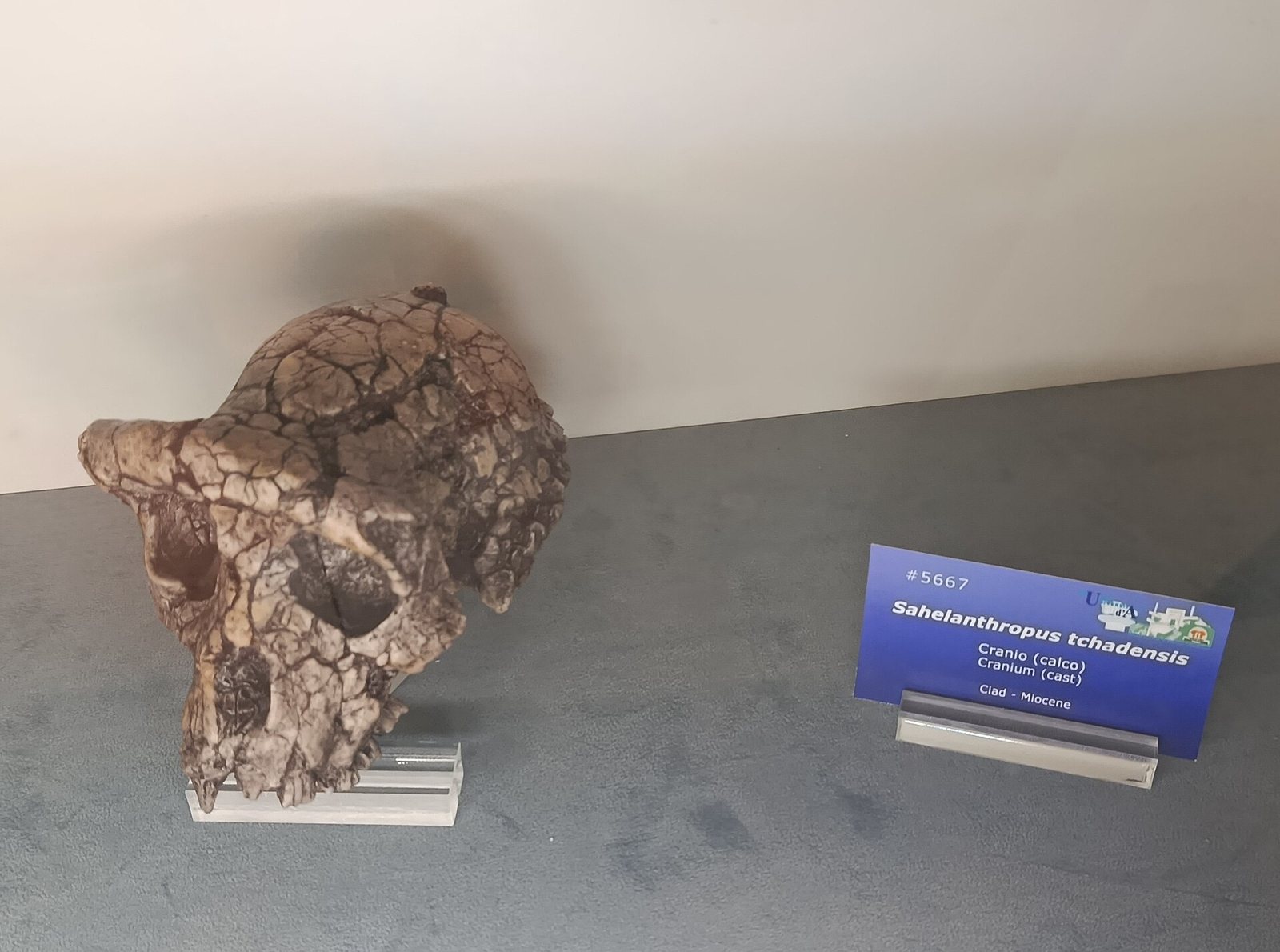
If you cannot travel, the Smithsonian Human Origins Program keeps an online record of the specimen with its catalogue number, site and age (Smithsonian specimen record). An openly licensed photograph of a Toumaï cast by Didier Descouens is also available on Wikimedia Commons under a CC BY-SA 4.0 licence.
Gallery displays change, so confirm what is on show with the museum before you plan a visit.
How well do you know Toumaï?
Answer every question to check.
Frequently asked questions
A few more questions about Toumaï, answered briefly.
What is Toumaï?
Toumaï is the nickname of the fossil cranium that serves as the type specimen of *Sahelanthropus tchadensis*, found in 2001 in the Djurab Desert of Chad. The species is known from that cranium plus jaw fragments and teeth, and its place in human evolution is still debated.
Did Toumaï walk on two legs?
Scientists disagree. The skull's forward foramen magnum suggests an upright posture, but studies of the femur and forearm bones from the site have argued for regular two-legged walking, for a mix of walking and climbing, and for ape-like knuckle-walking.
Why is the Toumaï skull distorted?
It was crushed and distorted when it was found, after millions of years in the ground. The skull seen in casts and images has been reconstructed from its surviving bones.
Is Toumaï older than Lucy?
Yes, by a wide margin. Toumaï is about 7 million years old, while Lucy belongs to a much later chapter of the human story, as our Lucy story explains.
More early skulls to look at next
Toumaï opens the human story, and other fossils carry it forward. The Taung Child and Little Foot come from South Africa and added their own chapters, while the Black Skull is another fossil whose place in the family tree has kept scientists talking. Much closer to our own time, the Omo Kibish skulls from Ethiopia are among the oldest fossils of our own species, *Homo sapiens*.
Terms in this story
Tap a term to see what it means.
Sahelanthropus tchadensis. The species Toumaï belongs to. The name means "Sahel man from Chad."
---