

No. 002
Asmat Ancestor Skulls: How the Asmat of New Guinea Honored Their Dead
A decorated Asmat ancestor skull was a way of keeping a loved one close. For Asmat communities in Papua, Indonesia, on the island of New Guinea, the honored skull of a relative, often called a ndambirkus, kept that person present in the life of the family. It was kept in the household or the clan, carried to stay in contact with the ancestors, brought out for ceremonies and sometimes used as a headrest or pillow. The lower jaw was usually left attached, a detail that sets an ancestor skull apart from many enemy trophy skulls. What a skull meant could differ from one Asmat region or village to the next.
If you saw one in a museum, perhaps in the Metropolitan Museum of Art's Michael C. Rockefeller Wing, the seeds, feathers and fiber on it were not decoration for strangers. They were care given to a relative.
What an ancestor skull meant to the family
The Asmat live on the southwest coast of New Guinea, in what is now Papua, Indonesia. Museum records and anthropologists who have worked with Asmat collections, including the Lowell D. Holmes Museum at Wichita State University and the cultural historian David Stanley, describe the ancestor skull as part of a household's ongoing relationship with its dead.
A relative's skull did not go into a grave and stay there. It could be kept in the family's home, carried when someone traveled, displayed during ceremonies, and at times used as a headrest or pillow during sleep. The scholars and object records tie these practices to continuing contact with the dead, to protection, to remembrance and to the sense that the ancestor was still present. In Stanley's account of the Asmat Museum and its collections, ancestral power runs through Asmat art, and the skull is one of its most personal forms.
That is the short answer to why the Asmat kept ancestor skulls: to keep the dead close, in the most literal way. The details varied, and there was never one rule for every Asmat village.
Ancestor or enemy?
The question many museum visitors ask next is whether the skull in front of them belonged to a beloved grandparent or to an enemy. Both kinds of skulls exist in collections, and they are not the same thing.
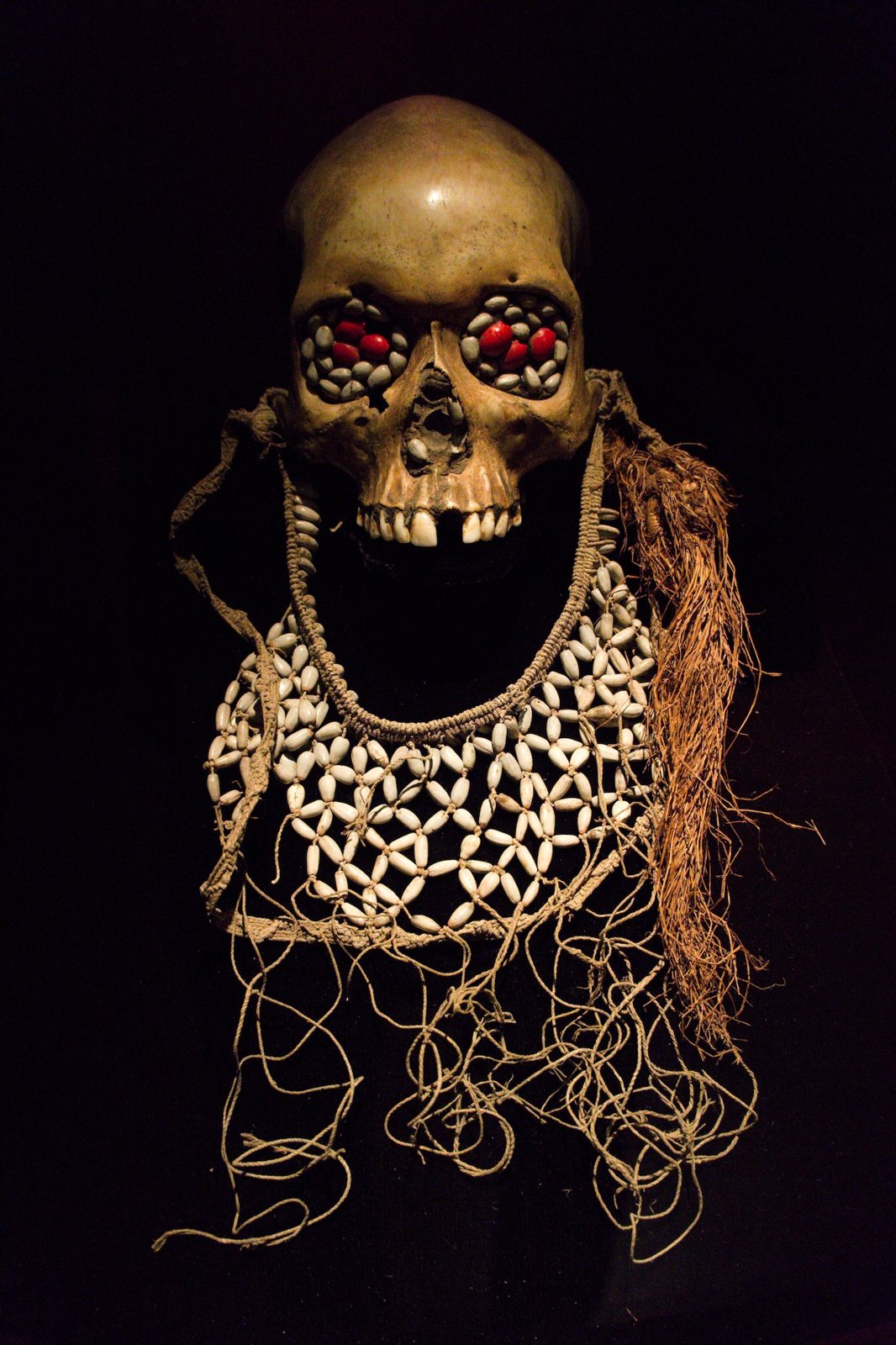
The most commonly cited difference is the jaw. On an ancestor skull, the lower jaw generally remained attached. Many enemy trophy skulls were treated differently, and museums catalog them separately. The Etnografiska museet in Sweden, for example, holds an Asmat skull identified as an enemy skull, distinct from the ancestor skulls in other collections.
So, when you look at an Asmat skull in a case, the museum label should tell you which kind it is. An ancestor skull is a relative's remains, kept with affection. An enemy skull belongs to the history of warfare covered further below.
Seeds, feathers and beeswax
Asmat makers decorated ancestor skulls with materials from the forest and the coast around them: seeds, feathers, plant fiber, rattan, shells, clay and beeswax. Each skull was its own piece of work, and the materials on one do not describe every other.
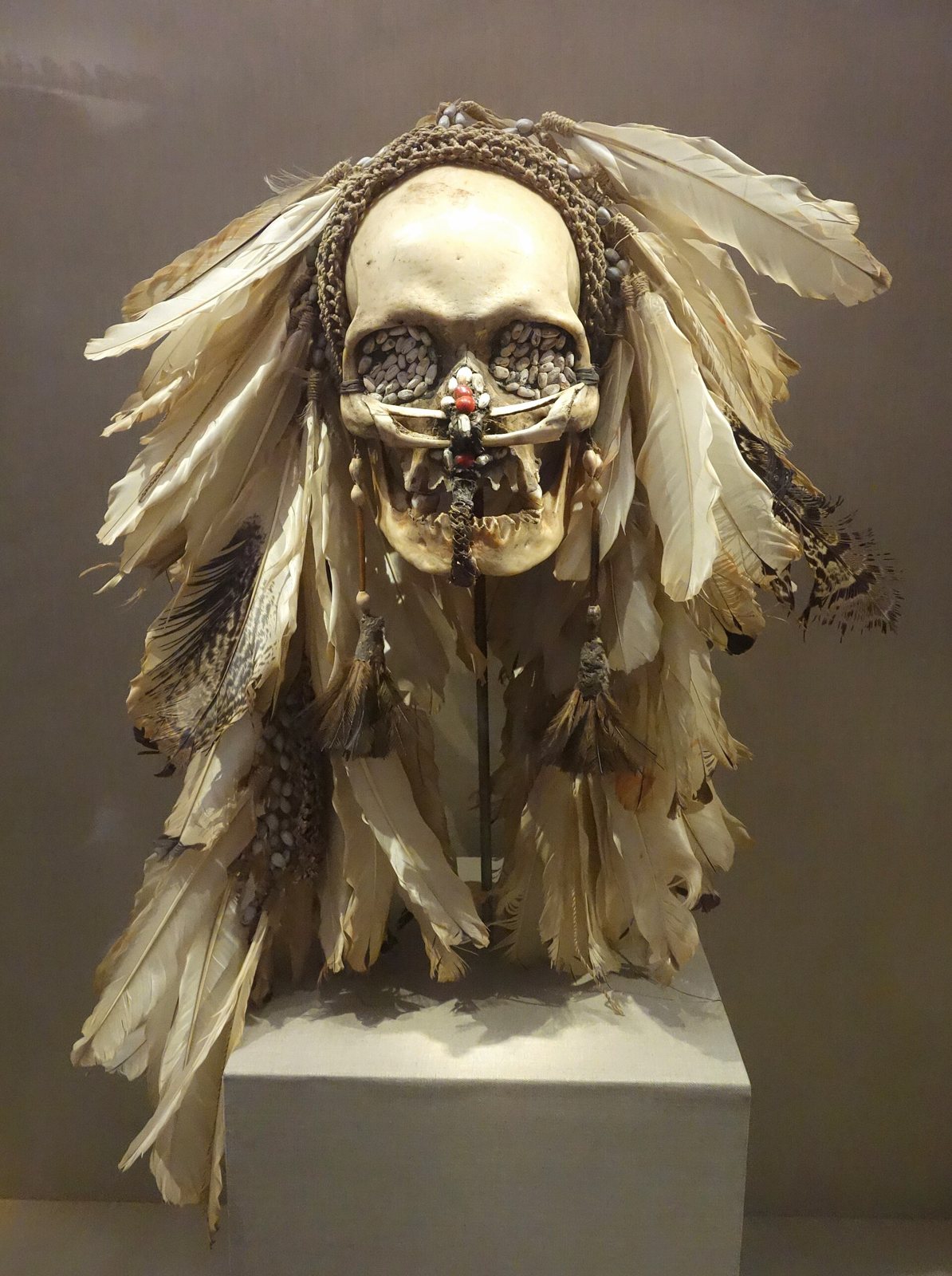
The Metropolitan Museum of Art holds two early to mid twentieth century Asmat ancestor skulls from West Papua in its Michael C. Rockefeller Memorial Collection. Object 1978.412.1299 is catalogued with human skull, clay, seeds, fiber, feathers and sago palm leaves. Object 1978.412.1287 comes from Momogo village on the Pomatsj River and was donated in 1965.
Other museums show the same care in different combinations. An ancestor skull at the de Young Museum, photographed for Wikimedia Commons, is labeled as a twentieth century work of the Asmat people of the Southwest Coast, made of skull, beads, feathers and fiber. Placed side by side, these skulls share a vocabulary of materials without being copies of one another.
Bisj poles and the ancestors
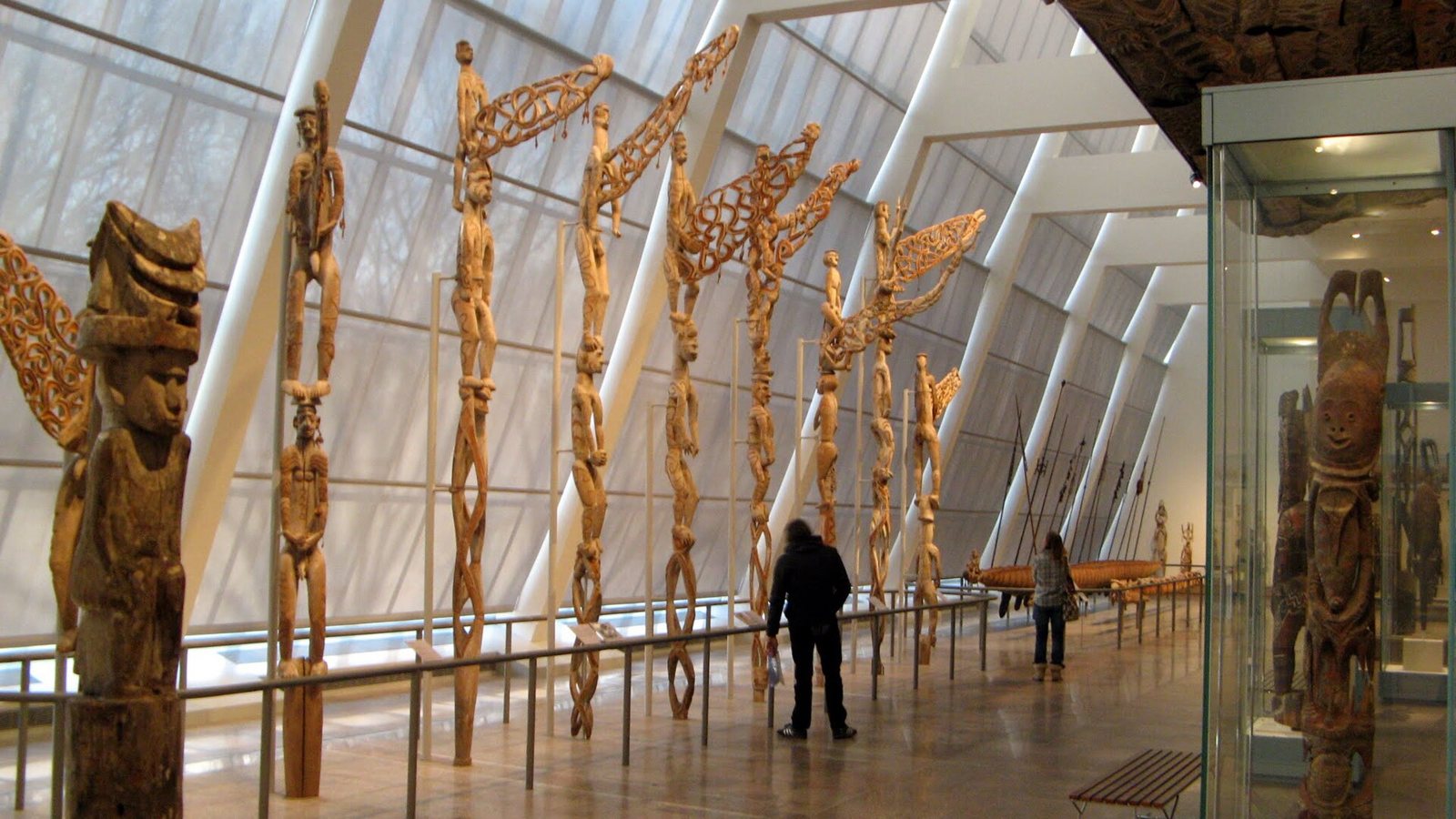
Alongside ancestor skulls, many museums show tall carved poles called bisj (also written bis). A bisj is a memorial pole carved from a single tree and made for particular people who had died. It is tied to ancestral power, to the balance of the community and to remembrance.
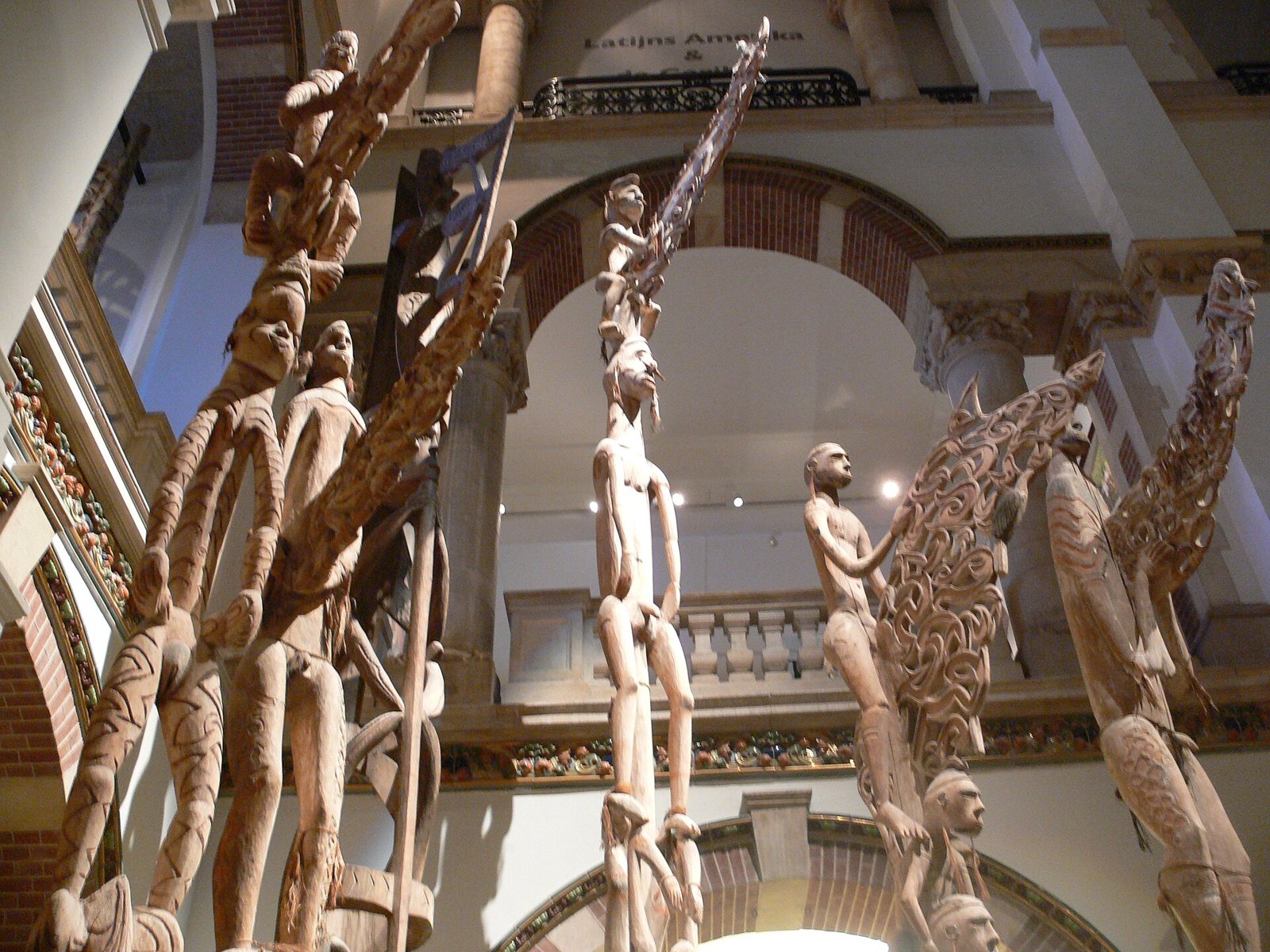
Ursula and Gunter Konrad, Abraham Kuruwaip and David Stanley describe the pole as a link between the living community, the dead and Safan, the land of the ancestors, as summarized in a survey of the changing Asmat world. In the Bismam region, a bis feast honored the dead and stood for the renewal of life force. Historically, the ceremony could also express obligations of revenge for people killed in raids.
Wereldmuseum Amsterdam explains why the poles faced the river: the river led toward the sea and toward the land of the ancestors. The museum's account includes a bisj ceremony at Omandesep on the Faretsj River, documented on June 29, 1961.
Asmat poles stand in museums far from Papua. Harvard's Peabody Museum holds two Asmat bis poles from Michael Rockefeller's collecting, and the Met's Michael C. Rockefeller Wing carries his name. Today the Asmat Museum of Culture and Progress describes contemporary ancestor sculptures and pole compositions as containing the spirits and characteristics of the people they represent.
Asmat ancestors and Asmat art, 1953 to 1981
Tap or hover a step to follow the order.
1953
Catholic Crosier missionaries establish a lasting mission presence in Asmat territory
1959
Gerard A. Zegwaard publishes a major study of Asmat headhunting practices
June 29, 1961
A bisj ceremony is documented at Omandesep on the Faretsj River
1963
A MUDEC object record dates the headhunting ban to this year; wooden ritual heads replace real skulls
1973
The Asmat Museum of Culture and Progress is founded in Agats
1981
Festival Asmat Pokman begins
Headhunting, told plainly
Any honest account of Asmat skulls includes headhunting, and it belongs here as history with dates, not as a label for a people.
Headhunting was historically part of Asmat warfare, of initiation, of ritual connected to the ancestors and of ideas about restoring balance between the community and the wider world. Rev. Gerard A. Zegwaard documented these practices in "Headhunting Practices of the Asmat of Netherlands New Guinea," published in American Anthropologist in 1959, when the region was known as Netherlands New Guinea.
Missionary settlement began in 1953. The Lowell D. Holmes Museum says that Catholic Crosier missionaries helped end headhunting while encouraging other Asmat traditions. A museum record from MUDEC in Milan dates a ban to 1963 and explains that wooden heads were then carved as ritual substitutes for real skulls.
The end did not come as one event everywhere. Government suppression, missionary pressure and cultural change unfolded through the 1950s and 1960s, and the timing and scale varied from place to place.
Asmat art and culture today
Asmat carving did not stop when the old rituals changed. The Asmat Museum of Culture and Progress in Agats, Papua, was founded in 1973 through the Diocese of Agats and presents more than 2,000 objects. Part of its stated purpose is helping younger Asmat people keep their connection with their own history and culture.
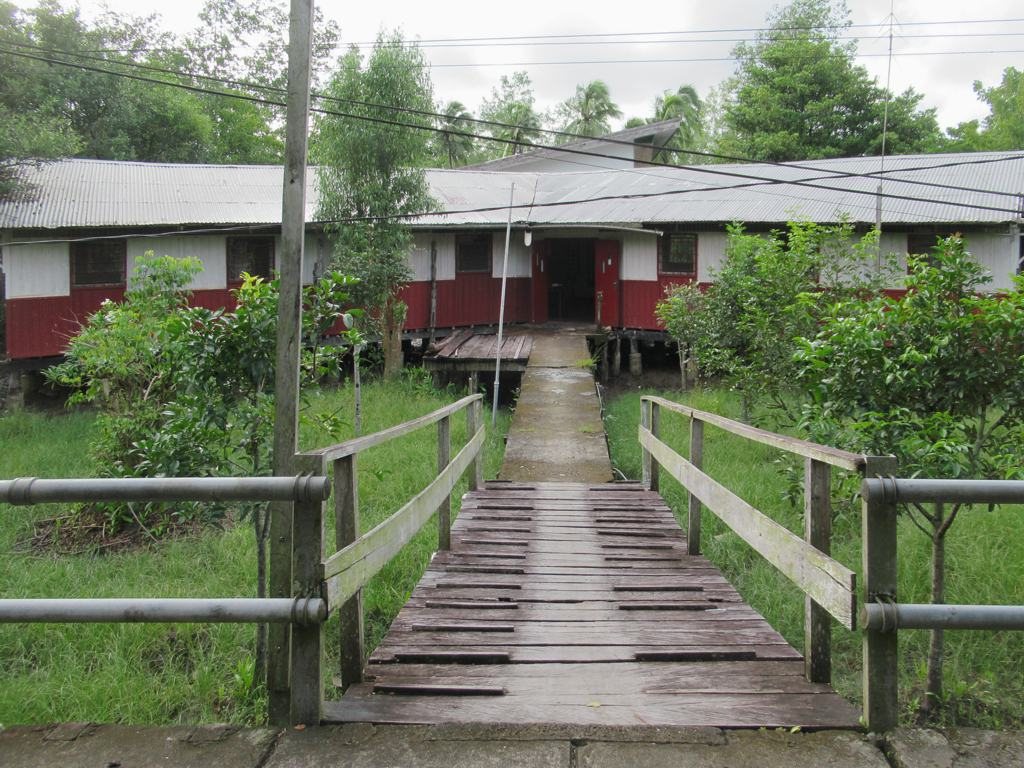
The museum describes contemporary Asmat sculpture as including traditional ancestor sculptures, ancestor figures, busts, openwork carvings and panels, alongside scenes of daily life, myths and ceremonies. Since 1981, the Festival Asmat Pokman has supported carving, weaving, music, dance, ritual knowledge, workshops, local food, canoe demonstrations and creative livelihoods.
If you hope to visit the museum or attend the festival, confirm current details directly with the Asmat Museum before making plans.
Questions people ask about Asmat skulls
Why did the Asmat keep ancestor skulls?
The Asmat kept ancestor skulls to keep dead relatives close to the family and the community. Skulls could be kept at home, carried, brought out for ceremonies and sometimes used as a headrest, and they were linked with protection, remembrance and the continuing presence of the ancestor.
What is an Asmat bisj pole?
A bisj, or bis, is a tall memorial pole carved from a tree for people who had died, linked with ancestral spirits and the balance of the community. In traditional ceremonies it could stand for a route for the dead toward Safan, the land of the ancestors, and Asmat artists still work with the form today.
Are Asmat skulls ancestor skulls or enemy trophies?
Both exist, and museums catalog them separately. On ancestor skulls the lower jaw generally stayed attached, which distinguishes them from many enemy trophy skulls, such as the Asmat enemy skull at the Etnografiska museet in Sweden.
Where can you see Asmat ancestor skulls?
Several museums hold them, including the Metropolitan Museum of Art, whose Michael C. Rockefeller Memorial Collection includes two early to mid twentieth century Asmat ancestor skulls from West Papua (objects 1978.412.1287 and 1978.412.1299). The de Young Museum also holds an Asmat ancestor skull decorated with beads, feathers and fiber, and the Asmat Museum of Culture and Progress in Agats presents more than 2,000 Asmat objects.
When did Asmat headhunting end?
Headhunting ended over the 1950s and 1960s, at different times in different places. Missionary settlement began in 1953, and a MUDEC museum record dates a ban to 1963, after which carvers made wooden heads as ritual substitutes.
How much do you know about Asmat ancestor skulls?
Answer every question to check.
Where to go next
The Asmat are one of several peoples who kept the dead within reach. In Sulawesi, Toraja families clean and re-dress their ancestors during Ma'Nene', and in La Paz, Bolivia, families carry their named skulls to the Cementerio General every November 8 for the Fiesta de las Ñatitas. For skulls modeled and kept by families thousands of years earlier, read about the Jericho plastered skulls, and for the wider story of what skulls have meant around the world, start with skull symbolism.
Terms in this story
Tap a term to see what it means.
Asmat. A people of the southwest coast of New Guinea, in Papua, Indonesia, known for their carving.