

No. 176
The Lady of Cao: The Tattooed Moche Woman Who Ruled
The Lady of Cao was an elite Moche woman of the Chicama Valley on Peru's north coast who died in her early twenties around 400 CE. The El Brujo Archaeological Complex places her burial in the fourth to fifth century CE (El Brujo). Her carefully wrapped body, its arms, hands, ankles and feet still marked with tattoos of snakes and spiders, was excavated in 2005 inside a painted ceremonial mausoleum at Huaca Cao Viejo, in the La Libertad region, and the Fundación Wiese announced the find in 2006 (Fundación Wiese). Her tomb held crowns, nose and ear ornaments and ceremonial war clubs, which is why many scholars think she held political or religious authority. She rests today in the Museo Cao at El Brujo.
The tattooed forearms and the calm reconstructed face that circulate online belong to a young woman who had already given birth at least once, who was buried with more care than almost anyone of her time, and whose role still keeps archaeologists talking.
The tomb at Huaca Cao Viejo
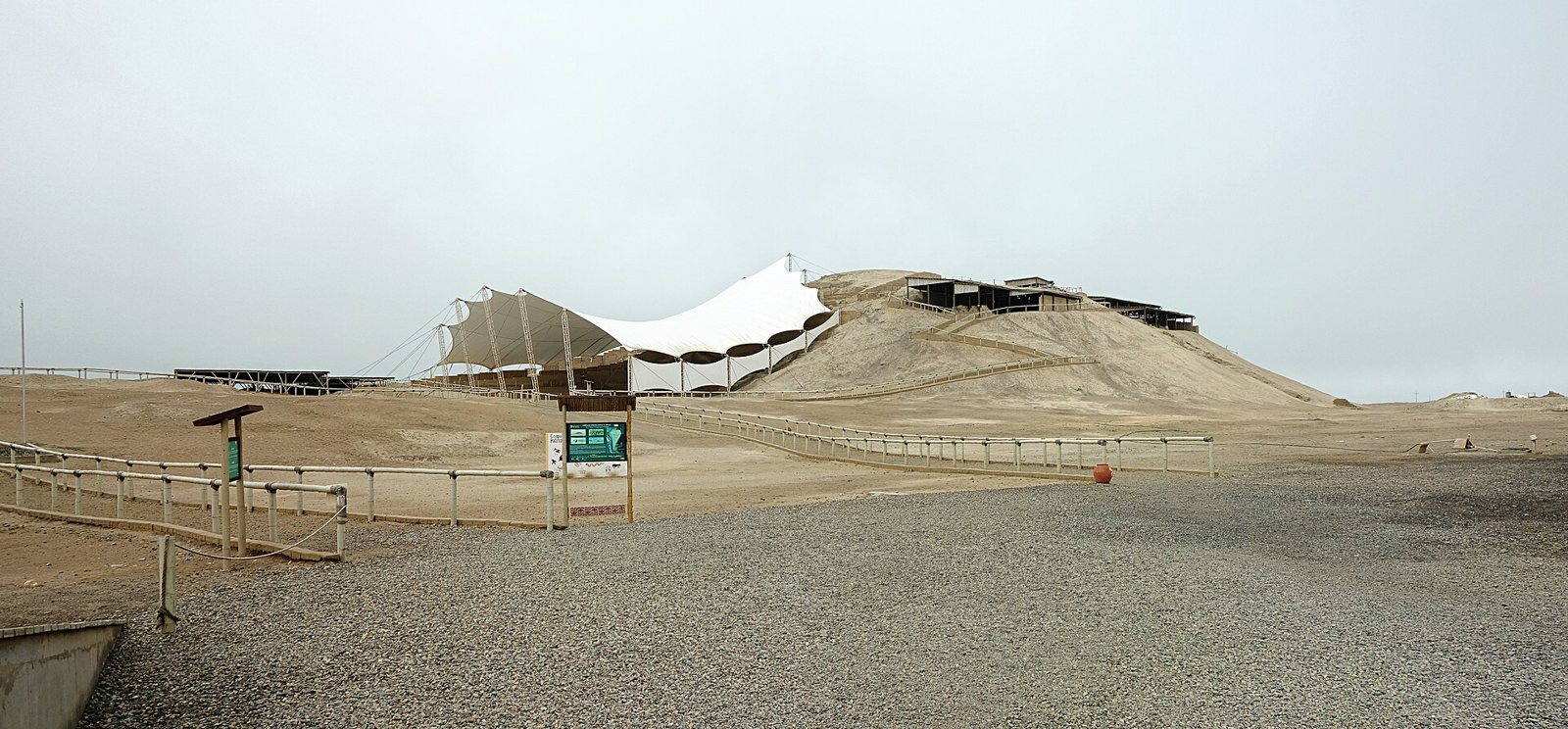
El Brujo is an archaeological complex in Magdalena de Cao, in Ascope Province, La Libertad. It includes three huacas, Huaca Cao Viejo, Huaca Cortada and Huaca Prieta, along with the Museo Cao, and it holds a long sequence of human occupation, including major Moche ceremonial buildings (Fundación Wiese). Huaca Cao Viejo, the one that matters most here, is a Moche ceremonial building.
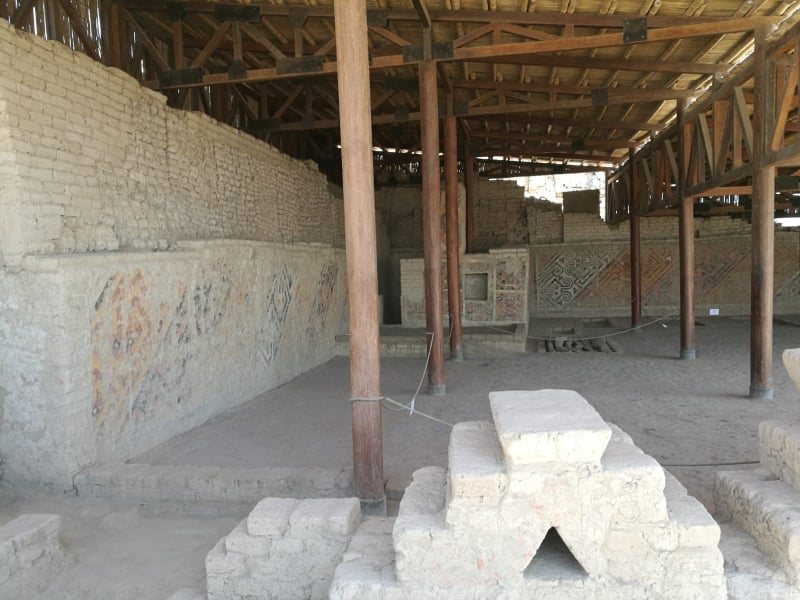
Work at the temple has been a long, shared effort. In 1991 the Fundación Wiese, Peru's cultural authorities and the Universidad Nacional de Trujillo began coordinated research at Huaca Cao Viejo (Fundación Wiese). The excavation that reached her was led by the Peruvian archaeologist Régulo Franco Jordán with the El Brujo archaeological project team. They located the burial in 2005, and the Fundación Wiese announced it to the public in 2006.
Her tomb lay in a painted ceremonial mausoleum inside the temple. She had been wrapped in a funerary bundle of textiles, and her body was naturally preserved along with the skin and its tattoos. That is why she is often called the "Lady of Cao mummy": she is a naturally preserved body inside a Moche funerary bundle.
The Lady of Cao, from excavation to museum
Tap or hover a step to follow the order.
1991
The Fundación Wiese, Peru's cultural authorities and the Universidad Nacional de Trujillo begin coordinated research at Huaca Cao Viejo.
2005
The Lady of Cao's burial is excavated at Huaca Cao Viejo.
2006
The find is publicly announced.
2 April 2009
Museo Cao opens at El Brujo.
July 2017
A 3D and forensic facial reconstruction is presented.
When she lived
The excavators date her tomb to roughly the fourth to fifth centuries CE, commonly summarized as about 400 CE (Fundación Wiese; El Brujo). Published dates are not uniform, though. A 2014 archaeometric study of her nose ornaments by Cesareo and colleagues gives an earlier approximate date of 300 CE (Cesareo et al., 2014). The fair way to put it is that she lived in the Moche period, between about 300 and 500 CE depending on the study, with the excavators favoring about 400 CE.
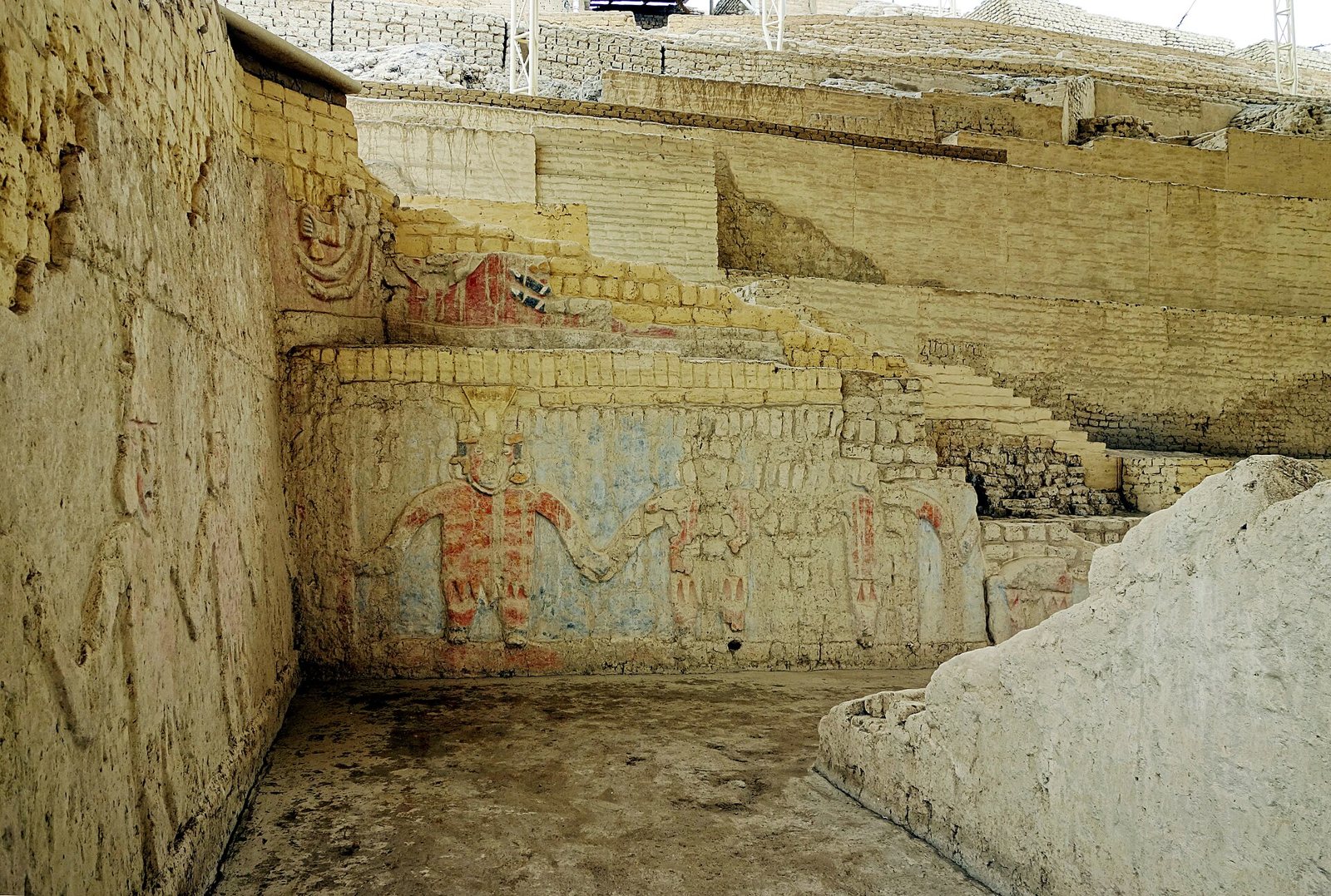
Either date puts her centuries before the Inca Empire. So, if you have wondered whether a pre-Inca mummy has been found in Peru, the Lady of Cao is one of the best-known answers. Another is the Lord of Sipán, a Moche ruler of the same north coast.
What her body tells us
The Lady of Cao died young. The physical anthropologists John Verano, Guido Lombardi, Sonia Guillén and Jordi Esteban estimated that she was about 20 to 25 years old (Fundación Wiese). Another paper summarizes Verano's estimate a little more broadly, as a woman in her mid to late twenties (Cichero, Brown University). She stood approximately 1.48 metres tall, a little under 4 feet 11 inches.
Her skeleton shows no clear signs of injury, chronic illness, poor nutrition or problems in development. The back of her skull is slightly flattened, which is consistent with being carried on a cradleboard as a baby, and changes to her pelvis show that she had given birth before (Fundación Wiese).
How she died is a more careful question. Her abdomen was markedly distended. The excavators and the researchers working with them interpret the evidence as compatible with death during or shortly after childbirth, possibly from eclampsia, a complication of pregnancy (Cichero, Brown University). That is an interpretation of what the body shows, not a cause of death anyone observed. Behind the regalia was a young mother.
If you are curious how anthropologists read age, height and childbirth from a skeleton, our story on what bones tell archaeologists walks through the basics.
The tattoos and what they may mean
The tattoos are what most people see first. They cover parts of both forearms, her hands, her ankles and her feet (Fundación Wiese). The motifs include snakes, spiders, felines, birds, lunar animals and geometric figures, along with other designs that nobody has yet deciphered (Cichero, Brown University).
The Lady of Cao's tattoos at a glance
Tap a card to bring it forward.
- Where: Parts of both forearms, the hands, the ankles and the feet.
- Animals: Snakes, spiders, felines, birds and lunar animals.
- Patterns: Geometric figures and other designs not yet deciphered.
- Pigment: Mainly ferrous oxide, possibly from jagua fruit according to Víctor Vásquez Sánchez.
- Meaning: Linked by Régulo Franco Jordán and the Fundación Wiese to earth, water and the cosmos; John Verano calls the meanings speculative.
Analysis of the pigment identified mainly ferrous oxide, an iron compound. Víctor Vásquez Sánchez has proposed that it may have been derived from the fruit of the jagua (Fundación Wiese).
What did the tattoos mean to her and to the people who made them? Régulo Franco Jordán and the Fundación Wiese associate the snakes and spiders with Moche ideas about the earth, water and the cosmos, and they suggest that the tattoos may reflect a spiritual or healing role (Fundación Wiese). John Verano has stressed the other side: the meanings remain speculative, because the Moche left no written explanation of their tattoo system (Archaeology Magazine). Both views can stand together, and the exact meaning of the motifs on her skin is still an open question.
Why she is thought to have ruled
Her burial contained the insignia of power: crowns, diadems, nose ornaments, ear ornaments and ceremonial clubs, with more than 100 metal objects in all (Fundación Wiese). Inside the bundle were also textiles, necklaces, pieces of gold, silver, copper and tumbaga (a gold and copper alloy), ceramics and cinnabar, along with materials tied to funeral ritual (El Brujo).
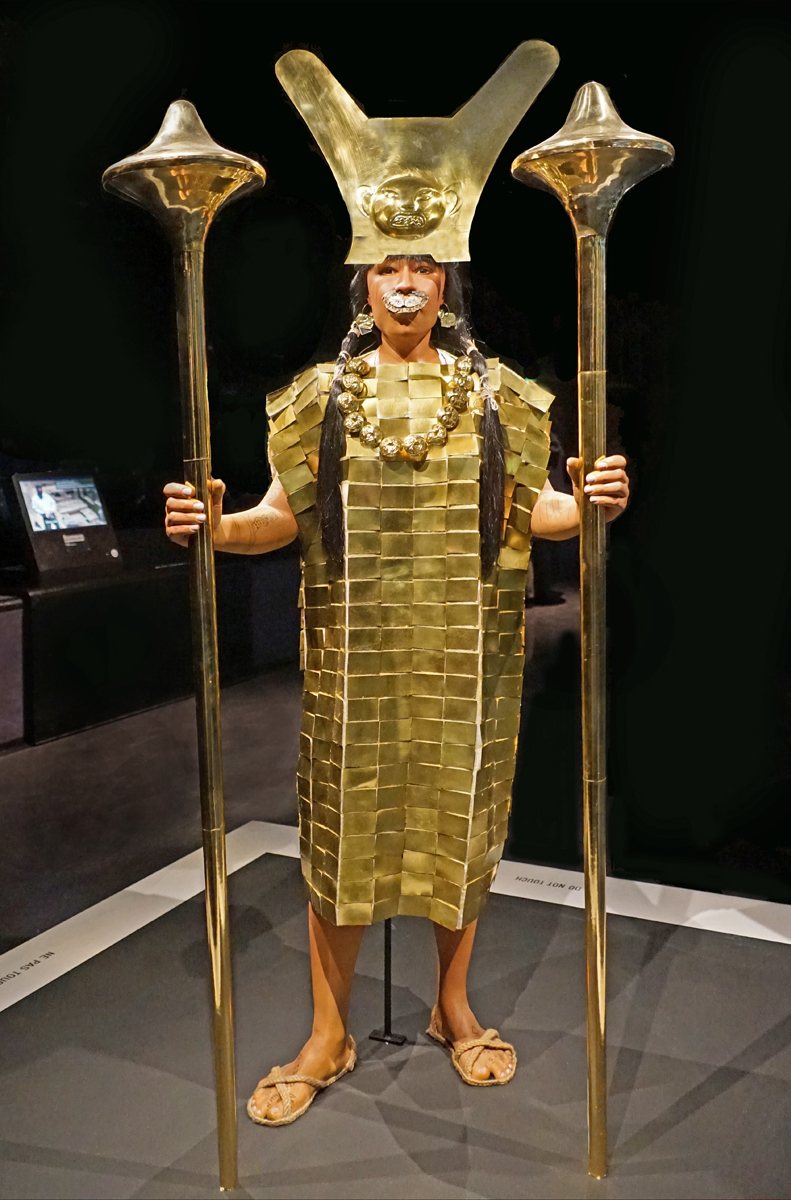
The ceremonial war clubs are the detail that surprises people most, because weapons and regalia like these point to authority. Add the painted mausoleum inside a major temple and the extraordinary care given to her funerary bundle, and the case for very high status is strong (Cichero, Brown University).
What exactly was her role? Here the scholars differ, and it is worth hearing both. Régulo Franco Jordán connects her regalia with a figure archaeologists call "Personage D," who appears in Moche scenes of ritual sacrifice. Other scholars prefer a more cautious description: she may have been a ruler, a high-ranking priestess, or both (Fundación Wiese). The weapons and regalia point to authority, but there is no written title and no personal name. In Spanish she is the Señora de Cao, also called the Dama de Cao.
For archaeology, what she represents is clear enough: proof that women could hold high authority in Moche society (El Brujo).
The face reconstruction of 2017
In July 2017 the El Brujo team, the Fundación Wiese, FARO Technologies and their collaborators presented a reconstruction of her face, after about ten months of work (El Brujo; Peru Ministry of Culture).
The process began with a three-dimensional scan of her skull. A team of archaeologists, physical anthropologists, dentists, forensic artists and engineers then followed forensic facial-reconstruction protocols, building the face up from the skull's shape, and the result was produced with 3D printing (El Brujo).
It is a scientific and artistic approximation, not a photograph of her living face. For how this kind of work is done and what it can and cannot tell us, see our story on facial reconstruction.
Where she is now, and visiting Museo Cao
The Lady of Cao rests at the Museo Cao, inside the El Brujo Archaeological Complex near Magdalena de Cao, in Ascope Province, about 60 kilometres northwest of the city of Trujillo (Peru Ministry of Culture Museum Guide). The museum opened on 2 April 2009. Its permanent galleries cover Moche ceramics, textiles, metalwork, stone and organic materials, setting her within the wider history and symbolism of the region. The final gallery presents her burial, her ornaments, her symbols of power and the objects placed with her. One admission covers both the museum and Huaca Cao Viejo.
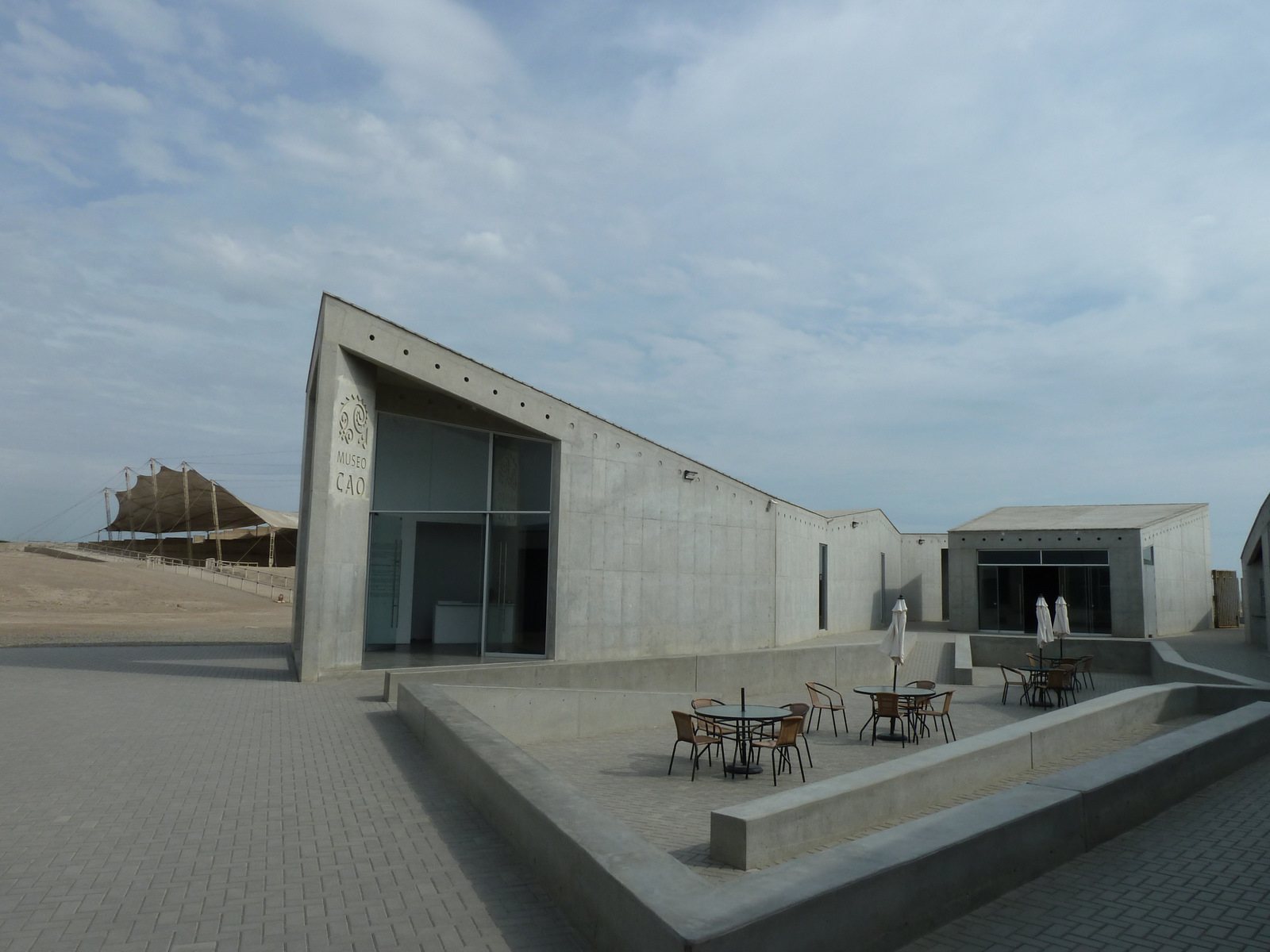
The official El Brujo visitor page lists the following hours and prices (El Brujo, hours and prices):
Tap or hover a row to highlight it.
| Visitor | Price |
|---|---|
| VisitorAdults | PriceS/10 |
| VisitorPeople over 60, military personnel, teachers, higher-education students and retirees | PriceS/5 |
| VisitorChildren and school students | PriceS/1 |
| VisitorPeople with disabilities | PriceFree |
| VisitorPeruvians and foreign residents with valid ID, first Sunday of each month | PriceFree |
The site is open from 9:00 a.m. to 4:00 p.m. every day except 25 December and 1 January. The September 2025 visitor regulations say that no food is allowed inside except water, pets are not allowed except accredited assistance animals, and visitor capacity limits apply (El Brujo visitor regulations). Hours and fees can change, so confirm them, and the photography rules for her gallery, with Museo Cao before you go.
Questions people ask about the Lady of Cao
Quick answers to the questions that come up most.
Who was the Lady of Cao?
She was an elite Moche woman of the Chicama Valley on Peru's north coast, buried around 400 CE at Huaca Cao Viejo. Her tomb, her symbols of power and its ceremonial setting show that she held a political or religious position, or both (El Brujo).
What is El Brujo?
El Brujo is an archaeological complex in Magdalena de Cao, Ascope Province, La Libertad, Peru. It includes Huaca Cao Viejo, Huaca Cortada and Huaca Prieta and the Museo Cao, and preserves a long record of human occupation (Fundación Wiese).
Who found the Lady of Cao?
The excavation was led by the Peruvian archaeologist Régulo Franco Jordán, with the El Brujo archaeological project team, the Fundación Wiese and Peru's cultural authorities. The burial was excavated in 2005 and announced in 2006 (Fundación Wiese).
How old was the Lady of Cao when she died, and how tall was she?
She was about 20 to 25 years old, according to the physical anthropologists who studied her, and some publications describe John Verano's estimate as mid to late twenties. The Fundación Wiese gives her height as approximately 1.48 metres (Fundación Wiese).
What was found in the Lady of Cao's tomb?
Her tattooed body in a funerary bundle, with textiles, crowns, diadems, nose and ear ornaments, necklaces, objects of gold, silver, copper and tumbaga, ceremonial clubs, ceramics and cinnabar. More than 100 of the objects were metal (El Brujo).
What did the Lady of Cao represent?
For archaeologists she represents women holding high authority in Moche society. Her exact role is still debated: ruler, priestess, ritual specialist, or a combination of these (El Brujo).
Where is the Museo Cao?
It is inside the El Brujo Archaeological Complex, near Magdalena de Cao in Ascope Province, La Libertad, about 60 kilometres northwest of Trujillo, Peru (Peru Ministry of Culture Museum Guide).
Lady of Cao quiz
Answer every question to check.
A young woman remembered at El Brujo
Behind the tattoos and the reconstructed face is a woman in her twenties who had borne a child, who grew up healthy in the Chicama Valley, and who was laid to rest inside a painted temple with the crowns and clubs of authority. Scholars still debate whether she ruled, served as a priestess or both, and what the snakes and spiders on her arms meant to her. What nobody disputes is the care her people took in burying her, a care the Museo Cao continues today. For the other great Moche royal burial on Peru's north coast, read the story of the Lord of Sipán.
Terms in this story
Tap a term to see what it means.
Moche. An ancient culture of Peru's north coast, also called Mochica, to which the Lady of Cao belonged; she lived around 400 CE.
---